
[Paper Review] Improving Word Translation via Two-Stage Contrastive Learning
This paper proposes a two-stage contrastive learning framework to improve bilingual lexicon induction (BLI), first refining static word embeddings via contrastive learning with self-learning (C1), then fine-tuning mBERT with contrastive objectives using C1 outputs as negative examples (C2). The method achieves state-of-the-art performance, with gains of up to +10 Precision@1 points across 112 out of 112 BLI setups on diverse language pairs.
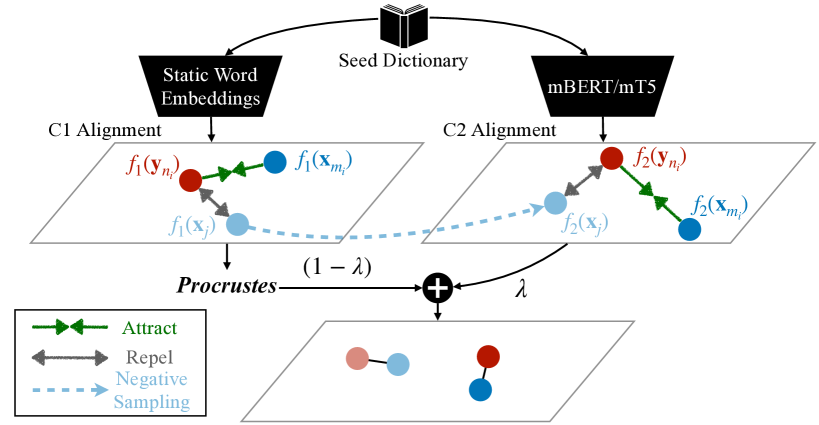
Word translation or bilingual lexicon induction (BLI) is a key cross-lingual task, aiming to bridge the lexical gap between different languages. In this work, we propose a robust and effective two-stage contrastive learning framework for the BLI task. At Stage C1, we propose to refine standard cross-lingual linear maps between static word embeddings (WEs) via a contrastive learning objective; we also show how to integrate it into the self-learning procedure for even more refined cross-lingual maps. In Stage C2, we conduct BLI-oriented contrastive fine-tuning of mBERT, unlocking its word translation capability. We also show that static WEs induced from the `C2-tuned' mBERT complement static WEs from Stage C1. Comprehensive experiments on standard BLI datasets for diverse languages and different experimental setups demonstrate substantial gains achieved by our framework. While the BLI method from Stage C1 already yields substantial gains over all state-of-the-art BLI methods in our comparison, even stronger improvements are met with the full two-stage framework: e.g., we report gains for 112/112 BLI setups, spanning 28 language pairs.
Motivation & Objective
- To improve weakly supervised bilingual lexicon induction (BLI) using static word embeddings (WEs) by enhancing cross-lingual mapping via contrastive learning.
- To unlock the word translation capability of multilingual language models like mBERT through BLI-oriented contrastive fine-tuning.
- To combine cross-lingual representations from refined static WEs (C1) and fine-tuned mBERT (C2) for superior BLI performance.
- To investigate whether integrating static WEs and multilingual LM representations can yield stronger BLI results than either alone.
Proposed method
- In Stage C1, a contrastive learning objective is applied to refine linear cross-lingual maps between static word embeddings using true translation pairs as positives and hard negatives.
- The C1 framework integrates a self-learning loop that iteratively improves the mapping by refining the training dictionary and retraining the map with contrastive loss.
- In Stage C2, mBERT is fine-tuned using a contrastive learning objective, where positive examples are true translation pairs and negative examples are drawn from the output of C1.
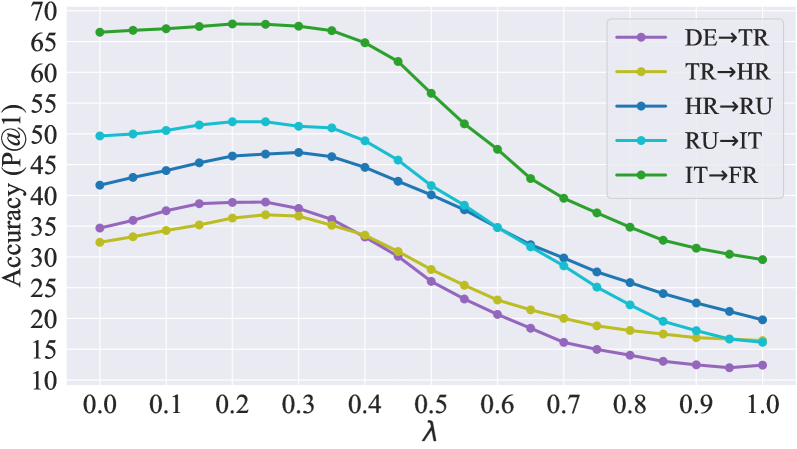
- The final word representations are formed by concatenating or combining the cross-lingual static WEs from C1 and the fine-tuned mBERT representations from C2.
- Contrastive learning in both stages uses a contrastive loss function that maximizes similarity between positive pairs and minimizes it between negative pairs.
- The framework is evaluated on the standard BLI benchmark across 8 diverse languages and 112 language pairs under various setups.
Experimental results
Research questions
- RQ1Can we further improve (weakly supervised) mapping-based BLI methods based on static word embeddings?
- RQ2How can we extract more useful cross-lingual word representations from pretrained multilingual language models such as mBERT?
- RQ3Is it possible to boost BLI by combining cross-lingual representations from static word embeddings and multilingual language models?
Key findings
- The C1 stage alone achieves gains of approximately +8 Precision@1 points on average across all 112 BLI setups, with improvements in 107 out of 112 setups.
- The full two-stage framework (C1 + C2) achieves gains in all 112 BLI setups, with improvements of up to +10 Precision@1 points on many language pairs.
- For challenging examples like 'čvrsto' (HR) → 'firmly' (EN), the C2 (C1) method improves predictions from failing to succeeding by ranking 'firmly' higher in the top five.
- On the HR-EN and IT-EN pairs, the C2 (C1) method consistently ranks correct translations such as 'monkeys', 'enzymes', and 'peach' higher than baseline and C1, demonstrating improved semantic alignment.
- The method shows consistent gains across diverse language pairs, including low-resource and dissimilar language pairs, indicating robustness.
- The combination of C1-derived static WEs and C2-fine-tuned mBERT representations leads to superior performance, confirming the benefit of integrating multiple cross-lingual signal sources.
Read this paper
Open the full text in the Nubint reader and ask about any passage as you read.
Read this paper on NubintThis review was generated by AI from the original paper. Please check the paper before citing it.