
[Paper Review] In ChatGPT We Trust? Measuring and Characterizing the Reliability of ChatGPT
This paper conducts a large-scale evaluation of ChatGPT’s reliability across multiple QA datasets, analyzes the impact of system roles, and tests resilience to adversarial inputs.
The way users acquire information is undergoing a paradigm shift with the advent of ChatGPT. Unlike conventional search engines, ChatGPT retrieves knowledge from the model itself and generates answers for users. ChatGPT's impressive question-answering (QA) capability has attracted more than 100 million users within a short period of time but has also raised concerns regarding its reliability. In this paper, we perform the first large-scale measurement of ChatGPT's reliability in the generic QA scenario with a carefully curated set of 5,695 questions across ten datasets and eight domains. We find that ChatGPT's reliability varies across different domains, especially underperforming in law and science questions. We also demonstrate that system roles, originally designed by OpenAI to allow users to steer ChatGPT's behavior, can impact ChatGPT's reliability in an imperceptible way. We further show that ChatGPT is vulnerable to adversarial examples, and even a single character change can negatively affect its reliability in certain cases. We believe that our study provides valuable insights into ChatGPT's reliability and underscores the need for strengthening the reliability and security of large language models (LLMs).
Motivation & Objective
- Assess ChatGPT’s correctness and unanswerable question identification across diverse QA datasets and domains.
- Investigate how system roles influence ChatGPT’s reliability in practice.
- Examine ChatGPT’s vulnerability to adversarial, sentence-level and character-level inputs.
Proposed method
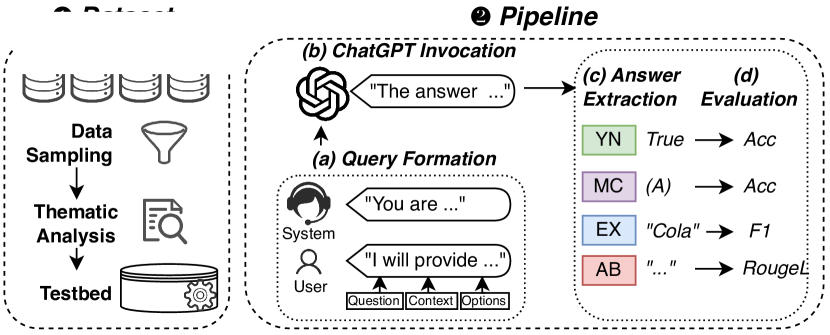
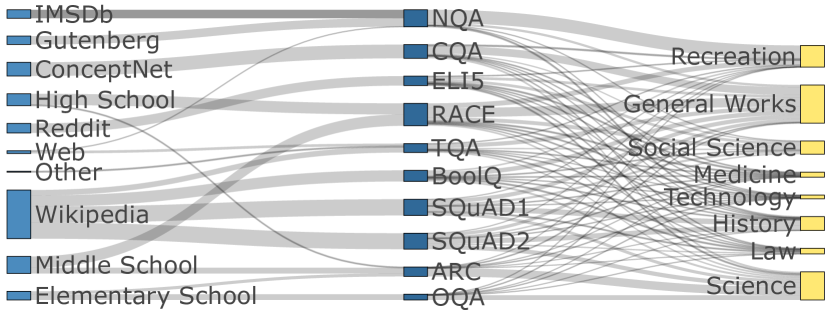
- Assemble a representative QA testbed of 5,695 questions from ten datasets spanning eight domains and four answer types (YN, MC, EX, AB).
- Evaluate ChatGPT (GPT-3.5 baseline; GPT-4 on a subset) for correctness and unanswerable-question identification with repeated trials for robustness.
- Apply thematic analysis with BERTopic to map questions to eight domains and ensure domain coverage.
- Invoke ChatGPT via official API with prompts designed to elicit task-specific formats; extract answers automatically or via human annotators when needed.
- Perform qualitative error analysis to categorize failure and refusal reasons; analyze system role effects using predefined benign, bad, and jailbreak roles.
Experimental results
Research questions
- RQ1RQ1: Is ChatGPT reliable in generic QA scenarios across domains and tasks?
- RQ2RQ2: Do system roles impact ChatGPT’s reliability?
- RQ3RQ3: Can ChatGPT respond reliably when facing adversarial examples?
Key findings
- ChatGPT’s correctness varies by domain, with higher performance in recreation and technology and lower performance in law and science across tasks.
- GPT-4 shows modest improvements over GPT-3.5 but reliability remains imperfect.
- ChatGPT’s ability to identify unanswerable questions is limited (GPT-3.5: 26.63%; GPT-4: 14.29%).
- System roles can affect reliability in an imperceptible way; benign roles may improve correctness while jailbreak/bad roles can reduce it.
- Adversarial, sentence-level and character-level attacks significantly affect reliability; a leakage prompt can enable score-based score extraction attacks.
- Qualitative analysis reveals failure reasons (hallucinatory facts, casual answers, referential confusion, lack of knowledge) and refusal reasons (not mentioned, inappropriate, it depends, no knowledge).
- Among system roles, Expert-R (reject unanswerable questions) improves unanswerable identification and correctness in some datasets; jailbreak roles generally worsen performance.
Read this paper
Open the full text in the Nubint reader and ask about any passage as you read.
Read this paper on NubintThis review was generated by AI from the original paper. Please check the paper before citing it.