
[Paper Review] Industry-Relevant Implicit Large-Eddy Simulation of a High-Performance Road Car via Spectral/hp Element Methods
This paper presents the first high-order accurate implicit Large-Eddy Simulation (LES) of a full high-performance road car using spectral/$hp$ element methods. By developing robust high-order meshing and advanced numerical schemes—particularly a CG-SVV operator based on energy-stable analysis—the authors achieve stable, high-fidelity simulations of complex, high-Reynolds-number flows, marking a major step toward industrial adoption of high-order CFD.
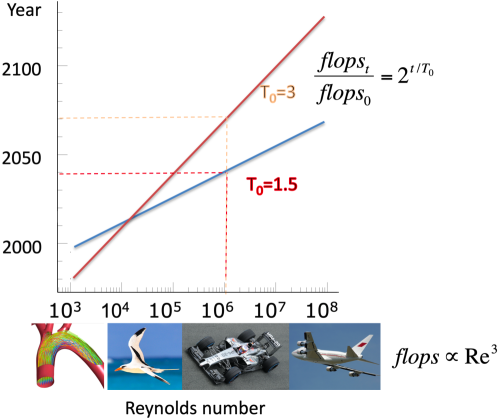
We present a successful deployment of high-fidelity Large-Eddy Simulation (LES) technologies based on spectral/hp element methods to industrial flow problems, which are characterized by high Reynolds numbers and complex geometries. In particular, we describe the numerical methods, software development and steps that were required to perform the implicit LES of a real automotive car, namely the Elemental Rp1 model. To the best of the authors' knowledge, this simulation represents the first fifth-order accurate transient LES of an entire real car geometry. Moreover, this constitutes a key milestone towards considerably expanding the computational design envelope currently allowed in industry, where steady-state modelling remains the standard. To this end, a number of novel developments had to be made in order to overcome obstacles in mesh generation and solver technology to achieve this simulation, which we detail in this paper. The main objective is to present to the industrial and applied mathematics community, a viable pathway to translate academic developments into industrial tools, that can substantially advance the analysis and design capabilities of high-end engineering stakeholders. The novel developments and results were achieved using the academic-driven open-source framework Nektar++.
Motivation & Objective
- To bridge the gap between academic high-order CFD research and industrial application in automotive aerodynamics.
- To overcome key challenges in high-order mesh generation for complex, curved geometries typical of real vehicles.
- To enable stable, high-fidelity implicit LES of an entire high-performance car at high Reynolds numbers using spectral/$hp$ methods.
- To demonstrate that high-order methods can outperform traditional RANS and DES by capturing unsteady flow physics more accurately.
- To validate the feasibility of using open-source, academic frameworks like Nektar++ for industrial-scale CFD workflows.
Proposed method
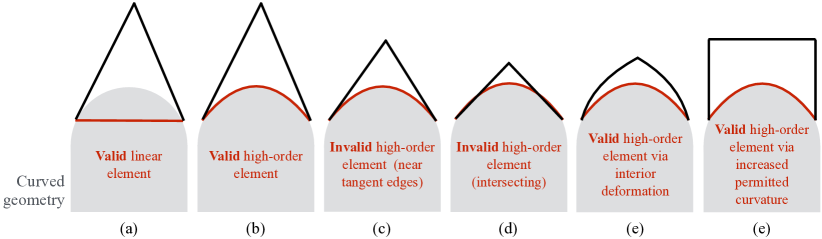
- Employed a novel a posteriori high-order meshing workflow that deforms linear meshes by embedding geometric curvature, ensuring mesh validity while preserving surface accuracy.
- Used spectral/$hp$ element methods with polynomial orders up to 4 for spatial discretization, enabling high-order accuracy in both geometry and solution.
- Implemented a consistent stabilization strategy based on Energy-Stable Analysis (ESA) to mitigate aliasing-driven instabilities in nonlinear and turbulent flows.
- Applied a new CG-SVV (Continuous Galerkin - Skew-Symmetric Variational) formulation derived from ESA estimates to naturally regularize under-resolved scales without explicit modeling.
- Integrated CAD data via the CFI interface in CADfix to enable accurate geometry reconstruction and high-order mesh generation.
- Leveraged the open-source Nektar++ framework to implement and test the full simulation pipeline, including meshing, solver, and post-processing.
Experimental results
Research questions
- RQ1Can high-order spectral/$hp$ element methods produce stable and accurate implicit LES of a full, complex automotive geometry at high Reynolds numbers?
- RQ2To what extent can a robust, a posteriori high-order meshing pipeline preserve geometric accuracy while maintaining mesh validity for industrial-grade geometries?
- RQ3How effective is the CG-SVV scheme based on ESA estimates in stabilizing high-order simulations without explicit turbulence modeling?
- RQ4Does high-order discretization reduce artificial diffusion at curved no-slip boundaries compared to linear meshes, thereby improving flow physics fidelity?
- RQ5Can the integration of academic high-order CFD tools into industrial workflows yield results that are both physically faithful and computationally feasible?
Key findings
- This work presents the first high-order (polynomial order 4) implicit LES of a complete real car geometry using spectral/$hp$ element methods.
- The simulation achieved stable, high-fidelity results despite the absence of explicit turbulence models, thanks to the inherent numerical dissipation of high-order schemes.
- The novel high-order meshing pipeline produced a mesh with less than 5% straight-sided elements, minimizing artificial diffusion while maintaining robustness.
- The CG-SVV scheme based on ESA estimates effectively suppressed aliasing instabilities and provided sufficient regularization for under-resolved scales, enabling long-time integration.
- The results showed good agreement across different ride heights (D1, D2, D3), indicating that the simulation captured key unsteady flow features consistently.
- The study demonstrates that high-order methods can significantly improve the accuracy of industrial CFD by better resolving unsteady vortical structures and aerodynamic forces without relying on RANS or DES.
Read this paper
Open the full text in the Nubint reader and ask about any passage as you read.
Read this paper on NubintThis review was generated by AI from the original paper. Please check the paper before citing it.