
[Paper Review] Influence of preferential diffusion on the distribution of species in lean H2-air laminar premixed flames at different equivalence ratios
This study investigates preferential diffusion effects in 2D simulations of lean H₂-air laminar premixed flames at φ=0.4 and φ=0.7, revealing that decreasing equivalence ratio intensifies thermo-diffusive instabilities, leading to significant deviations in species mass fractions and reaction rates—especially for H₂—due to curvature-dependent heat and species focussing/defocussing. The H₂-based reaction progress variable is found to be most suitable for modeling due to monotonic behavior and boundedness, while O₂ and H₂O-based definitions show non-monotonicity and super-adiabatic deviations.
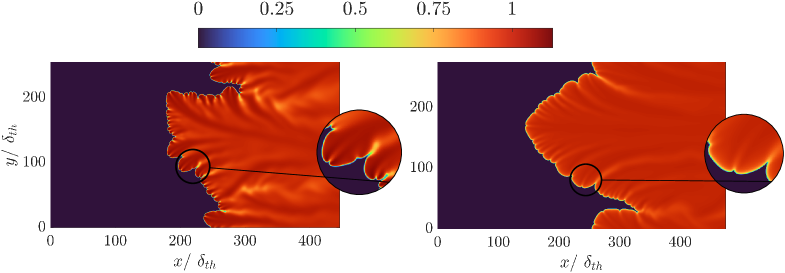
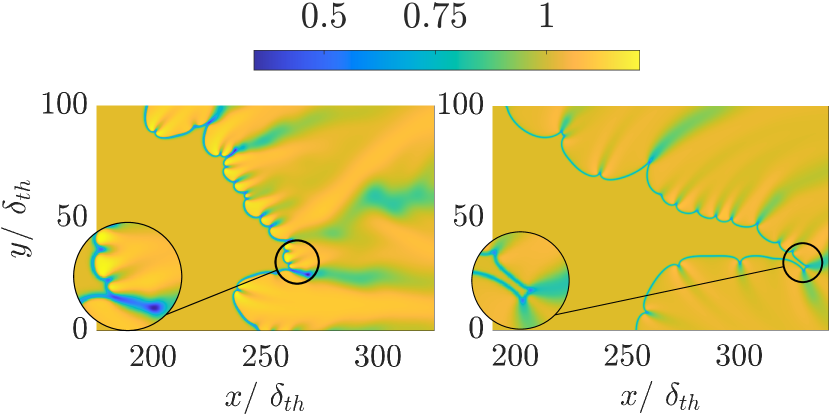
The influence of equivalence ratio on preferential diffusion effects and the resulting changes in the distributions of major species and their reaction rates have been analysed based on 2D simulations of lean ${\mathrm{H_2}}$-air laminar premixed flames, at $ϕ=0.4$ and $0.7$. The enhancements of burning rate, flame surface area, and stretch factor increase with decreasing equivalence ratio with the increase in stretch factor particularly prominent when the burning rate and flame area are evaluated based on normalised mass fraction variation of ${\mathrm{H_2}}$. The preferential diffusion effects have been demonstrated to lead to significant deviations of mass fractions of major species and their reaction rates from the corresponding 1D unstretched laminar premixed flame solution and local variations of equivalence ratio. This tendency is particularly strong for ${\mathrm{H_2}}$ among all the major species. Moreover, mass fractions of ${\mathrm{O_2}}$ and ${\mathrm{H_2O}}$ are found to assume super-adiabatic values at the super-adiabatic temperature zones and this trend is particularly strong for the $ϕ=0.4$ case. It has been demonstrated that the deviations of major species mass fractions and their reaction rates from their corresponding 1D unstretched laminar premixed flame values arise principally due to preferential diffusion effects induced by relative focussing/defocussing of species and heat at the positively and negatively curved regions with the nature of the deviations being opposite to each other depending on the sign of the curvature. The variations of normalised species mass fractions of $\mathrm{O_2}$ and $\mathrm{H_2O}$ are found to be significantly affected by the local equivalence ratio within the 2D laminar flame with $ϕ=0.4$ but these effects weaken with an increase in global equivalence ratio.
Motivation & Objective
- To identify the optimal reaction progress variable for modeling lean H₂-air premixed flames by analyzing species distribution under preferential diffusion.
- To quantify the influence of equivalence ratio on flame wrinkling, stretch factor, and burning rate in 2D laminar H₂-air flames.
- To assess how curvature-induced preferential diffusion alters local equivalence ratio, species mass fractions, and reaction rates.
- To evaluate the impact of different species (H₂, O₂, H₂O) on flame surface area and stretch factor calculations.
- To determine the suitability of O₂ and H₂O mass fractions as reaction progress variables in high-fidelity combustion modeling.
Proposed method
- 2D direct numerical simulations (DNS) of laminar H₂-air premixed flames were performed at equivalence ratios φ=0.4 and φ=0.7.
- Flame structure and species distributions were analyzed using normalized mass fractions of H₂, O₂, and H₂O as reaction progress variables.
- Flame surface area (A′) and stretch factor (I₀) were computed based on different species definitions to assess sensitivity to reaction progress variable choice.
- Curvature effects were analyzed by examining local variations in equivalence ratio and species mass fractions in positively and negatively curved flame regions.
- The effective Lewis number (Le_eff) was calculated to assess thermo-diffusive instability potential, with Le_eff decreasing at lower φ.
- Statistical comparisons of burning rate, flame area, and stretch factor were made between φ=0.4 and φ=0.7 to quantify equivalence ratio effects.
Experimental results
Research questions
- RQ1How does decreasing equivalence ratio (φ) affect preferential diffusion and species distribution in lean H₂-air flames?
- RQ2What is the impact of flame curvature on local equivalence ratio, species mass fractions, and reaction rates in 2D H₂-air flames?
- RQ3Which species (H₂, O₂, H₂O) provides the most suitable reaction progress variable for modeling lean H₂-air premixed flames?
- RQ4How do flame surface area (A′) and stretch factor (I₀) vary with different species-based definitions of the reaction progress variable?
- RQ5To what extent do O₂ and H₂O mass fractions exceed 1.0 in super-adiabatic temperature zones, and how does this affect their suitability as reaction progress variables?
Key findings
- The stretch factor I₀ increases with decreasing equivalence ratio, reaching 1.70 at φ=0.4 compared to 1.09 at φ=0.7, indicating stronger flame stretch at leaner conditions.
- Flame surface area (A′) is significantly enhanced at φ=0.4 due to increased flame wrinkling from stronger thermo-diffusive instabilities.
- H₂ mass fraction shows the strongest deviation from 1D unstretched flame solutions due to preferential diffusion, especially in negatively curved regions.
- O₂ and H₂O mass fractions exhibit super-adiabatic values in high-temperature zones, particularly at φ=0.4, with H₂O-based progress variables showing non-monotonic behavior.
- The H₂-based reaction progress variable yields the most monotonic and bounded behavior across the flame, making it the most suitable for modeling.
- The O₂-based progress variable remains bounded between 0.0 and 1.0 when local equivalence ratio variations are accounted for, unlike the H₂O-based definition, which becomes non-monotonic.
Read this paper
Open the full text in the Nubint reader and ask about any passage as you read.
Read this paper on NubintThis review was generated by AI from the original paper. Please check the paper before citing it.