
[Paper Review] Injecting Semantic Concepts into End-to-End Image Captioning
This paper proposes ViTCAP, a detector-free, vision transformer-based image captioning model that injects semantic concepts via a novel Concept Token Network (CTN) to improve caption quality. By predicting concept tokens from image features and integrating them into the captioning decoder, ViTCAP achieves state-of-the-art performance on COCO, nocaps, and Google-CC datasets without relying on object detectors.
Tremendous progress has been made in recent years in developing better image captioning models, yet most of them rely on a separate object detector to extract regional features. Recent vision-language studies are shifting towards the detector-free trend by leveraging grid representations for more flexible model training and faster inference speed. However, such development is primarily focused on image understanding tasks, and remains less investigated for the caption generation task. In this paper, we are concerned with a better-performing detector-free image captioning model, and propose a pure vision transformer-based image captioning model, dubbed as ViTCAP, in which grid representations are used without extracting the regional features. For improved performance, we introduce a novel Concept Token Network (CTN) to predict the semantic concepts and then incorporate them into the end-to-end captioning. In particular, the CTN is built on the basis of a vision transformer and is designed to predict the concept tokens through a classification task, from which the rich semantic information contained greatly benefits the captioning task. Compared with the previous detector-based models, ViTCAP drastically simplifies the architectures and at the same time achieves competitive performance on various challenging image captioning datasets. In particular, ViTCAP reaches 138.1 CIDEr scores on COCO-caption Karpathy-split, 93.8 and 108.6 CIDEr scores on nocaps, and Google-CC captioning datasets, respectively.
Motivation & Objective
- To develop a detector-free image captioning model that eliminates the computational and architectural overhead of object detectors.
- To improve captioning performance by injecting rich semantic concepts into the multimodal fusion process.
- To explore the effectiveness of concept tokens derived from image captions versus object detector tags as supervision signals.
- To demonstrate that a pure vision transformer backbone with a lightweight CTN can outperform both detector-based and existing detector-free models.
Proposed method
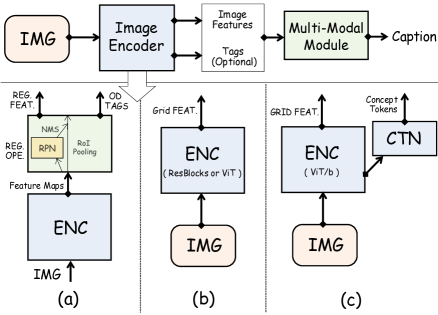
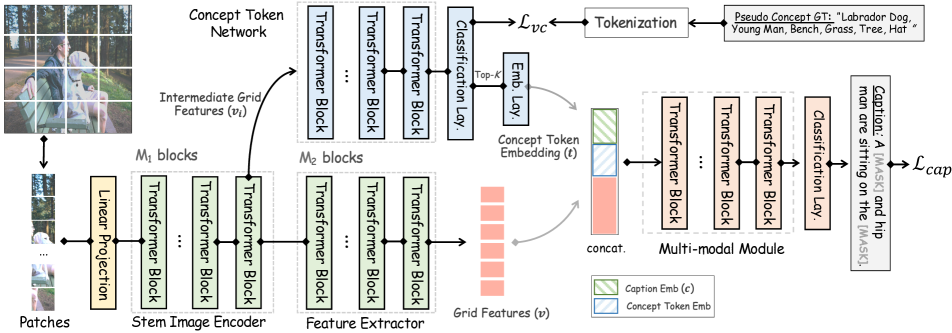
- Utilizes a vision transformer (ViT) as the visual encoder to produce grid features from input images, replacing the need for object detectors.
- Introduces a Concept Token Network (CTN), a lightweight head on top of the ViT, to predict semantic concept tokens via a classification task.
- The CTN is trained to predict concept tokens from image captions using a pseudo-ground-truth signal extracted from the text.
- Integrates the top-K predicted concept tokens with the grid features in a multimodal transformer decoder for end-to-end caption generation.
- Employs a two-tower training schema in large-scale pre-training, where the CTN first predicts concepts for all images, which are then used as off-the-shelf tags.
- Applies knowledge distillation from a pre-trained vision-language model (teacher) to enhance the student model’s performance during fine-tuning.
Experimental results
Research questions
- RQ1Can a detector-free image captioning model based on vision transformers achieve competitive performance without relying on object detectors?
- RQ2Does injecting semantic concept tokens derived from image captions improve captioning quality compared to using object detector tags?
- RQ3How effective is the Concept Token Network (CTN) in capturing and utilizing rich semantic information for caption generation?
- RQ4Can a pure vision transformer architecture with a lightweight CTN branch outperform existing detector-based and detector-free models on standard benchmarks?
Key findings
- ViTCAP achieves a CIDEr score of 138.1 on the COCO-caption Karpathy split, surpassing most existing detector-based models and setting a new SOTA for detector-free models.
- On the nocaps dataset, ViTCAP attains a CIDEr score of 95.4, demonstrating strong generalization to open-vocabulary and diverse image descriptions.
- On the Google-CC dataset, ViTCAP reaches a CIDEr score of 108.6, indicating strong performance on large-scale, open-domain image captioning.
- The ablation study confirms that concept tokens extracted from image captions outperform object detector tags as supervision signals for the CTN.
- ViTCAP demonstrates strong performance even without large-scale pre-training, achieving a SMURF score of 0.55, which correlates well with human judgment.
- Visualizations show that the attention maps from different transformer blocks focus on distinct image regions, and averaged maps cover holistic content, suggesting potential for weakly supervised grounding.
Read this paper
Open the full text in the Nubint reader and ask about any passage as you read.
Read this paper on NubintThis review was generated by AI from the original paper. Please check the paper before citing it.