
[Paper Review] Innovation Compression for Communication-efficient Distributed Optimization with Linear Convergence
This paper proposes COLD and Dyna-COLD, two communication-efficient distributed optimization algorithms that achieve linear convergence by compressing innovation vectors—the difference between decision variables and their estimates. By leveraging $δ$-contracted compressors and a novel dynamical scaling mechanism, the algorithms match the convergence rate of uncompressed methods while enabling low-communication protocols, even with biased compressors like 1-bit quantizers.
Information compression is essential to reduce communication cost in distributed optimization over peer-to-peer networks. This paper proposes a communication-efficient linearly convergent distributed (COLD) algorithm to solve strongly convex optimization problems. By compressing innovation vectors, which are the differences between decision vectors and their estimates, COLD is able to achieve linear convergence for a class of $δ$-contracted compressors. We explicitly quantify how the compression affects the convergence rate and show that COLD matches the same rate of its uncompressed version. To accommodate a wider class of compressors that includes the binary quantizer, we further design a novel dynamical scaling mechanism and obtain the linearly convergent Dyna-COLD. Importantly, our results strictly improve existing results for the quantized consensus problem. Numerical experiments demonstrate the advantages of both algorithms under different compressors.
Motivation & Objective
- Address the challenge of high communication costs in distributed optimization over peer-to-peer networks by enabling efficient compression without sacrificing convergence speed.
- Overcome the limitations of prior methods that only work with specific compressors or require unbiased, stochastic compression operators.
- Achieve linear convergence for both unbiased and biased $δ$-contracted compressors, including deterministic quantizers like the 1-bit binary quantizer.
- Design a dynamical scaling mechanism to extend convergence guarantees to a broader class of compressors, improving robustness and communication efficiency.
- Strengthen theoretical bounds for the quantized consensus problem, improving upon existing rates in the literature.
Proposed method
- Propose COLD, a distributed algorithm that compresses innovation vectors (differences between decision variables and their estimates) to reduce communication overhead.
- Use $δ$-contracted compressors—both unbiased and biased—where the compression error is bounded by $δ \|\mathbf{x}\|^{2}$, ensuring controlled distortion.
- Introduce a dynamical scaling mechanism in Dyna-COLD that adaptively adjusts the scaling factor to maintain convergence under biased compressors.
- Analyze convergence using a Lyapunov function and derive a linear convergence rate dependent on the spectral gap $\rho$ and compression parameter $\delta$.
- Establish that COLD achieves the same convergence rate as the uncompressed NIDS method when $\delta = 0$, validating efficiency.
- Design a step-size rule $s^k = 3\|X^1\|_{\text{max}} \cdot 0.99^k$ in Dyna-COLD to ensure stability and convergence without fine-tuning.
Experimental results
Research questions
- RQ1Can innovation compression be used to achieve linear convergence in distributed optimization under general classes of compressors, including biased ones?
- RQ2How does compression affect the convergence rate, and can the rate be preserved to match that of the uncompressed baseline?
- RQ3Can a dynamical scaling mechanism extend linear convergence to compressors that are not unbiased or not stochastic?
- RQ4Does the proposed method outperform existing quantized consensus algorithms in terms of convergence speed and communication cost?
- RQ5Can the theoretical convergence rate be improved for the quantized consensus problem compared to prior work like CHOCO-GOSSIP?
Key findings
- COLD achieves linear convergence for both unbiased and biased $δ$-contracted compressors, with a convergence rate of $\mathcal{O}\big{(}\max\big{\{}\frac{L}{\mu},\frac{1}{(1-\delta)^2\rho}\big{\}}\log\frac{1}{\epsilon}\big{)}$.
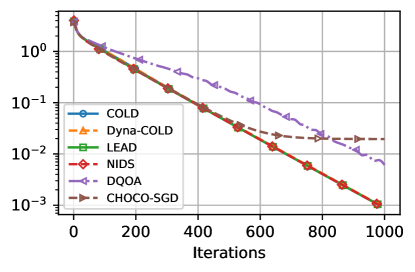
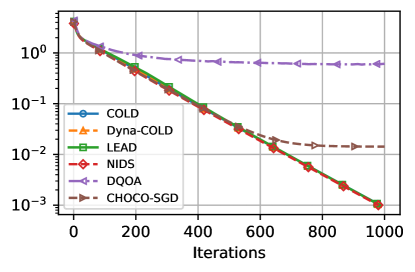
- When $\delta = 0$, COLD matches the convergence rate of the uncompressed NIDS algorithm, confirming that compression does not degrade performance in the ideal case.
- Dyna-COLD achieves linear convergence under a wider class of compressors, including the 1-bit binary quantizer, which is excluded by prior unbiased stochastic assumptions.
- Numerical experiments show that Dyna-COLD with the 1-bit quantizer achieves the lowest communication cost and matches NIDS performance in terms of iterations.
- For the consensus problem, the convergence rate is improved from $\mathcal{O}(\frac{1}{(1-\delta)\rho^2}\log\frac{1}{\epsilon})$ (CHOCO-GOSSIP) to $\mathcal{O}(\frac{1}{(1-\delta)\rho}\log\frac{1}{\epsilon})$, matching the best-known rate.
- Dyna-COLD is robust to the choice of scaling parameter $s^k$, maintaining fast convergence even without fine-tuning.
Read this paper
Open the full text in the Nubint reader and ask about any passage as you read.
Read this paper on NubintThis review was generated by AI from the original paper. Please check the paper before citing it.