
[Paper Review] Integrating Edge-AI in Structural Health Monitoring domain
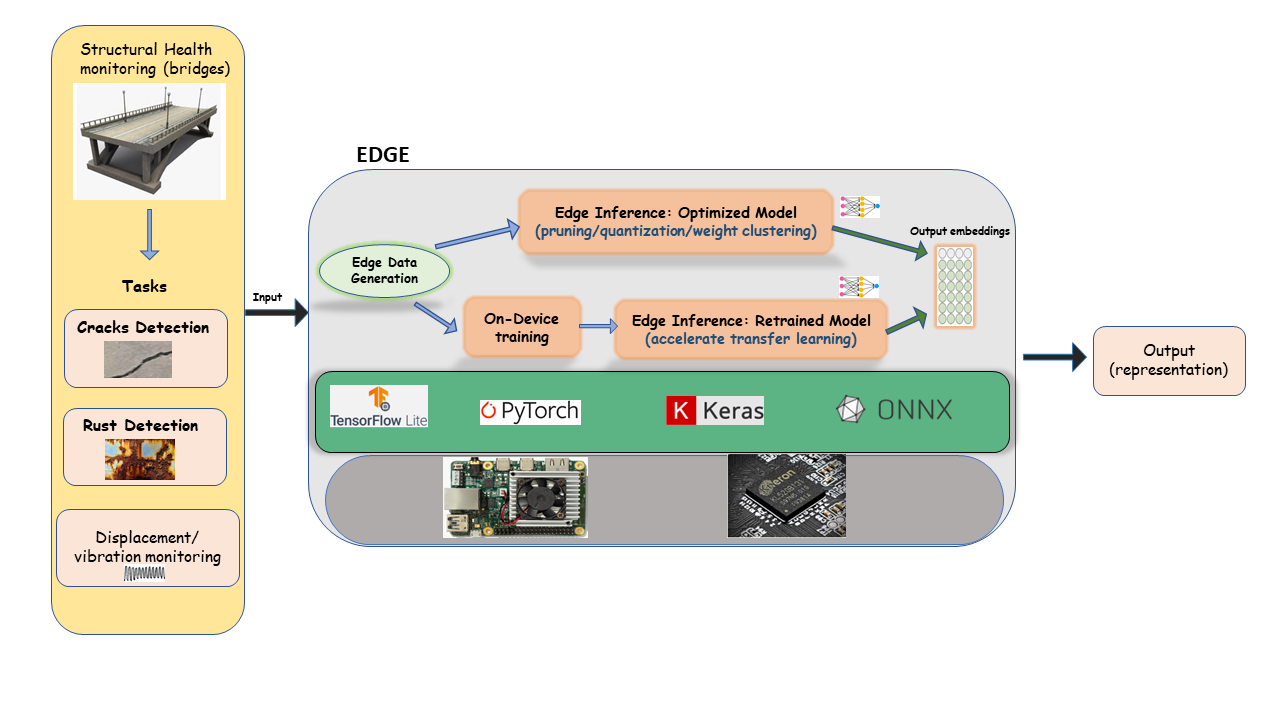
This paper proposes a novel edge-AI framework for real-time structural health monitoring, specifically crack detection in bridges, using the Kneron KL520 edge AI chip. By applying post-quantization and model optimization techniques, the authors reduce inference time from 3 seconds to 20 milliseconds per image while maintaining 92.4% accuracy, enabling on-device, low-latency decision-making critical for infrastructure safety.
Structural health monitoring (SHM) tasks like damage detection are crucial for decision-making regarding maintenance and deterioration. For example, crack detection in SHM is crucial for bridge maintenance as crack progression can lead to structural instability. However, most AI/ML models in the literature have low latency and late inference time issues while performing in real-time environments. This study aims to explore the integration of edge-AI in the SHM domain for real-time bridge inspections. Based on edge-AI literature, its capabilities will be valuable integration for a real-time decision support system in SHM tasks such that real-time inferences can be performed on physical sites. This study will utilize commercial edge-AI platforms, such as Google Coral Dev Board or Kneron KL520, to develop and analyze the effectiveness of edge-AI devices. Thus, this study proposes an edge AI framework for the structural health monitoring domain. An edge-AI-compatible deep learning model is developed to validate the framework to perform real-time crack classification. The effectiveness of this model will be evaluated based on its accuracy, the confusion matrix generated, and the inference time observed in a real-time setting.
Motivation & Objective
- To address the challenge of high latency and delayed inference in AI-based structural health monitoring (SHM) systems.
- To enable real-time, on-device crack classification in bridge inspections using edge-AI platforms.
- To optimize a lightweight CNN model for deployment on low-power edge devices like the Kneron KL520.
- To reduce inference time from 3 seconds to under 20 milliseconds per image while preserving classification accuracy.
- To validate the framework using real-world image data and demonstrate feasibility for on-site decision support systems.
Proposed method
- The study uses a public crack dataset with 40,000 images (20,000 positive, 20,000 negative) of concrete cracks, preprocessed to 227×227 RGB format.
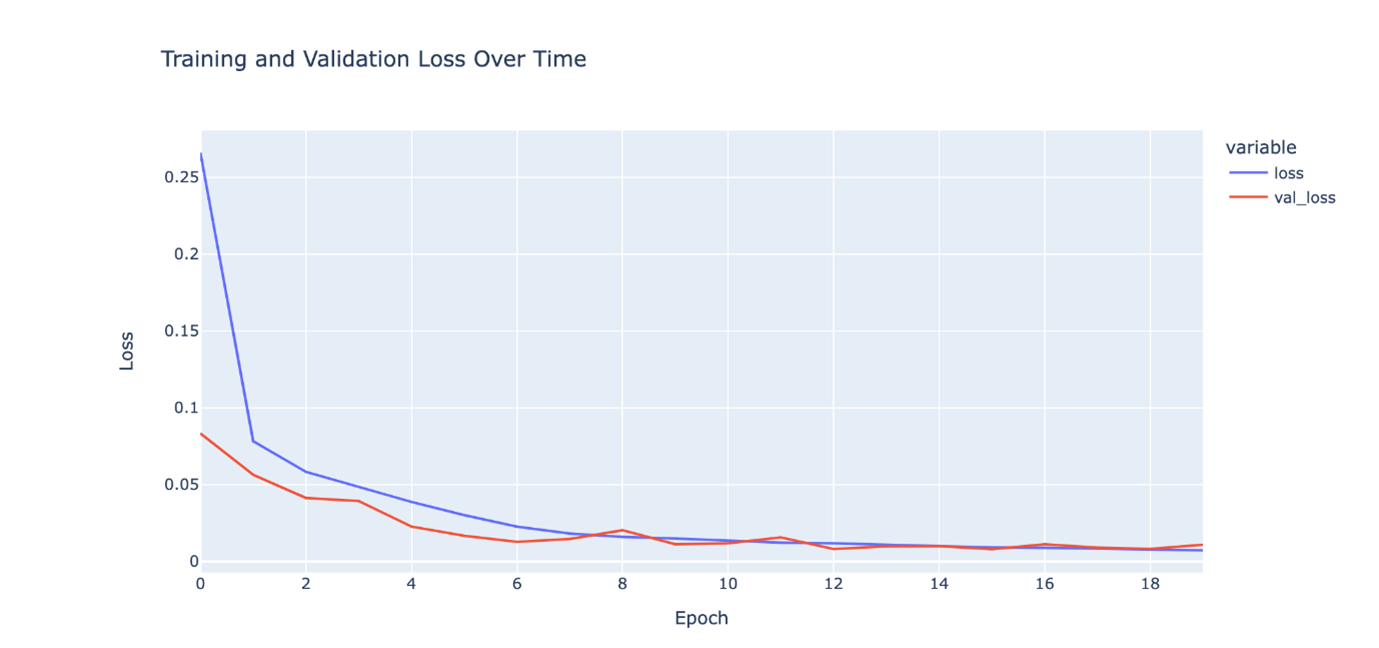
- A CNN model is trained on a 80-20 train-validation split for 20 epochs, achieving 99.54% training and 99.52% validation accuracy.
- The model is converted to ONNX format to ensure compatibility with edge hardware, and the unsupported softmax layer is removed prior to device deployment.
- Post-quantization to 8-bit integer representation is applied to reduce model size and accelerate inference on the Kneron KL520's NPU.
- The optimized model is compiled into NEF (NPU Executable Format) and deployed on the Kneron KL520 chip for real-time inference.
- Pre-processing and post-processing are performed on the host device, including image resizing and class probability calculation, due to NPU limitations.
Experimental results
Research questions
- RQ1Can edge-AI platforms like the Kneron KL520 enable real-time crack detection in structural health monitoring with low latency?
- RQ2How effective is post-quantization and model optimization in reducing inference time without significant accuracy loss?
- RQ3What is the performance of a lightweight CNN model on edge hardware when tested on diverse real-world crack images?
- RQ4To what extent does data distribution shift in manually collected test images affect model accuracy on edge devices?
- RQ5Can on-device fine-tuning via transfer learning further improve inference performance in real-world SHM scenarios?
Key findings
- The optimized edge-AI model achieved a real-time inference time of 20 milliseconds per image, a 150-fold reduction from the original 3 seconds.
- The model maintained a test accuracy of 92.4% on a diverse test set of 355 images, including 100 manually collected samples with varying crack and background characteristics.
- The confusion matrix confirmed strong classification performance, with minimal false positives and false negatives despite data distribution shifts.
- The Kneron KL520 delivered 0.35 TOPS per watt efficiency, demonstrating strong energy efficiency for on-device AI inference.
- The removal of the softmax layer and post-quantization to 8-bit representation were critical for achieving hardware compatibility and speed.
- The framework enables secure, low-bandwidth, and low-latency on-device inference, making it suitable for real-time bridge inspection systems.
Read this paper
Open the full text in the Nubint reader and ask about any passage as you read.
Read this paper on NubintThis review was generated by AI from the original paper. Please check the paper before citing it.