
[Paper Review] Integrating end-to-end neural and clustering-based diarization: Getting the best of both worlds
This paper proposes EEND-vector clustering, a hybrid speaker diarization framework that combines end-to-end neural diarization (EEND) with clustering by generating global speaker embeddings per chunk. By clustering these embeddings across blocks using a constrained algorithm, the method resolves the inter-block label permutation problem, enabling robust performance on long recordings with overlapped speech—outperforming original EEND especially in long-duration settings.
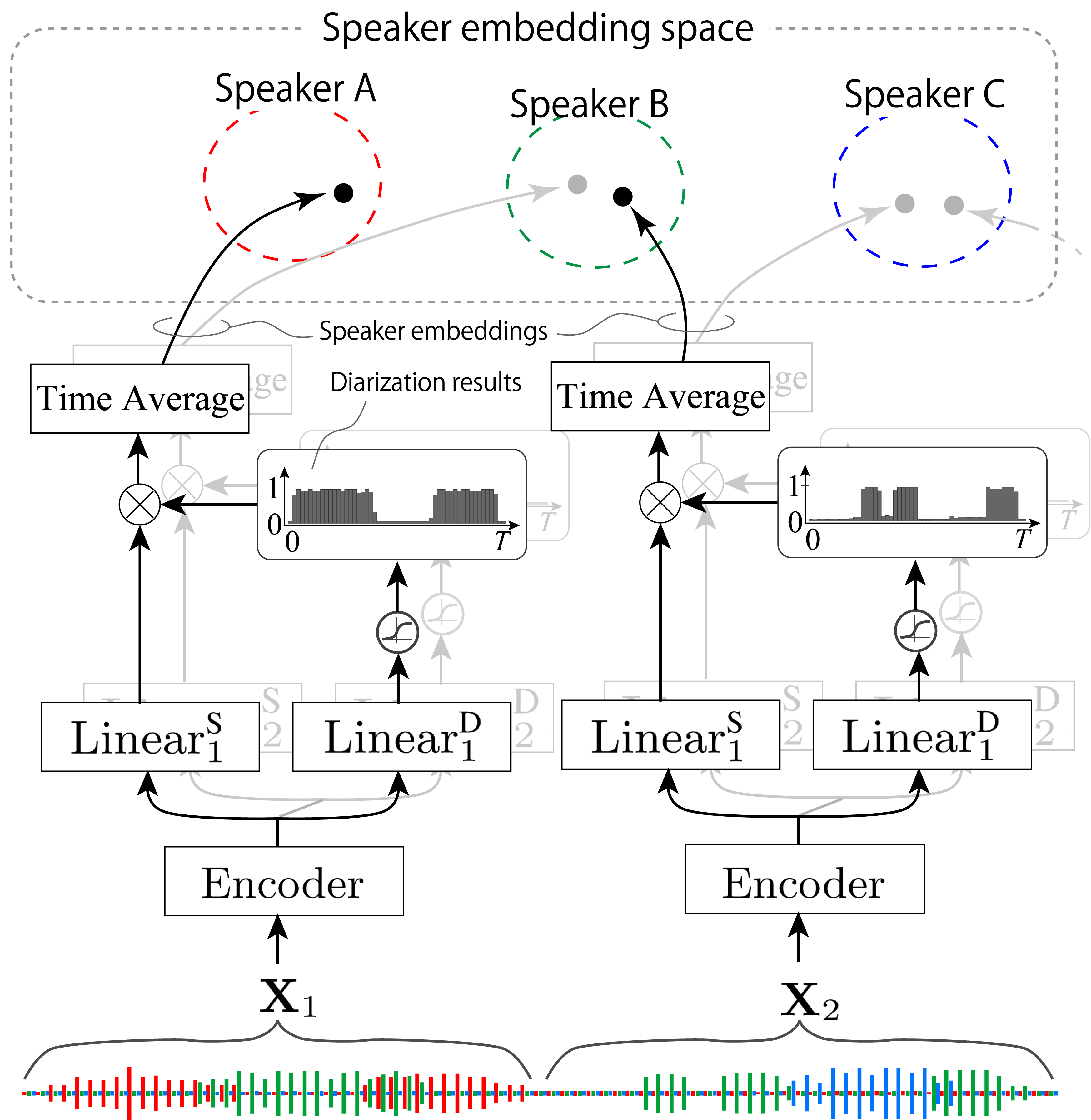
Recent diarization technologies can be categorized into two approaches, i.e., clustering and end-to-end neural approaches, which have different pros and cons. The clustering-based approaches assign speaker labels to speech regions by clustering speaker embeddings such as x-vectors. While it can be seen as a current state-of-the-art approach that works for various challenging data with reasonable robustness and accuracy, it has a critical disadvantage that it cannot handle overlapped speech that is inevitable in natural conversational data. In contrast, the end-to-end neural diarization (EEND), which directly predicts diarization labels using a neural network, was devised to handle the overlapped speech. While the EEND, which can easily incorporate emerging deep-learning technologies, has started outperforming the x-vector clustering approach in some realistic database, it is difficult to make it work for `long' recordings (e.g., recordings longer than 10 minutes) because of, e.g., its huge memory consumption. Block-wise independent processing is also difficult because it poses an inter-block label permutation problem, i.e., an ambiguity of the speaker label assignments between blocks. In this paper, we propose a simple but effective hybrid diarization framework that works with overlapped speech and for long recordings containing an arbitrary number of speakers. It modifies the conventional EEND framework to simultaneously output global speaker embeddings so that speaker clustering can be performed across blocks to solve the permutation problem. With experiments based on simulated noisy reverberant 2-speaker meeting-like data, we show that the proposed framework works significantly better than the original EEND especially when the input data is long.
Motivation & Objective
- To address the limitations of end-to-end neural diarization (EEND) in handling long recordings due to high memory usage and poor generalization.
- To solve the inter-block label permutation problem in chunked EEND processing, which prevents consistent speaker labeling across segments.
- To combine the strengths of clustering-based diarization (robustness to long sequences) and EEND (handling overlapped speech) in a single framework.
- To enable effective diarization for long recordings (>5 minutes) with arbitrary numbers of speakers and significant overlapping speech.
Proposed method
- Modify the EEND model to output both frame-level diarization labels and global speaker embeddings per audio chunk.
- Use a constrained clustering algorithm (COP-k-means) to align speaker labels across chunks based on shared speaker embeddings.
- Apply a speaker loss term during training to improve embedding quality, with hyperparameter λ = 0.01.
- Process long recordings by splitting into non-overlapping chunks, apply EEND with embedding output, then cluster embeddings across chunks to resolve label permutation.
- Use multi-head attention blocks (4 heads, 256 units) and Adam optimizer with learning rate scheduling for model training.
- Average the last 10 model checkpoints and run inference 10 times with random initialization to reduce variance.
Experimental results
Research questions
- RQ1Can a hybrid diarization system combining EEND and clustering effectively handle long recordings with overlapped speech?
- RQ2Does the proposed method mitigate the inter-block label permutation problem inherent in chunked EEND processing?
- RQ3How does the performance of the proposed EEND-vector clustering compare to original EEND on long-duration data?
- RQ4Does the inclusion of speaker embedding estimation improve clustering accuracy and overall diarization performance?
Key findings
- The proposed EEND-vector clustering significantly outperforms the original EEND on long recordings (e.g., 10-minute mixtures), especially as duration increases.
- The method maintains performance comparable to original EEND on short recordings, confirming no degradation from the added components.
- The inter-block label permutation problem causes significant performance degradation when EEND is applied to chunks without clustering, as shown by the drop in DER between chunked-only and clustered variants.
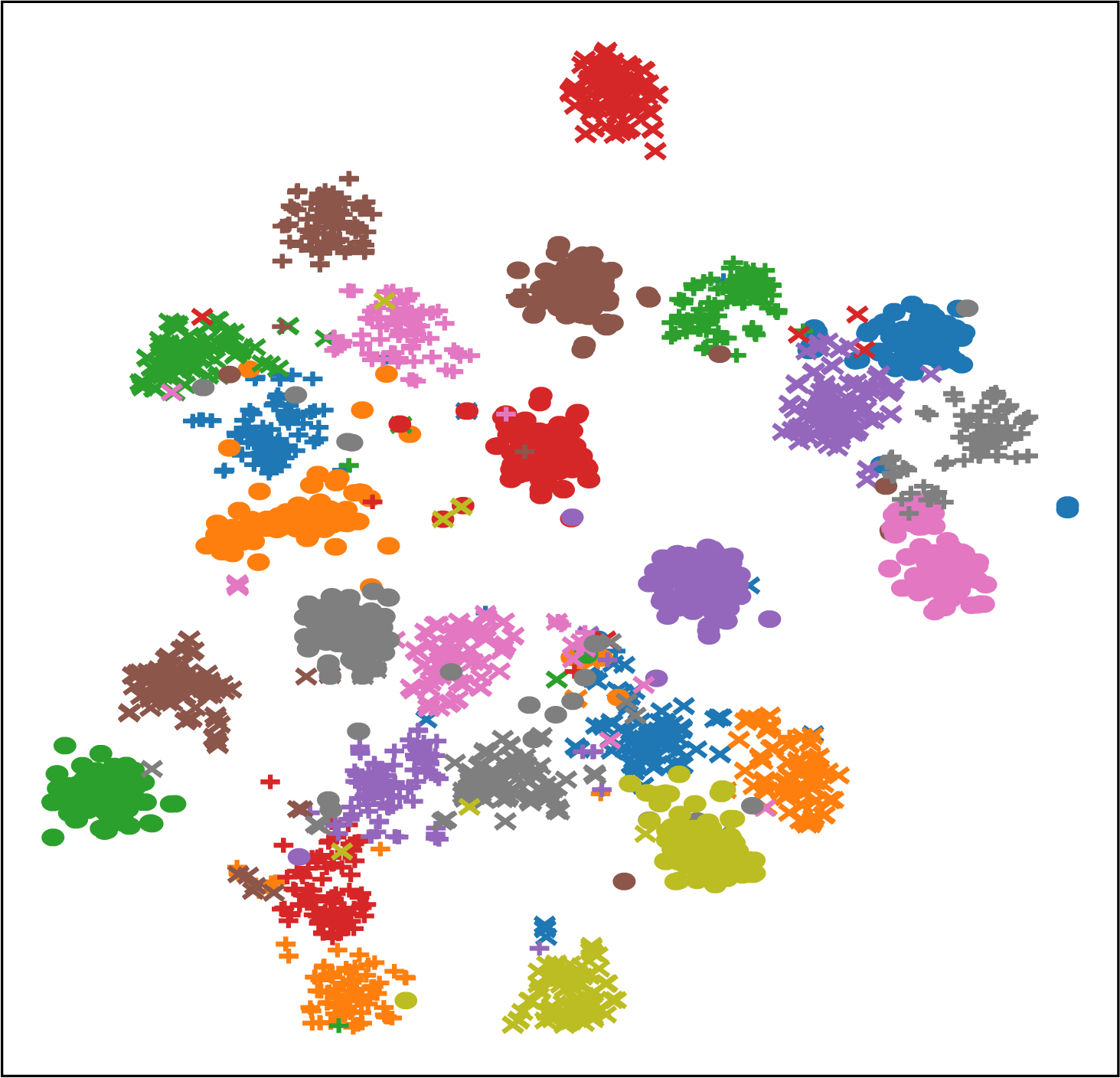
- t-SNE visualization confirms that speaker embeddings are well-separated and accurate, even in the presence of overlapping speech, indicating reliable global embedding estimation.
- DER is substantially lower for the proposed method than for original EEND across all overlap ratio ranges, demonstrating robustness to varying levels of speaker overlap.
- The standard deviation of DER across 10 random initializations was less than 0.2%, indicating high stability of the method.
Read this paper
Open the full text in the Nubint reader and ask about any passage as you read.
Read this paper on NubintThis review was generated by AI from the original paper. Please check the paper before citing it.