
[論文レビュー] Interplay of two $E_g$ orbitals in Superconducting La$_3$Ni$_2$O$_7$ Under Pressure
本研究は、圧力下のLa$_3$Ni$_2$O$_7$における高臨界温度超伝導のメカニズムを説明するため、二軌道二層型$ t $-$ J $モデルを提案する。$3d_{x^2-y^2}$軌道が強い層間スピン交換により$ s $-波超伝導を駆動する一方、$3d_{z^2}$軌道は極端なバンドフラットニングのため弱く寄与する。このモデルは実験的バンド構造を再現し、電子ドーピングによる$ T_c $の増大と、空孔ドーピング下でのBCS-BEC遷移を予測する。
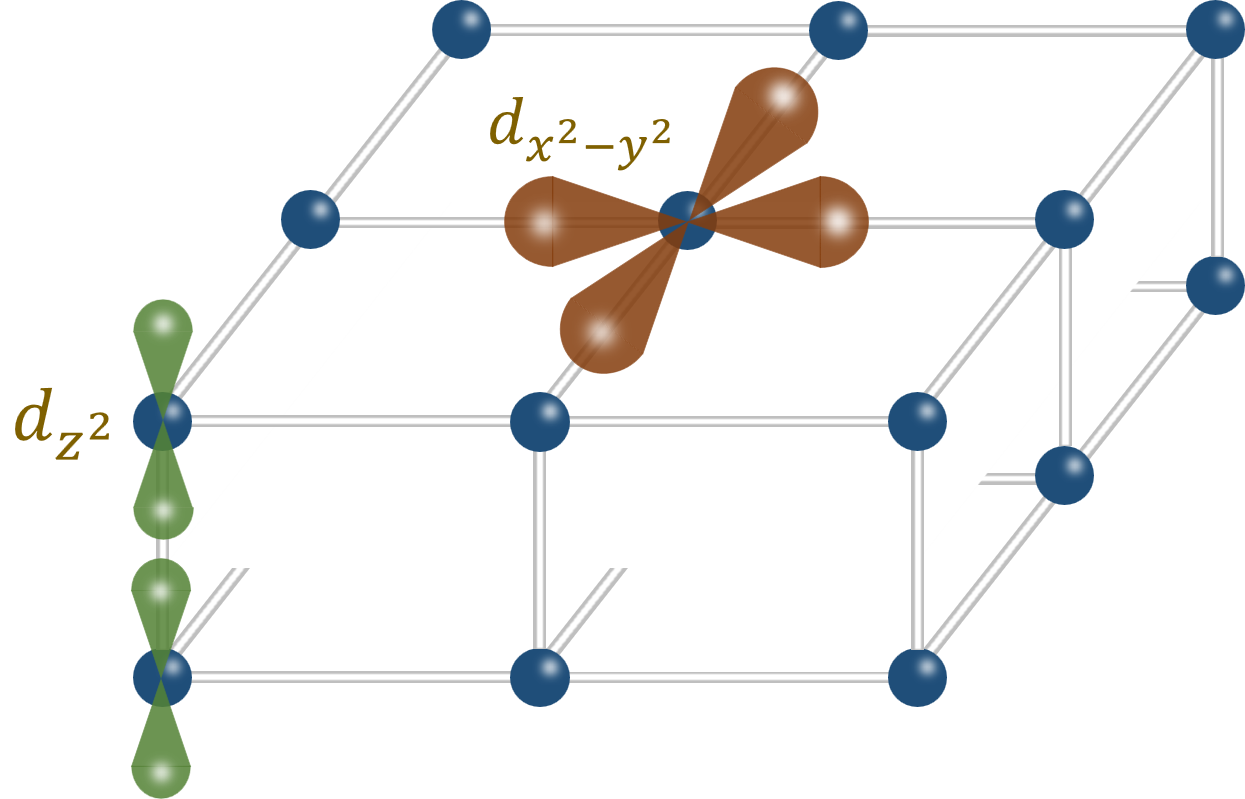
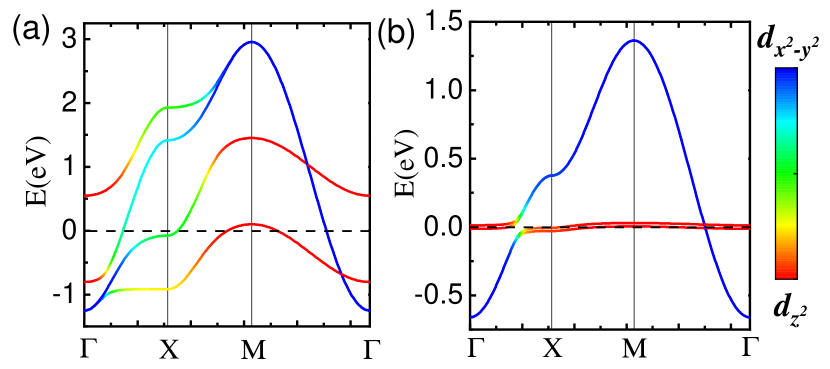
The discovery of high-$T_c$ superconductivity (SC) in La$_3$Ni$_2$O$_7$ (LNO) has aroused a great deal of interests. Previously, it was proposed that the Ni-$3d_{z^2}$ orbital is crucial to realize the high-$T_c$ SC in LNO: The preformed Cooper pairs therein acquire coherence via hybridization with the $3d_{x^2-y^2}$ orbital to form the SC. However, we held a different viewpoint that the interlayer pairing $s$-wave SC is induced by the $3d_{x^2-y^2}$ orbital, driven by the strong interlayer superexchange interaction. To include effects from both $E_g$-orbitals , we establish a two-orbital bilayer $t$-$J$ model. Our calculations reveal that due to the no-double-occupancy constraint, the $3d_{x^2-y^2}$ band and the $3d_{z^2}$ bonding band are flattened by a factor of about 2 and 10, respectively, which is consistent with recent angle-resolved-photo-emission-spectroscopy measurements. Consequently, a high temperature SC can be hardly induced in the $3d_{z^2}$-orbital due to the difficulty to develop phase coherence. However, it can be easily achieved by the $3d_{x^2-y^2}$ orbital under realistic interaction strength. With electron doping, the $3d_{z^2}$-band gradually dives below the Fermi level, but $T_c$ continues to enhance, suggesting that it is not necessary for the high-$T_c$ SC in LNO. With hole doping, $T_c$ initially drops and then rises, accompanied by the crossover from the BCS to BEC-type superconducting transitions.
研究の動機と目的
- 圧力下のLa$_3$Ni$_2$O$_7$における高臨界温度超伝導の支配的要因となる$ E_g $軌道($3d_{z^2}$ または $3d_{x^2-y^2}$)を特定すること。
- 二つの$ E_g $軌道と二層構造の相乗効果を統合的な理論枠組みで組み込むこと。
- 観測された高い$ T_c \approx 80 $ Kと、$ Fmmm $対称性への圧力誘発構造転移の役割を説明すること。
- 両軌道に強いバンドフラットニングが観測される角度分解光電子分光(ARPES)データを説明すること。
- ドーピング依存の$ T_c $と超伝導遷移の性質(BCSからBECへの遷移)を調査すること。
提案手法
- 層内および層間の hopping、スピン交換、軌道混合を含む二軌道二層型$ t $-$ J $モデルを構築する。
- $ t $-$ J $ハミルトニアンに対して平均場分解離法を適用し、$ \sigma $-結合と$ \pi $-結合チャネルを介してホール粒子とスピン粒子の部分に分離する。
- 二重占有禁止制約を用いて有効なバンドフラットニング係数を導出:$3d_{x^2-y^2}$ では約2、$3d_{z^2}$ では約10。
- 軌道混合と層間ペアリングをモデル化するため、混合項$ \chi^{xz}_{\parallel} $と層間ペアリング$ \Delta^{x}_{\perp} $を導入する。
- 平均場ハミルトニアンを数値的に解き、$ T_c $を計算するとともにドーピング依存の挙動を分析する。
- 全電子密度制約を満たすために、化学ポテンシャルのずれ$ \mu_f $、$ \mu_b $、および$ \delta\mu $を導入する。
実験結果
リサーチクエスチョン
- RQ1圧力下のLa$_3$Ni$_2$O$_7$における高$ T_c $超伝導の主な要因となる$ E_g $軌道は、$3d_{z^2}$ か $3d_{x^2-y^2}$ のどちらか?
- RQ2二つの$ E_g $軌道の相互作用が超伝導ペアリング機構にどのように寄与するか?
- RQ3$3d_{z^2}$軌道は強い層間結合を示すにもかかわらず、なぜ高$ T_c $超伝導を支持できないのか?
- RQ4電子ドーピングおよび空孔ドーピングが超伝導転移温度$ T_c $にどのように影響するか?
- RQ5空孔ドーピング下で超伝導遷移がBCSからBEC特性へと変化するか?
主な発見
- $3d_{x^2-y^2}$軌道が強い層間スピン交換により高$ T_c $ $ s $-波超伝導を駆動しており、実験的$ T_c \approx 80 $ Kと整合的である。
- $3d_{z^2}$軌道は二重占有禁止制約により、約10倍の極端なバンドフラットニングを示し、位相相関の抑制が生じ、高$ T_c $ペアリングを妨げる。
- 本モデルはARPESで測定されたバンドフラットニング($3d_{x^2-y^2}$ で約2、$3d_{z^2}$ で約10)を再現し、理論枠組みの妥当性を裏付けた。
- 電子ドーピングにより$ T_c $が向上するが、$3d_{z^2}$バンドがフェルミエネルギー以下に沈下しても、高$ T_c $超伝導が維持されるため、この軌道は高$ T_c $超伝導に不可欠ではない。
- 空孔ドーピングによりBCSからBECへの遷移が誘発され、$ T_c $は初期には減少してから再び上昇する。これは実験で観測される非単調な$ T_c $傾向と一致する。
より良い研究を、今すぐ始めましょう
論文の読解から最終レビューまで、研究時間を劇的に削減しましょう。
クレジットカード登録不要
このレビューはAIが作成し、人間の編集者が確認しました。