
[Paper Review] Investigating the Effectiveness of Task-Agnostic Prefix Prompt for Instruction Following
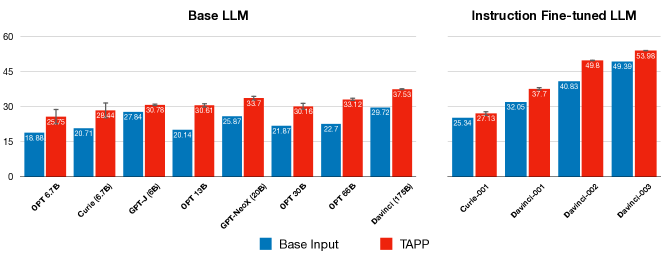
This paper shows that prepending a fixed Task-Agnostic Prefix Prompt (TAPP) to inputs during inference improves instruction-following across base and instruction-tuned LLMs, with gains up to 34.58% for base models and 12.26% for instruction-tuned models on evaluated tasks. The effect is orthogonal to fine-tuning and persists under some input corruption.
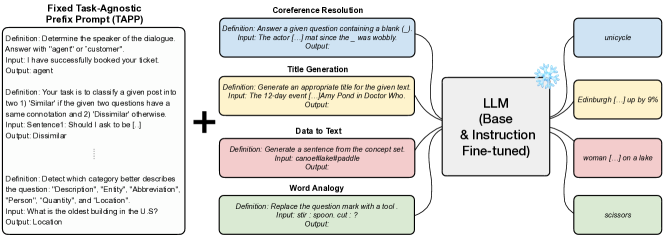
In this paper, we present our finding that prepending a Task-Agnostic Prefix Prompt (TAPP) to the input improves the instruction-following ability of various Large Language Models (LLMs) during inference. TAPP is different from canonical prompts for LLMs in that it is a fixed prompt prepended to the beginning of every input regardless of the target task for zero-shot generalization. We observe that both base LLMs (i.e. not fine-tuned to follow instructions) and instruction-tuned models benefit from TAPP, resulting in 34.58% and 12.26% improvement on average, respectively. This implies that the instruction-following ability of LLMs can be improved during inference time with a fixed prompt constructed with simple heuristics. We hypothesize that TAPP assists language models to better estimate the output distribution by focusing more on the instruction of the target task during inference. In other words, such ability does not seem to be sufficiently activated in not only base LLMs but also many instruction-fine-tuned LLMs. All experiments are reproducible from https://github.com/seonghyeonye/TAPP.
Motivation & Objective
- Demonstrate that a fixed, task-agnostic prefix improves instruction following during inference across diverse LLMs.
- Show that TAPP provides gains for both base and instruction-tuned models and is complementary to instruction fine-tuning.
- Analyze the construction rules for TAPP demonstrations and their impact on zero-shot and few-shot generalization.
- Investigate robustness of TAPP to input distribution corruption and its relation to task category signals.
Proposed method
- Construct a fixed TAPP prefix from cross-task demonstrations (instruction, input, output) using simple heuristics.
- Prepend M (the TAPP demonstrations) to the target task's instruction and input, and compute y_ti via arg max P(y_ti|M,I_t,x_ti;θ).
- Evaluate on 119 held-out SuperNI tasks across 12 categories using diverse LLMs (GPT-3, OPT, GPT-NeoX, GPT-J).
- Compare TAPP with task-specific prefixes (Nearest PP, Category PP, Output PP) and analyze few-shot ICL with TAPP.
- Investigate robustness to input-distribution corruption by substituting demonstrations’ inputs with random sentences.
Experimental results
Research questions
- RQ1Does a fixed, task-agnostic prefix improve instruction following for base LLMs and instruction-tuned LLMs during inference?
- RQ2Is the improvement from TAPP complementary to instruction fine-tuning and RLHF?
- RQ3What aspects of the TAPP demonstrations (instruction, input, output) drive its effectiveness?
- RQ4How does TAPP compare to task-specific prefixes and to few-shot in-context learning when combined with demonstrations?
- RQ5How robust is TAPP to corruption of demonstration inputs?
Key findings
- TAPP consistently improves base LLM performance across model scales, with substantial gains (e.g., OPT-13B).
- TAPP can make smaller models outperform much larger models without TAPP (e.g., 6B GPT-J vs 175B GPT-3 without TAPP).
- TAPP also improves instruction-tuned LLMs, especially for models over 100B parameters, and can boost top models (e.g., text-davinci-003) by up to 9.3%.
- The improvement from TAPP is orthogonal to instruction fine-tuning and works with few-shot demonstrations added to TAPP; input corruption has limited impact on performance.
- Demonstrations built from classification tasks with explicit answer choices are particularly effective, and avoiding overlap of answer choices across demonstrations helps performance, especially for generation tasks.
- TAPP demonstrations generated by ChatGPT yield comparable gains to benchmark-derived demonstrations, indicating the method’s robustness to demonstration source.
Read this paper
Open the full text in the Nubint reader and ask about any passage as you read.
Read this paper on NubintThis review was generated by AI from the original paper. Please check the paper before citing it.