
[Paper Review] IRS-Assisted Wireless Powered NOMA: Do We Really Need Different Phase Shifts in DL and UL?
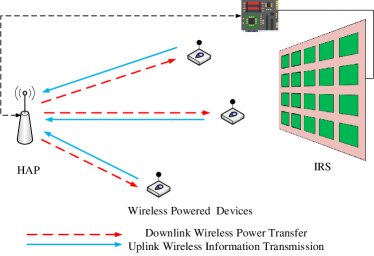
This paper proposes a joint optimization of time allocation and intelligent reflecting surface (IRS) phase shifts in an IRS-assisted wireless powered NOMA network, proving that dynamic beamforming—using different phase shifts for downlink energy transfer and uplink information transmission—is unnecessary. The key contribution is that identical phase shifts for both phases simplify design and reduce overhead without performance loss, enabling efficient sum throughput maximization via joint and alternating optimization algorithms with significant gains over benchmarks.
Intelligent reflecting surface (IRS) is a promising technology to improve the performance of wireless powered communication networks (WPCNs) due to its capability to reconfigure signal propagation environments via smart reflection. In particular, the high passive beamforming gain promised by IRS can significantly enhance the efficiency of both downlink wireless power transfer (DL WPT) and uplink wireless information transmission (UL WIT) in WPCNs. Although adopting different IRS phase shifts for DL WPT and UL WIT, i.e., dynamic IRS beamforming, is in principle possible but incurs additional signaling overhead and computational complexity, it is an open problem whether it is actually beneficial. To answer this question, we consider an IRS-assisted WPCN where multiple devices employ a hybrid access point (HAP) to first harvest energy and then transmit information using non-orthogonal multiple access (NOMA). Specifically, we aim to maximize the sum throughput of all devices by jointly optimizing the IRS phase shifts and the resource allocation. To this end, we first prove that dynamic IRS beamforming is not needed for the considered system, which helps reduce the number of IRS phase shifts to be optimized. Then, we propose both joint and alternating optimization based algorithms to solve the resulting problem. Simulation results demonstrate the effectiveness of our proposed designs over benchmark schemes and also provide useful insights into the importance of IRS for realizing spectrally and energy efficient WPCNs.
Motivation & Objective
- To address the open problem of whether dynamic IRS beamforming improves performance in IRS-assisted wireless powered NOMA networks.
- To maximize the sum throughput of multiple devices by jointly optimizing time allocation and IRS passive beamforming.
- To reduce signaling overhead and computational complexity by eliminating the need for different phase shifts in downlink and uplink.
- To develop low-complexity, practical algorithms—joint and alternating optimization—for system design.
- To provide insights into the role of IRS in enhancing both spectral and energy efficiency in WPCNs.
Proposed method
- Prove that identical IRS phase shifts for downlink and uplink are optimal, eliminating the need for dynamic beamforming.
- Formulate a non-convex optimization problem to maximize sum throughput under quality-of-service and energy harvesting constraints.
- Propose a joint optimization algorithm using semidefinite relaxation (SDR) and Gaussian randomization to handle rank-one constraints.
- Develop an alternating optimization algorithm with closed-form solutions for time allocation and phase shifts, reducing complexity.
- Use penalty methods to handle rank constraints in the optimization framework.
- Validate the design through simulations comparing proposed schemes against benchmarks with fixed phase shifts, fixed time allocation, and no IRS.
Experimental results
Research questions
- RQ1Is dynamic IRS beamforming—using different phase shifts in downlink and uplink—actually beneficial for IRS-assisted wireless powered NOMA networks?
- RQ2Can the same IRS phase shift be used for both downlink wireless power transfer and uplink information transmission without performance degradation?
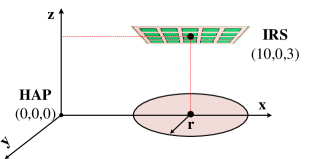
- RQ3What is the impact of IRS deployment on system throughput and energy consumption in WPCNs with NOMA?
- RQ4How does the number of IRS elements affect the optimal time allocation and harvested energy at devices?
- RQ5Can low-complexity alternating optimization achieve near-optimal performance compared to joint optimization?
Key findings
- Dynamic IRS beamforming does not improve system performance in the considered IRS-assisted WPCN with NOMA, and identical phase shifts for downlink and uplink are optimal.
- The proposed alternating optimization algorithm achieves throughputs nearly identical to the joint optimization benchmark, making it a practical low-complexity solution.
- As the number of IRS elements increases, the optimal downlink WPT duration τ₀ decreases, reducing HAP energy consumption while maintaining or improving device energy harvesting.
- The sum throughput gain over benchmark schemes increases with the number of IRS elements, especially when both time allocation and phase shifts are optimized.
- Harvested energy at devices increases with IRS size due to enhanced effective channel gain, despite shorter WPT durations.
- The system achieves a 'double-gain' by improving both spectral efficiency and energy efficiency as IRS size grows.
Read this paper
Open the full text in the Nubint reader and ask about any passage as you read.
Read this paper on NubintThis review was generated by AI from the original paper. Please check the paper before citing it.