
[Paper Review] Is ChatGPT a Good Teacher Coach? Measuring Zero-Shot Performance For Scoring and Providing Actionable Insights on Classroom Instruction
This paper evaluates ChatGPT's zero-shot ability to serve as an automated teacher coach by assessing its performance on three tasks: scoring classroom transcripts using observation rubrics (CLASS and MQI), identifying instructional highlights and missed opportunities, and generating actionable feedback to elicit student reasoning. Despite producing relevant-sounding responses, ChatGPT frequently suggests actions already being implemented by teachers (82% of suggestions), and its feedback lacks insightfulness and novelty, indicating significant room for improvement in generating truthful, original, and pedagogically meaningful coaching feedback.
Coaching, which involves classroom observation and expert feedback, is a widespread and fundamental part of teacher training. However, the majority of teachers do not have access to consistent, high quality coaching due to limited resources and access to expertise. We explore whether generative AI could become a cost-effective complement to expert feedback by serving as an automated teacher coach. In doing so, we propose three teacher coaching tasks for generative AI: (A) scoring transcript segments based on classroom observation instruments, (B) identifying highlights and missed opportunities for good instructional strategies, and (C) providing actionable suggestions for eliciting more student reasoning. We recruit expert math teachers to evaluate the zero-shot performance of ChatGPT on each of these tasks for elementary math classroom transcripts. Our results reveal that ChatGPT generates responses that are relevant to improving instruction, but they are often not novel or insightful. For example, 82% of the model's suggestions point to places in the transcript where the teacher is already implementing that suggestion. Our work highlights the challenges of producing insightful, novel and truthful feedback for teachers while paving the way for future research to address these obstacles and improve the capacity of generative AI to coach teachers.
Motivation & Objective
- To investigate whether generative AI like ChatGPT can serve as a scalable, cost-effective alternative to expert teacher coaching.
- To evaluate zero-shot performance of ChatGPT on three core teacher coaching tasks: scoring, identifying instructional strengths/gaps, and generating actionable feedback.
- To assess the relevance, faithfulness, insightfulness, and novelty of AI-generated feedback compared to expert human ratings.
- To identify limitations in current LLMs for providing high-quality, pedagogically meaningful coaching feedback in real classroom contexts.
Proposed method
- Utilizes the NCTE dataset of annotated elementary math classroom transcripts labeled with CLASS and MQI observation instruments.
- Employs zero-shot prompting to evaluate ChatGPT on three tasks: (A) scoring transcript segments using rubric items, (B) identifying highlights and missed opportunities, and (C) generating suggestions to elicit more student reasoning.
- Collects human evaluations from expert math teachers on the quality of model outputs using criteria including relevance, faithfulness, insightfulness, and actionability.
- Computes inter-annotator agreement using weighted Cohen’s kappa for relevance (0.23), faithfulness (0.36), and insightfulness (0.37).
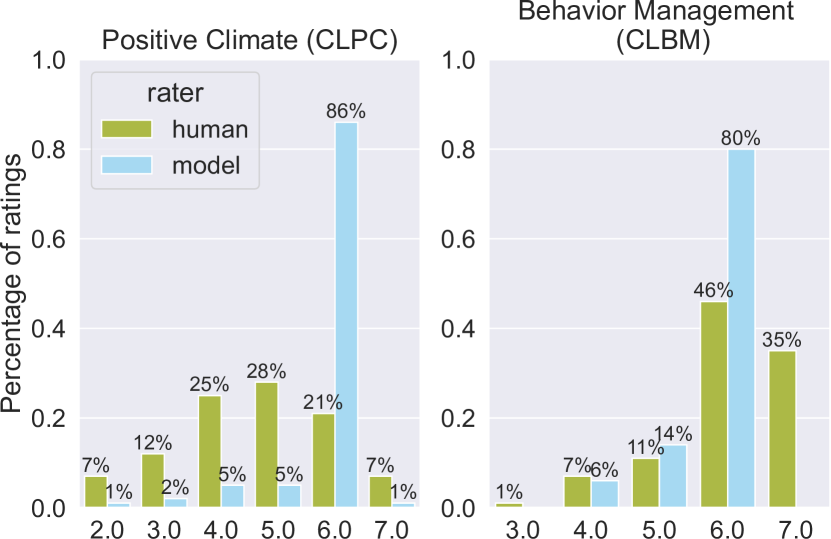
- Compares model-generated scores against human-annotated rubric scores to assess correlation, finding low agreement.
- Analyzes model outputs for redundancy by checking whether suggestions reference actions already present in the transcript.

Experimental results
Research questions
- RQ1Can ChatGPT generate accurate and reliable scores for classroom instruction using zero-shot prompting on established observation instruments?
- RQ2How well does ChatGPT identify instructional highlights and missed opportunities in classroom transcripts compared to expert human raters?
- RQ3To what extent are ChatGPT’s suggestions for improving student reasoning novel, actionable, and faithful to the transcript?
- RQ4How often do ChatGPT’s feedback suggestions describe actions that are already being implemented by the teacher?
- RQ5What is the level of agreement between human raters on the quality of AI-generated coaching feedback?
Key findings
- ChatGPT’s predicted scores showed low correlation with human-annotated scores across all CLASS and MQI items, even when provided with rubric details and reasoning prompts.
- 50–70% of ChatGPT’s responses to Task B (identifying highlights and missed opportunities) were rated as not insightful by expert raters.
- 35–50% of responses in Task B were rated as not relevant to the prompt or transcript content.
- 82% of suggestions generated in Task C described actions that were already being implemented by the teacher in the transcript, indicating high redundancy.
- Human raters showed only moderate agreement on the quality of model outputs, with weighted Cohen’s kappa of 0.23 for relevance, 0.36 for faithfulness, and 0.37 for insightfulness.
- Despite low inter-annotator agreement, the model’s outputs were consistently rated as more relevant and actionable than insightful, suggesting a need for improvement in generating novel, pedagogically rich feedback.
Read this paper
Open the full text in the Nubint reader and ask about any passage as you read.
Read this paper on NubintThis review was generated by AI from the original paper. Please check the paper before citing it.