
[Paper Review] JADES: A large population of obscured, narrow line AGN at high redshift
The study identifies 42 narrow-line AGN candidates (type-2) in JWST/JADES deep spectroscopy up to z~10, estimating an AGN host fraction of about 20% with bolometric luminosities 10^41.3−10^44.9 erg/s and host masses 10^7.2−10^9.3 Msun, and showing their contribution to UV luminosity and star formation trends.
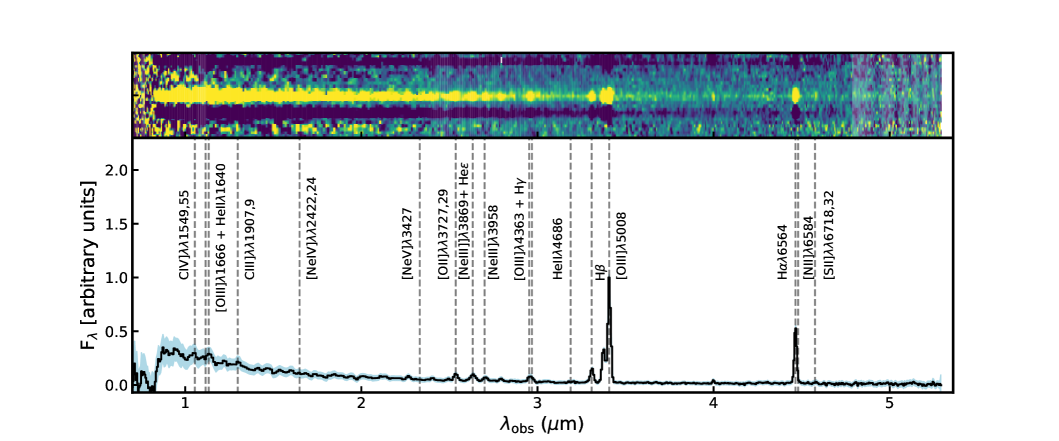
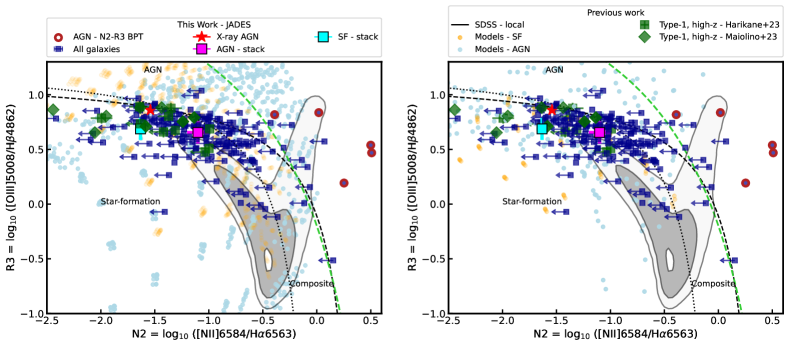
We present the identification of 42 narrow-line active galactic nuclei (type-2 AGN) candidates in the two deepest observations of the JADES spectroscopic survey with JWST/NIRSpec. The spectral coverage and the depth of our observations allow us to select narrow-line AGNs based on both rest-frame optical and UV emission lines up to z=10. Due to the metallicity decrease of galaxies, at $z>3$ the standard optical diagnostic diagrams (N2-BPT or S2-VO87) become unable to distinguish many AGN from other sources of photoionisation. Therefore, we also use high ionisation lines, such as HeII$λ$4686, HeII$λ$1640, NeIV$λ$2422, NeV$λ$3420, and NV$λ$1240, also in combination with other UV transitions, to trace the presence of AGN. Out of a parent sample of 209 galaxies, we identify 42 type-2 AGN (although 10 of them are tentative), giving a fraction of galaxies in JADES hosting type-2 AGN of about $20\pm3$\%, which does not evolve significantly in the redshift range between 2 and 10. The selected type-2 AGN have estimated bolometric luminosities of $10^{41.3-44.9}$ erg s$^{-1}$ and host-galaxy stellar masses of $10^{7.2-9.3}$ M$_{\odot}$. The star formation rates of the selected AGN host galaxies are consistent with those of the star-forming main sequence. The AGN host galaxies at z=4-6 contribute $\sim$8-30 \% to the UV luminosity function, slightly increasing with UV luminosity.
Motivation & Objective
- Identify type-2 AGN in deep JWST/NIRSpec spectra from the JADES survey up to z~12.
- Reassess high-redshift AGN vs. star-forming galaxy diagnostics using UV and optical lines.
- Calibrate AGN selection with photoionization models (Feltre 2016; Gutkin 2016; Nakajima 2022).
- Estimate AGN and host-galaxy properties (bolometric luminosity, stellar mass, SFR).
- Quantify AGN contribution to UV luminosity function and its evolution with redshift.
Proposed method
- Deep JWST/NIRSpec spectroscopy from two JADES programs (1210 & 3215) with PRISM and multiple gratings.
- Continuum and emission-line fitting with pPXF, tying kinematics across line groups and fixing flux ratios for multiplets.
- SED fitting with BEAGLE to derive stellar masses and SFRs under a delayed-exponential SFH and Chabrier IMF.
- Use high-ionization UV lines (e.g., Ne IV, Ne V, N V) and UV/optical lines to identify AGN beyond traditional BPT diagnostics at high z.
- Compare observed line ratios with photoionization model grids (Feltre+2016; Gutkin+2016; Nakajima+2022) to delineate AGN vs. star-forming regions.
- Adopt 3σ detections for required lines and integrate multiple diagnostics (N2-R3, S2-R3, He II-based diagrams) to select AGN.
Experimental results
Research questions
- RQ1What fraction of high-redshift galaxies host narrow-line (type-2) AGN and how does it evolve with redshift (z≈2–10)?
- RQ2Can high-redshift AGN be reliably distinguished from star-forming galaxies using rest-frame UV and optical line diagnostics given low metallicity and high ionization parameters?
- RQ3How do AGN narrow-line regions at high-z compare with photoionization model predictions across metallicities and ionization parameters?
- RQ4What are the bolometric luminosities, stellar masses, and SFRs of host galaxies for these high-redshift type-2 AGN?
- RQ5What is the contribution of AGN hosts to the UV luminosity function at z≈4–6 and its evolution with UV luminosity?
Key findings
- Identified 42 type-2 AGN candidates among 209 galaxies, with 10 tentative cases, yielding an AGN host fraction of 20±3%.
- Selected AGN span bolometric luminosities L_bol ≈ 10^41.3–10^44.9 erg s^-1 and host stellar masses M_* ≈ 10^7.2–10^9.3 M_sun.
- Star formation rates of AGN hosts are consistent with the star-forming main sequence.
- AGN host galaxies at z=4–6 contribute roughly 8–30% to the UV luminosity function, increasing with UV luminosity.
- The AGN fraction shows no strong evolution between z≈2 and z≈10, within uncertainties.
- Demarcation lines between AGN and star-forming galaxies in high-z BPT-like diagrams are refined to account for low metallicity and high ionization parameter.
Read this paper
Open the full text in the Nubint reader and ask about any passage as you read.
Read this paper on NubintThis review was generated by AI from the original paper. Please check the paper before citing it.