
[Paper Review] Jets from neutron-star merger remnants and massive blue kilonovae
This study presents 3D general-relativistic magnetohydrodynamic simulations showing that magnetized jets emerge within 30 ms post-merger from a long-lived neutron star remnant of a binary neutron star merger, driving a fast, magnetized wind that produces a UV/blue kilonova precursor within hours. The jet-driven wind launches ~0.02 M☉ of lanthanide-free ejecta at 0.1–0.2c within 50 ms, producing a kilonova signal consistent with GW170817’s early blue emission.
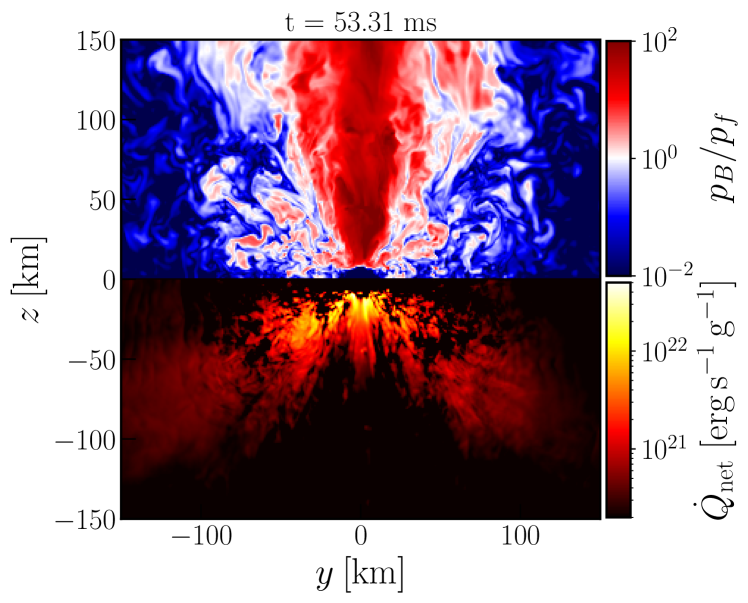
We perform high-resolution three-dimensional general-relativistic magnetohydrodynamic simulations with neutrino transport of binary neutron star (BNS) mergers resulting in a long-lived remnant neutron star, with properties typical of galactic BNS and consistent with those inferred for the first observed BNS merger GW170817. We demonstrate self-consistently that within $\lesssim\!30$ ms post-merger magnetized ($σ\sim 5-10$) twin polar jets emerge with asymptotic Lorentz factor $Γ\sim 5-10$, which successfully break out from the merger debris within $\lesssim\!20$ ms. A fast ($v\lesssim 0.6c$), magnetized ($σ\sim 0.1$) wind surrounds the jet core and generates a UV/blue kilonova precursor on timescales of hours, similar to the precursor signal due to free neutron decay in fast dynamical ejecta. Post-merger ejecta are quickly dominated by MHD-driven outflows from an accretion disk. We demonstrate that within only 50 ms post-merger, $\gtrsim 2 imes 10^{-2}M_\odot$ of lanthanide-free, quasi-spherical ejecta with velocity $\sim\!0.1c$ is launched, yielding a kilonova signal consistent with GW170817 on timescales of $\lesssim\!5$\,d.
Motivation & Objective
- To explain the origin of the early blue and UV kilonova emission observed in GW170817, which cannot be explained by dynamical ejecta alone.
- To investigate whether magnetohydrodynamically (MHD) driven winds from a post-merger accretion disk can produce the observed early kilonova precursor.
- To determine the role of jet formation and magnetic field amplification in shaping the early post-merger emission and ejecta properties.
- To assess whether the observed luminosity and spectral characteristics of the early kilonova can be reproduced by MHD-driven winds with realistic nuclear physics and opacity models.
Proposed method
- Performing three-dimensional general-relativistic magnetohydrodynamic (GRMHD) simulations with weak interactions using the EinsteinToolkit framework and GRHydro code.
- Implementing a tabulated nuclear equation of state (APR EOS), weak interactions, and a one-moment neutrino leakage scheme for energy transport.
- Using a fixed Cartesian grid hierarchy with adaptive mesh refinement (AMR) and reflection symmetry across the orbital plane to improve computational efficiency.
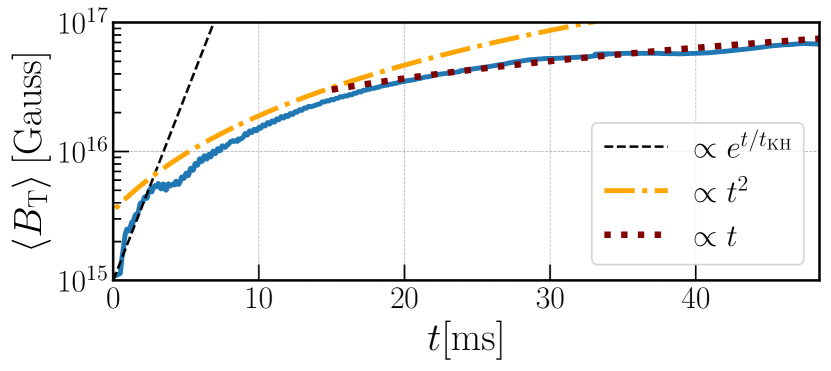
- Initializing a weak poloidal magnetic seed field (B_max = 3×10¹⁵ G) in each neutron star to study magnetic field amplification and jet formation.
- Tracking the evolution of magnetic fields, outflows, and energy dissipation, particularly focusing on polar and disk wind components.
- Calculating kilonova light curves using a multi-angle, axisymmetric approach with detailed heating rates from nuclear reaction networks and opacity prescriptions (κ = 0.5 cm²/g for v > 0.2c, κ = 10 cm²/g for v < 0.2c).
Experimental results
Research questions
- RQ1Can MHD-driven winds from a post-merger accretion disk explain the early UV/blue kilonova precursor observed in GW170817?
- RQ2What is the timescale and mechanism for jet emergence and breakout from the merger debris in long-lived neutron star remnants?
- RQ3How do magnetic fields amplify and organize into large-scale toroidal structures capable of launching relativistic jets?
- RQ4What is the mass, velocity, and composition of the ejecta produced by MHD winds, and how do they compare to the observed kilonova light curves?
- RQ5To what extent do the simulated light curves match the observed photometric and spectroscopic features of GW170817’s early emission?
Key findings
- Magnetized jets emerge within ~30 ms post-merger with asymptotic Lorentz factors of Γ ~ 5–10 and break out from the merger debris in ~20 ms.
- A fast, magnetized wind (v ~ 0.6c, σ ~ 0.1) forms around the jet core, producing a UV/blue kilonova precursor within hours, with luminosity comparable to or exceeding that from free neutron decay in dynamical ejecta.
- By 50 ms post-merger, ~2×10⁻² M☉ of lanthanide-free, quasi-spherical ejecta is launched at velocities of 0.1–0.2c, consistent with the early kilonova emission of GW170817.
- The kinetic power of the polar wind increases by over an order of magnitude upon jet emergence, approaching the Poynting luminosity of the jet and extracting rotational energy from the remnant neutron star.
- The mass-loss rate of the magnetized polar wind reaches ~1×10⁻² M☉ s⁻¹, enhanced by an order of magnitude compared to the prior neutrino-driven wind, with Yₑ ≈ 0.3–0.4 and poloidal field strength ~few×10¹⁴ G.
- The combined emission from polar and disk winds produces a prolonged precursor signal in UV/blue bands lasting ~1–few hours, overlapping with and potentially enhancing the neutron decay precursor.
Read this paper
Open the full text in the Nubint reader and ask about any passage as you read.
Read this paper on NubintThis review was generated by AI from the original paper. Please check the paper before citing it.