
[Paper Review] Kernel interpolation of acoustic transfer functions with adaptive kernel for directed and residual reverberations
This paper proposes a kernel ridge regression-based method for interpolating region-to-region acoustic transfer functions (ATFs) by adaptively modeling directed and residual sound fields separately using directional weighting functions and neural networks. The approach improves interpolation accuracy—especially at high frequencies—by incorporating physical acoustic constraints and learning environment-specific kernel adaptations, outperforming existing methods in numerical evaluations.
An interpolation method for region-to-region acoustic transfer functions (ATFs) based on kernel ridge regression with an adaptive kernel is proposed. Most current ATF interpolation methods do not incorporate the acoustic properties for which measurements are performed. Our proposed method is based on a separate adaptation of directional weighting functions to directed and residual reverberations, which are used for adapting kernel functions. Thus, the proposed method can not only impose constraints on fundamental acoustic properties, but can also adapt to the acoustic environment. Numerical experimental results indicated that our proposed method outperforms the current methods in terms of interpolation accuracy, especially at high frequencies.
Motivation & Objective
- To address the limitation of current ATF interpolation methods that do not incorporate acoustic properties of the measurement environment.
- To develop a generalized, environment-adaptive framework for region-to-region ATF interpolation applicable across diverse acoustic settings.
- To enhance interpolation accuracy by modeling directed and residual sound fields separately using physics-informed kernel functions.
- To optimize directional weighting and residual field representations through gradient-based learning while preserving closed-form kernel ridge regression solutions.
- To validate the method's superiority, particularly at high frequencies, through numerical experiments in a controlled room environment.
Proposed method
- The method models the reverberant component of the ATF as a superposition of a directed field (modeled via unimodal directional weighting functions) and a residual field (modeled via neural networks).
- The kernel function in kernel ridge regression is adapted using separate directional weighting functions for directed and residual components, informed by the Helmholtz equation and reciprocity constraints.
- Directional weighting for the directed field is constructed as a superposition of unimodal functions aligned with dominant propagation directions, while residual field weighting is learned via a two-layer fully connected neural network.
- Hyperparameters of the directional and residual models are optimized by minimizing leave-one-out cross-validation error, ensuring robust generalization.
- The final ATF estimate is obtained by combining the learned reverberant component with the free-field Green’s function, preserving physical consistency.
- The method operates within a reproducing kernel Hilbert space (RKHS) that enforces the homogeneous Helmholtz equation and reciprocity, ensuring acoustic plausibility.

Experimental results
Research questions
- RQ1Can a unified ATF interpolation framework be developed that incorporates physical acoustic constraints such as the Helmholtz equation and reciprocity?
- RQ2How does separating the modeling of directed and residual sound fields improve interpolation accuracy compared to joint modeling?
- RQ3To what extent can adaptive kernel functions, informed by directional and residual field characteristics, enhance performance in high-frequency regions?
- RQ4Does learning environment-specific directional weighting functions lead to better generalization than fixed or uniform kernel designs?
- RQ5How does the proposed method compare in accuracy to state-of-the-art ATF interpolation techniques, particularly in challenging high-frequency regimes?
Key findings
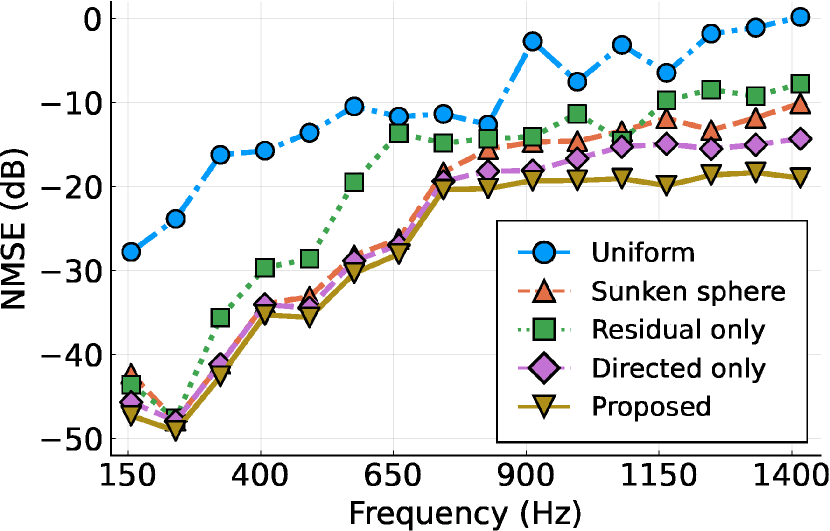
- The proposed method achieved the lowest normalized mean square error (NMSE) across all tested frequencies, particularly excelling at high frequencies where other methods degrade.
- At 1150 Hz, the proposed method reconstructed the sound field more accurately and over a larger effective area in the receiver region than Uniform, Sunken sphere, Directed only, and Residual only methods.
- The directional weighting function learned by the proposed method showed concentrated, high-amplitude responses in dominant propagation directions, confirming effective modeling of directivity.
- The residual field weighting function exhibited a more diffuse, low-amplitude structure, consistent with the expected behavior of late reflections.
- Compared to Directed only, the inclusion of residual field modeling in the proposed method significantly improved performance, especially in the 1–2 kHz range.
- The method demonstrated robustness under 20 dB SNR conditions, maintaining high accuracy despite added measurement noise.
Read this paper
Open the full text in the Nubint reader and ask about any passage as you read.
Read this paper on NubintThis review was generated by AI from the original paper. Please check the paper before citing it.