
[Paper Review] Label-Aware Distribution Calibration for Long-tailed Classification
This paper proposes Label-Aware Distribution Calibration (LADC), a novel method for long-tailed classification that calibrates the feature distribution of tail classes by transferring statistical knowledge from similar, well-represented head classes. By leveraging inter-class similarity in feature space and generating synthetic samples from calibrated distributions, LADC significantly improves tail-class performance over existing methods, with state-of-the-art results on image and text benchmarks.
Real-world data usually present long-tailed distributions. Training on imbalanced data tends to render neural networks perform well on head classes while much worse on tail classes. The severe sparseness of training instances for the tail classes is the main challenge, which results in biased distribution estimation during training. Plenty of efforts have been devoted to ameliorating the challenge, including data re-sampling and synthesizing new training instances for tail classes. However, no prior research has exploited the transferable knowledge from head classes to tail classes for calibrating the distribution of tail classes. In this paper, we suppose that tail classes can be enriched by similar head classes and propose a novel distribution calibration approach named as label-Aware Distribution Calibration LADC. LADC transfers the statistics from relevant head classes to infer the distribution of tail classes. Sampling from calibrated distribution further facilitates re-balancing the classifier. Experiments on both image and text long-tailed datasets demonstrate that LADC significantly outperforms existing methods.The visualization also shows that LADC provides a more accurate distribution estimation.
Motivation & Objective
- To address the performance degradation of neural networks on tail classes in long-tailed datasets due to data sparsity and biased distribution estimation.
- To explore the transferable knowledge from head classes to tail classes for improving feature distribution estimation of underrepresented classes.
- To develop a distribution calibration mechanism that leverages inter-class similarity in the feature space to enhance representation learning for tail classes.
- To improve classifier re-balancing through a new sampling strategy based on calibrated distributions, reducing overfitting and distribution mismatch.
- To achieve state-of-the-art performance on long-tailed image and text classification benchmarks without relying solely on re-weighting or data augmentation.
Proposed method
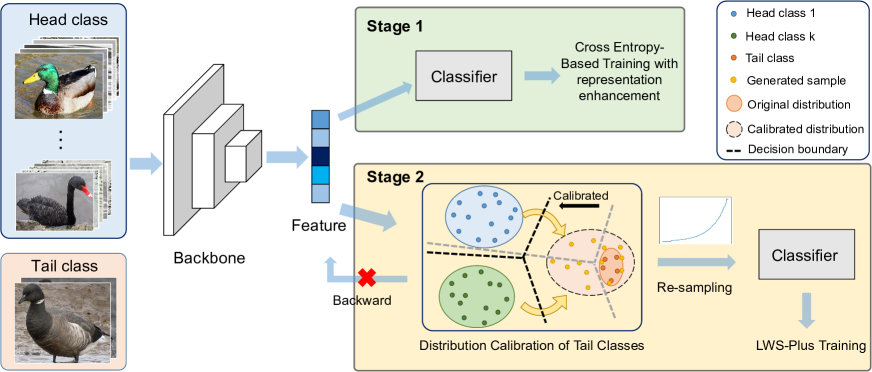
- LADC decouples training into two stages: first, a backbone is trained with data augmentation (Re-balanced Mixup and RandAugment) to enhance representation learning.
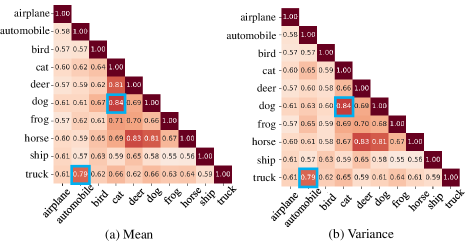
- In the second stage, for each tail class, the method identifies the m most similar head classes based on feature mean and covariance similarity.
- It computes a calibrated distribution for each tail class by combining the means and covariance matrices of the most similar head classes, assuming Gaussian-distributed features in each dimension.
- New training instances are sampled from these calibrated distributions to re-balance the classifier, mitigating data sparsity in tail classes.
- A new classifier re-balancing technique, LWS-Plus, is introduced to further improve the rectification of the classifier using the calibrated samples.
- The method assumes that similar classes share similar feature statistics (mean and variance), enabling knowledge transfer from head to tail classes.
Experimental results
Research questions
- RQ1Can inter-class similarity in the feature space be leveraged to improve distribution estimation for long-tailed classes?
- RQ2Does transferring statistical knowledge from head classes to tail classes lead to better generalization and reduced bias in classification models?
- RQ3Can calibrated feature distributions from similar head classes improve the performance of tail classes without relying on traditional re-weighting or data augmentation?
- RQ4How does label-aware distribution calibration compare to existing two-stage training methods in terms of tail-class accuracy and distribution mismatch mitigation?
- RQ5To what extent does the proposed sampling strategy from calibrated distributions reduce overfitting and improve classifier re-balancing?
Key findings
- On CIFAR100-LT with an imbalance factor of 200, LADC achieves a top-1 accuracy of 55.24% using cRT, outperforming the next best method (LAS) by 2.12 percentage points.
- On CIFAR100-LT with an imbalance factor of 100, LADC achieves 54.00% accuracy with LWS-Plus, surpassing the baseline LWS method by 1.41 percentage points.
- LADC demonstrates consistent improvements across multiple imbalance factors (200, 100, 50), showing robustness to varying degrees of long-tailed skew.
- Visualization results confirm that LADC provides more accurate distribution estimation by aligning the feature statistics of tail classes with those of similar head classes.
- The method achieves state-of-the-art performance on both image and text long-tailed classification datasets, validating its generalization across domains.
- The ablation study confirms that the combination of distribution calibration and LWS-Plus leads to better classifier re-balancing than either component alone.
Read this paper
Open the full text in the Nubint reader and ask about any passage as you read.
Read this paper on NubintThis review was generated by AI from the original paper. Please check the paper before citing it.