
[Paper Review] LaMD: Latent Motion Diffusion for Image-Conditional Video Generation
LaMD proposes a novel latent motion diffusion framework for image-conditional video generation by decomposing videos into content and motion components, using a motion-decomposed video autoencoder (MCD-VAE) and a diffusion-based motion generator (DMG). It achieves state-of-the-art performance on BAIR, Landscape, and CATER-GENs benchmarks with high-quality, diverse motion generation and sampling speeds comparable to image diffusion models.
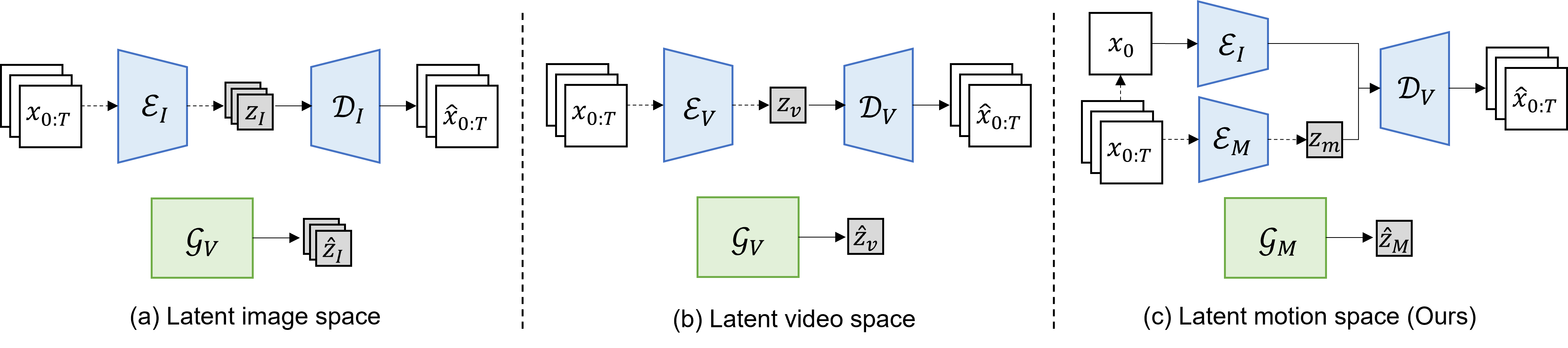
The video generation field has witnessed rapid improvements with the introduction of recent diffusion models. While these models have successfully enhanced appearance quality, they still face challenges in generating coherent and natural movements while efficiently sampling videos. In this paper, we propose to condense video generation into a problem of motion generation, to improve the expressiveness of motion and make video generation more manageable. This can be achieved by breaking down the video generation process into latent motion generation and video reconstruction. Specifically, we present a latent motion diffusion (LaMD) framework, which consists of a motion-decomposed video autoencoder and a diffusion-based motion generator, to implement this idea. Through careful design, the motion-decomposed video autoencoder can compress patterns in movement into a concise latent motion representation. Consequently, the diffusion-based motion generator is able to efficiently generate realistic motion on a continuous latent space under multi-modal conditions, at a cost that is similar to that of image diffusion models. Results show that LaMD generates high-quality videos on various benchmark datasets, including BAIR, Landscape, NATOPS, MUG and CATER-GEN, that encompass a variety of stochastic dynamics and highly controllable movements on multiple image-conditional video generation tasks, while significantly decreases sampling time.
Motivation & Objective
- To address the challenge of generating coherent, natural motion in video generation, which remains a key bottleneck despite advances in image generation.
- To reduce computational complexity and improve modeling efficiency by separating motion from visual content and operating in a compact latent motion space.
- To enable high-fidelity, controllable video generation under image-conditional and text-image-conditional conditions using a diffusion-based approach.
- To achieve sampling speeds comparable to image diffusion models while maintaining high perceptual quality and motion coherence.
Proposed method
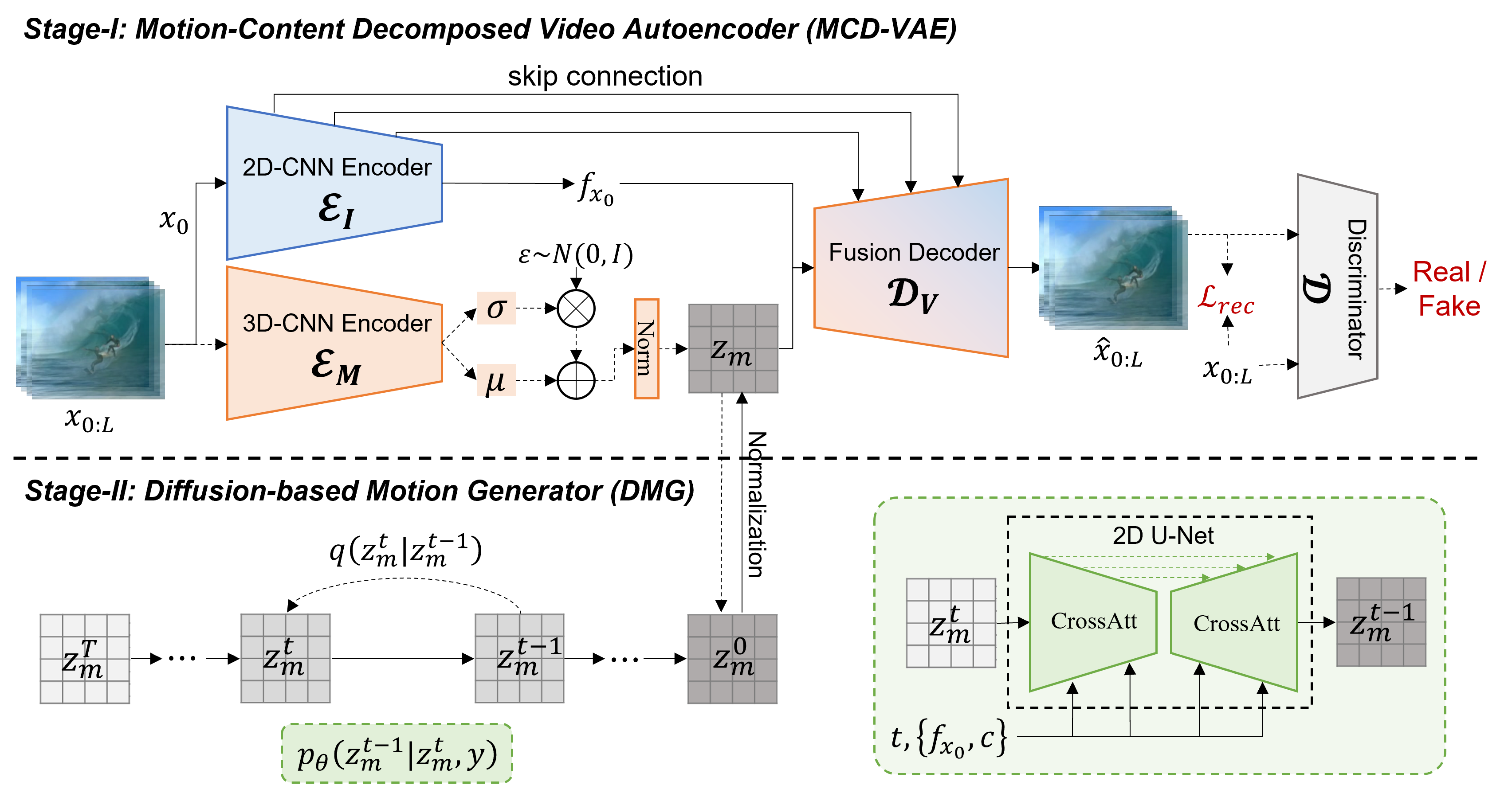
- The framework uses a Motion-Content Decomposed Video Autoencoder (MCD-VAE) that separates visual appearance from motion using a multi-scale image encoder, a lightweight motion encoder with an information bottleneck, and a video reconstruction decoder.
- Motion is compressed into a compact latent representation via a bottlenecked motion encoder, enabling efficient modeling of temporal dynamics.
- A diffusion-based motion generator (DMG) progressively denoises latent motion representations in continuous space, conditioned on content features and optional text.
- The DMG operates in a latent space with computational cost similar to image diffusion models, enabling fast sampling.
- The system supports image-to-video (I2V) and text-image-to-video (TI2V) generation, and extends to text-to-video (T2V) with pre-trained text-to-image models.
- The framework is trained end-to-end with reconstruction and denoising objectives, optimizing for motion realism and temporal consistency.
Experimental results
Research questions
- RQ1Can video generation be effectively reframed as motion generation in a compact latent space to improve coherence and reduce complexity?
- RQ2Can a diffusion-based motion generator produce realistic, diverse, and controllable motion with computational efficiency comparable to image diffusion models?
- RQ3Does separating motion from content via a motion-decomposed autoencoder lead to better reconstruction quality and motion expressiveness?
- RQ4Can the proposed framework achieve state-of-the-art performance on diverse benchmarks including stochastic dynamics and controllable movements?
Key findings
- LaMD achieves new state-of-the-art FVD scores on the BAIR, Landscape, and CATER-GENs benchmarks for image-to-video and text-image-to-video generation tasks.
- The diffusion-based motion generator (DMG) samples videos in approximately 9–11 seconds per video on a single RTX 3090 GPU, with sampling speed comparable to image diffusion models.
- The MCD-VAE achieves high reconstruction quality with effective compression of motion patterns into a compact latent representation.
- Ablation studies show that the motion-decomposed design enables better motion expressiveness and temporal coherence compared to end-to-end video diffusion models.
- The framework successfully generates diverse motions—from stochastic dynamics to highly controllable movements—under both image and text conditions.
- The latent motion space enables progressive refinement of motion during diffusion sampling, with chaotic motion at early denoising steps evolving into natural, coherent motion at inference end.
Read this paper
Open the full text in the Nubint reader and ask about any passage as you read.
Read this paper on NubintThis review was generated by AI from the original paper. Please check the paper before citing it.