
[Paper Review] Large-capacity and Flexible Video Steganography via Invertible Neural Network
This paper proposes LF-VSN, a large-capacity and flexible video steganography framework based on invertible neural networks (INNs) that enables reversible hiding and recovery of up to seven secret videos within a single cover video using a single model. The method achieves high security and performance through key-controllable recovery and scalable embedding, with stego video quality exceeding 35 dB and robust resistance to steganalysis tools.
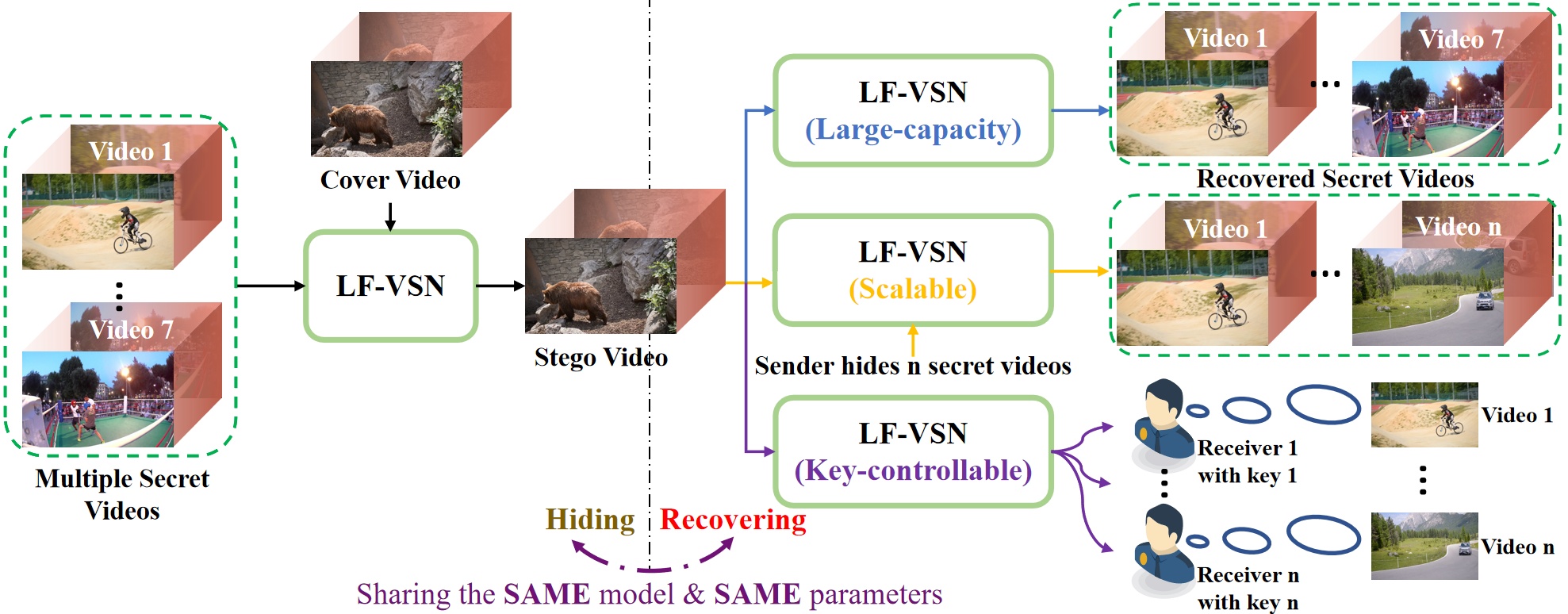
Video steganography is the art of unobtrusively concealing secret data in a cover video and then recovering the secret data through a decoding protocol at the receiver end. Although several attempts have been made, most of them are limited to low-capacity and fixed steganography. To rectify these weaknesses, we propose a Large-capacity and Flexible Video Steganography Network (LF-VSN) in this paper. For large-capacity, we present a reversible pipeline to perform multiple videos hiding and recovering through a single invertible neural network (INN). Our method can hide/recover 7 secret videos in/from 1 cover video with promising performance. For flexibility, we propose a key-controllable scheme, enabling different receivers to recover particular secret videos from the same cover video through specific keys. Moreover, we further improve the flexibility by proposing a scalable strategy in multiple videos hiding, which can hide variable numbers of secret videos in a cover video with a single model and a single training session. Extensive experiments demonstrate that with the significant improvement of the video steganography performance, our proposed LF-VSN has high security, large hiding capacity, and flexibility. The source code is available at https://github.com/MC-E/LF-VSN.
Motivation & Objective
- To address the limitations of existing video steganography methods, which suffer from low hiding capacity and rigid pipelines.
- To enable reversible hiding and recovery of multiple secret videos within a single cover video using a unified model.
- To introduce key-controllability, allowing different receivers to recover specific secret videos using unique keys.
- To design a scalable embedding strategy that supports variable numbers of secret videos with a single trained model.
- To achieve state-of-the-art performance in both steganographic capacity and security against steganalysis.
Proposed method
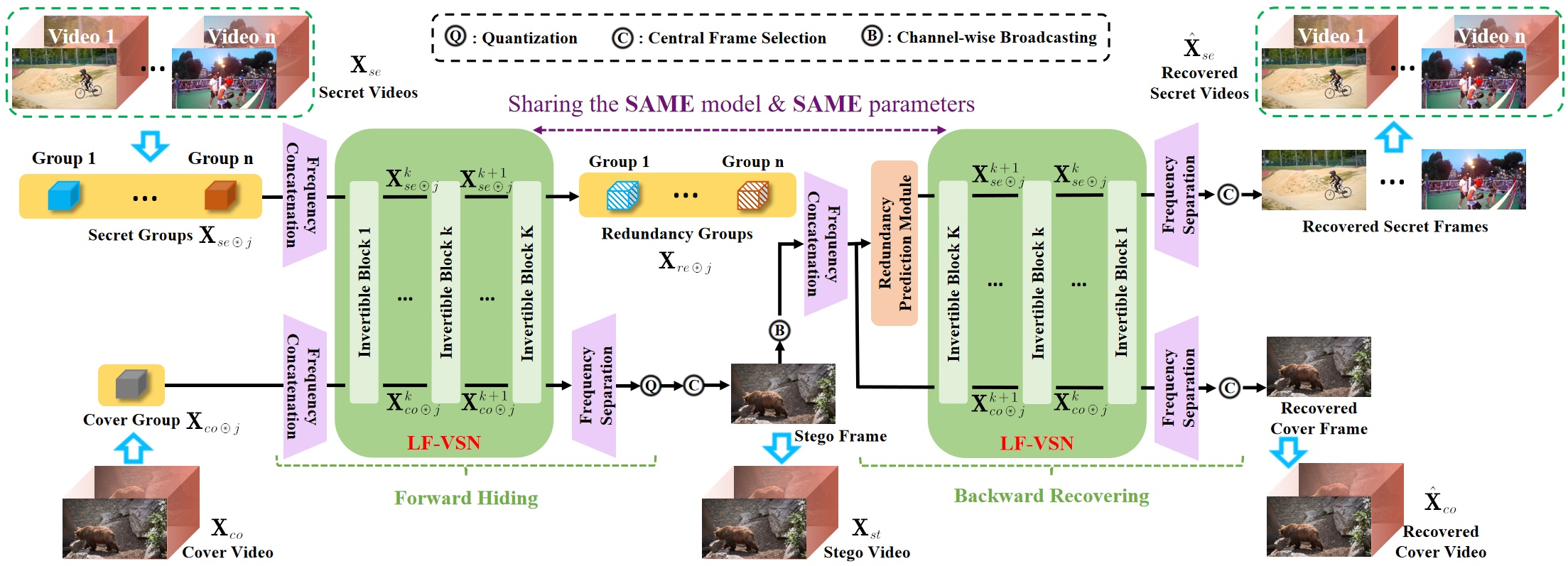
- The framework employs an invertible neural network (INN) to perform reversible encoding and decoding of multiple secret videos into a single cover video.
- A sliding window mechanism with a window size of 3 is used to exploit temporal correlations across video frames.
- Frequency concatenation via discrete wavelet transform (DWT) fuses features from input video groups in the frequency domain to improve information fusion.
- A redundancy prediction module (RPM) replaces random sampling in the backward process, enabling key-controllability and performance gains.
- The model uses weight-sharing across multiple video hiding tasks to reduce complexity while maintaining high capacity.
- A scalable design allows the same model to embed variable numbers of secret videos (up to 7) with a single training session.
Experimental results
Research questions
- RQ1Can a single invertible neural network model achieve reversible hiding and recovery of multiple secret videos in a cover video?
- RQ2How can key-controllability be integrated into a video steganography system to enable selective recovery by authorized receivers?
- RQ3Can a single model support variable numbers of secret videos without retraining, enhancing flexibility?
- RQ4What is the performance trade-off between fixed and scalable embedding designs in terms of video quality and security?
- RQ5How resistant is the proposed method to state-of-the-art steganalysis tools like StegExpose?
Key findings
- The proposed LF-VSN achieves a stego video quality of over 35 dB, with peak signal-to-noise ratio (PSNR) reaching 42.40 dB when hiding 7 secret videos.
- The method maintains high security, with steganalysis detection accuracy close to 50% (ideal), indicating strong resistance to detection by StegExpose.
- The key-controllable scheme enables different receivers to recover specific secret videos using unique keys, enhancing data security.
- The scalable design allows a single model to embed up to 7 secret videos with minimal performance degradation compared to fixed-configuration models.
- Ablation studies confirm that frequency concatenation via DWT improves PSNR by 1.7–1.91 dB, and RPM enhances both performance and key-controllability.
- The model achieves state-of-the-art performance in hiding capacity, flexibility, and security, with a parameter count significantly lower than prior 3D-CNN-based methods.
Read this paper
Open the full text in the Nubint reader and ask about any passage as you read.
Read this paper on NubintThis review was generated by AI from the original paper. Please check the paper before citing it.