
[Paper Review] Large Language Model (LLM) as a System of Multiple Expert Agents: An Approach to solve the Abstraction and Reasoning Corpus (ARC) Challenge
This paper proposes a system of multiple expert agents powered by large language models (LLMs) to solve the Abstraction and Reasoning Corpus (ARC) challenge. By converting input grids into multiple abstraction spaces—grid, object, and pixel—and using iterative environmental feedback, the method achieves 50 out of 111 (45%) training set solutions with zero-shot prompting and no fine-tuning, demonstrating the feasibility of LLMs as functional agents in program synthesis tasks.
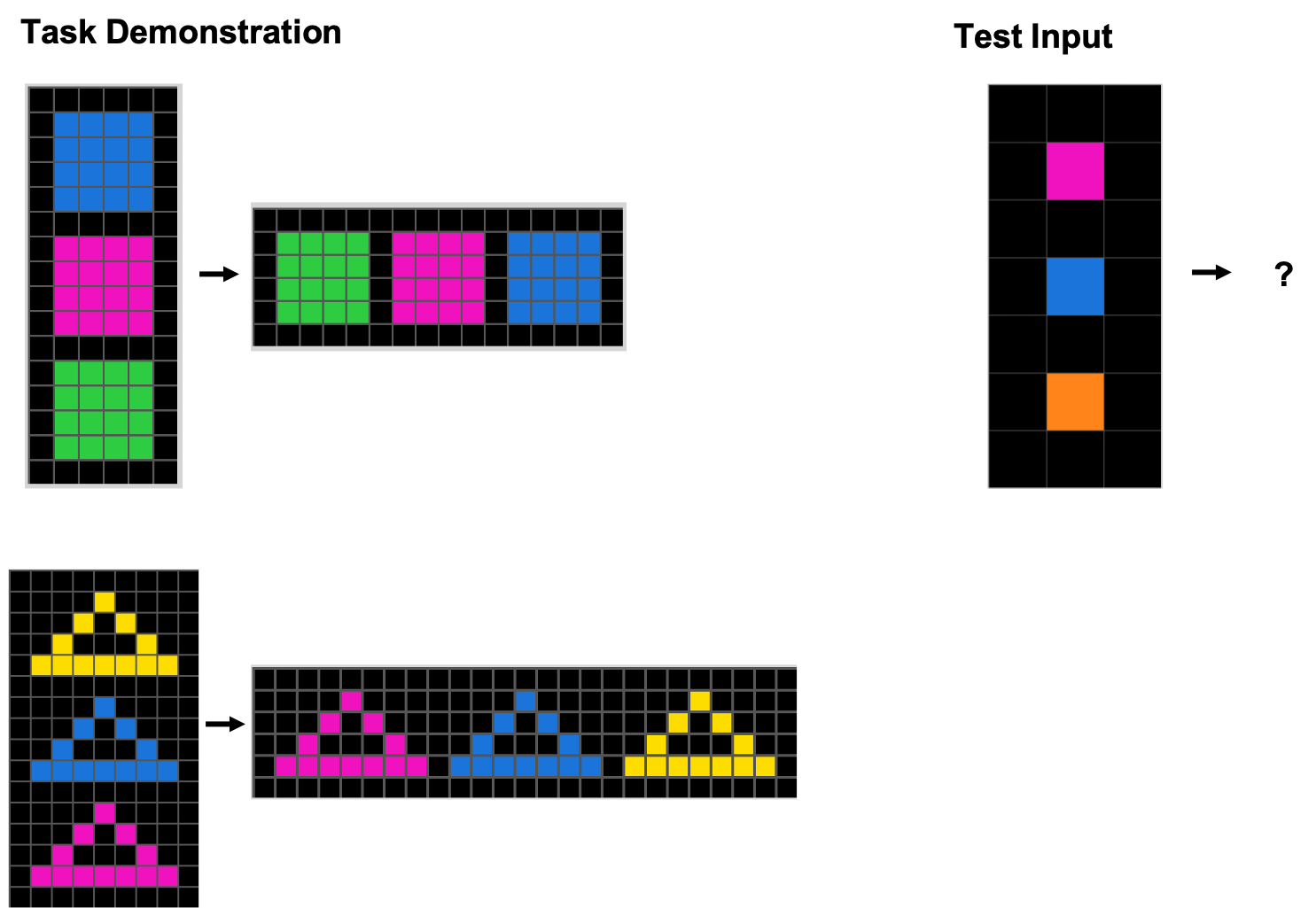
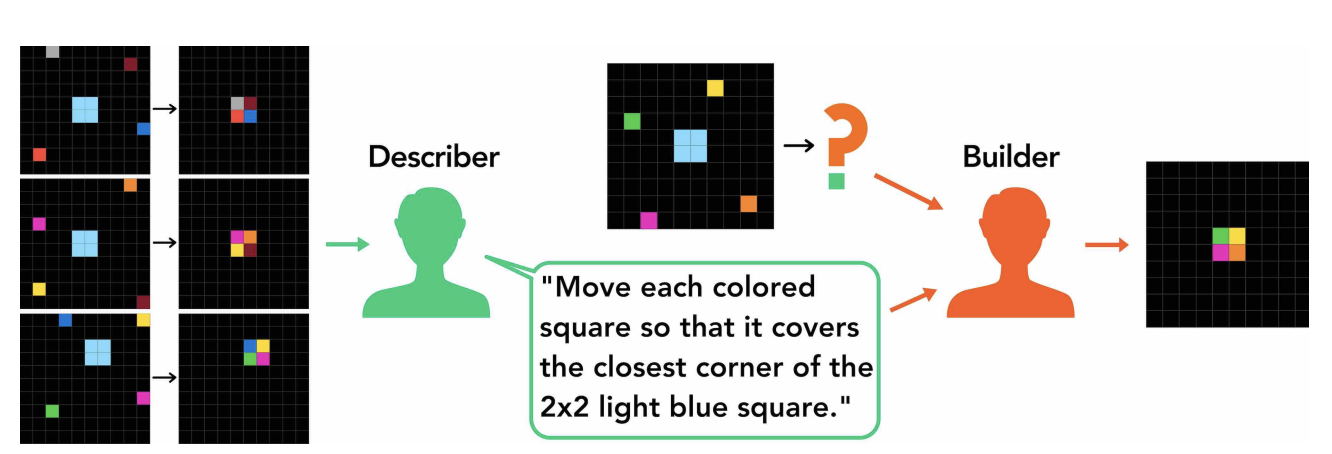
We attempt to solve the Abstraction and Reasoning Corpus (ARC) Challenge using Large Language Models (LLMs) as a system of multiple expert agents. Using the flexibility of LLMs to be prompted to do various novel tasks using zero-shot, few-shot, context-grounded prompting, we explore the feasibility of using LLMs to solve the ARC Challenge. We firstly convert the input image into multiple suitable text-based abstraction spaces. We then utilise the associative power of LLMs to derive the input-output relationship and map this to actions in the form of a working program, similar to Voyager / Ghost in the MineCraft. In addition, we use iterative environmental feedback in order to guide LLMs to solve the task. Our proposed approach achieves 50 solves out of 111 training set problems (45%) with just three abstraction spaces - grid, object and pixel - and we believe that with more abstraction spaces and learnable actions, we will be able to solve more.
Motivation & Objective
- To address the ARC challenge, which demands few-shot, abstract reasoning akin to human cognition, by leveraging LLMs as a system of expert agents.
- To explore the feasibility of using LLMs for program synthesis without pre-training, relying on zero-shot and few-shot prompting.
- To improve reasoning performance by grounding LLMs in multiple abstraction spaces (grid, object, pixel) and using environmental feedback.
- To demonstrate that iterative feedback and functional action spaces can guide LLMs toward correct program generation in visual reasoning tasks.
Proposed method
- Convert input grids into multiple abstraction spaces: grid (raw pixel), object (structured entities), and pixel (individual cell attributes).
- Use LLMs to infer input-output relationships and generate executable programs in a domain-specific language (DSL) via zero-shot, few-shot, and context-grounded prompting.
- Implement iterative environmental feedback: execute generated programs, observe output, and refine the program based on correctness or compilation errors.
- Introduce additional agent types such as object relations, edge detection, symmetry, difference, and diagonal views to enhance reasoning capabilities.
- Use code generation with primitive functions to simulate a skill library, mimicking systems like Voyager and Ghost in the Minecraft.
- Optimize prompts to reduce context length and improve focus, e.g., by explicitly highlighting differences between input and output grids.
Experimental results
Research questions
- RQ1Can LLMs function as a system of expert agents to solve the ARC challenge without pre-training?
- RQ2How effective are multiple abstraction spaces (grid, object, pixel) in improving LLM-based reasoning on visual tasks?
- RQ3To what extent can iterative environmental feedback improve program generation accuracy in LLM-based systems?
- RQ4Can functional action spaces grounded in program synthesis enable zero-shot reasoning in few-shot visual reasoning benchmarks?
- RQ5What additional abstraction views (e.g., symmetry, diagonal, edge detection) enhance LLM performance on ARC tasks?
Key findings
- The proposed method achieved 50 out of 111 (45%) solutions on the ARC training set using only three abstraction spaces: grid, object, and pixel.
- Iterative feedback enabled correction of incorrect outputs and compilation errors, with 6 tasks solved after incorrect output and 1 task solved after fixing a compilation error.
- Tasks requiring multi-step reasoning—such as modifying object color and removing objects—were successfully solved using iterative feedback.
- The inclusion of additional abstraction views (e.g., object relations, symmetry, difference) was shown to be beneficial, especially for complex or symmetry-based problems.
- The method demonstrated that LLMs can generate correct programs for visual transformations using only natural language prompting and environmental feedback, without fine-tuning.
- The approach outperformed baseline LLM-only text-to-program methods, suggesting that structured abstraction spaces and feedback loops are critical for success.
Read this paper
Open the full text in the Nubint reader and ask about any passage as you read.
Read this paper on NubintThis review was generated by AI from the original paper. Please check the paper before citing it.