
[Paper Review] Large Language Models are Zero-Shot Recognizers for Activities of Daily Living
The paper proposes ADL-LLM, an LLM-based system that converts smart-home sensor data into text and uses zero-shot (and optionally few-shot) prompting to recognize Activities of Daily Living without labeled data, evaluated on MARBLE and UCI ADL datasets.
The sensor-based recognition of Activities of Daily Living (ADLs) in smart home environments enables several applications in the areas of energy management, safety, well-being, and healthcare. ADLs recognition is typically based on deep learning methods requiring large datasets to be trained. Recently, several studies proved that Large Language Models (LLMs) effectively capture common-sense knowledge about human activities. However, the effectiveness of LLMs for ADLs recognition in smart home environments still deserves to be investigated. In this work, we propose ADL-LLM, a novel LLM-based ADLs recognition system. ADLLLM transforms raw sensor data into textual representations, that are processed by an LLM to perform zero-shot ADLs recognition. Moreover, in the scenario where a small labeled dataset is available, ADL-LLM can also be empowered with few-shot prompting. We evaluated ADL-LLM on two public datasets, showing its effectiveness in this domain.
Motivation & Objective
- Motivate sensor-based ADL recognition for smart homes to aid health and well-being applications.
- Propose ADL-LLM to transform sensor data into textual narratives and use LLM prompting for zero-shot recognition.
- Demonstrate that zero-shot ADL-LLM can match or exceed supervised approaches in data-scarce settings.
- Show that few-shot prompting improves performance when a small labeled dataset is available.
- Provide source code to ensure results are reproducible.
Proposed method
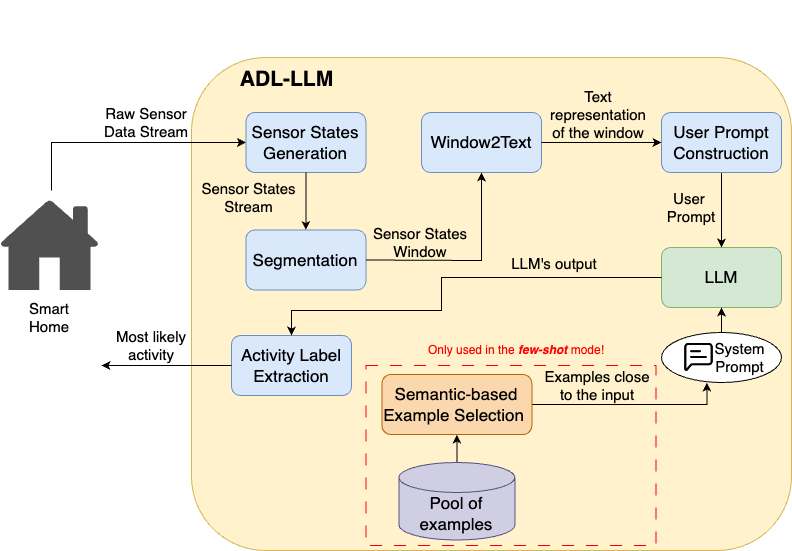
- Convert raw sensor streams into a sequence of sensor states.
- Segment sensor states into fixed-time windows with overlap.
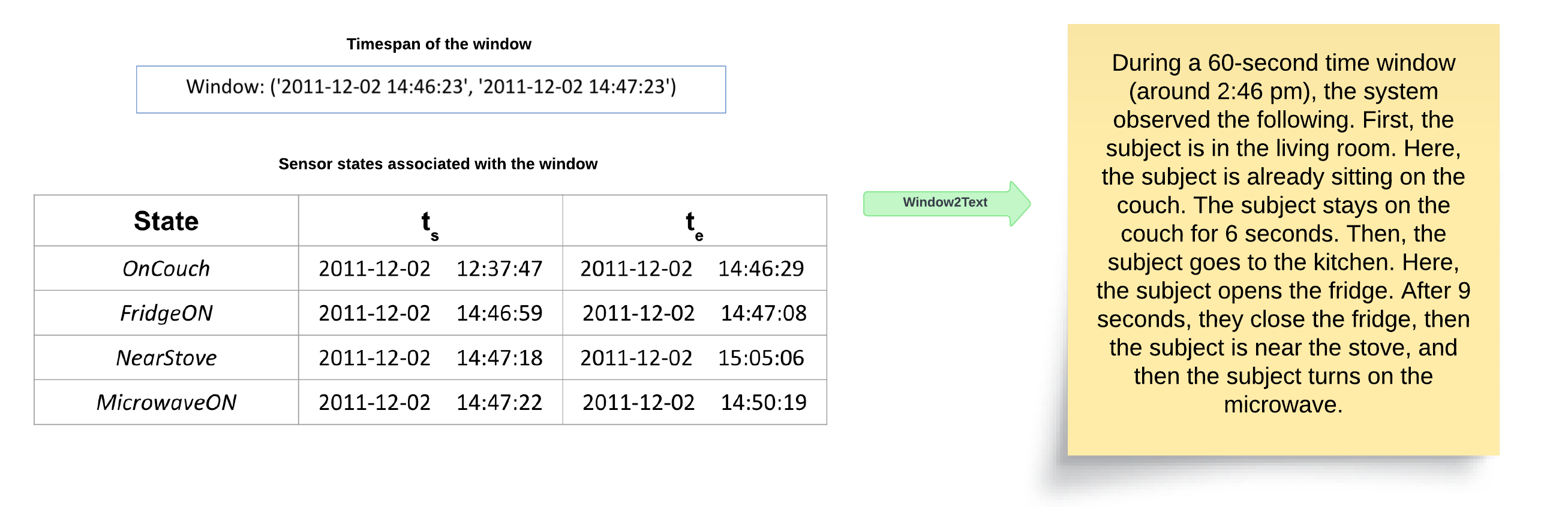
- Transform each window into a natural language description via Window2Text.
- Query an LLM with a system prompt and a window-specific user prompt to obtain activity predictions.
- Extract the activity label from LLM output using regular expressions and cosine similarity for fallback labels.
- Optionally enrich prompts with a Pool of Examples and semantic-based example selection for few-shot prompting.
- Use a cosine similarity-based embedding approach to select relevant examples for few-shot prompting.
Experimental results
Research questions
- RQ1Can an LLM recognize ADLs from textual representations of sensor data without labeled training data?
- RQ2Does few-shot prompting with semantically similar examples improve ADL recognition when small labeled data is available?
- RQ3How does zero-shot ADL-LLM compare to supervised baselines on public smart-home ADL datasets?
- RQ4What is the impact of different sensor modalities and home layouts on zero-shot LLM-based recognition?
Key findings
- ADL-LLM achieves competitive recognition rates in zero-shot mode compared to supervised baselines on public ADL datasets.
- Few-shot prompting with semantically selected examples further improves performance in data-scarce scenarios.
- The system relies on a modular pipeline that converts sensor streams to natural language descriptions before LLM reasoning.
- System prompts incorporate room locations and possible interactions to guide LLM reasoning.
- Regular-expression extraction with a cosine similarity fallback ensures robust activity labeling when LLM output deviates from expected labels.
Read this paper
Open the full text in the Nubint reader and ask about any passage as you read.
Read this paper on NubintThis review was generated by AI from the original paper. Please check the paper before citing it.