
[Paper Review] Large Language Models as Batteries-Included Zero-Shot ESCO Skills Matchers
This paper proposes a zero-shot, end-to-end pipeline for matching job description skills to the ESCO taxonomy using large language models (LLMs). It generates synthetic training data for 13,890 ESCO skills and uses a two-stage approach: candidate retrieval via embeddings followed by GPT-4 re-ranking, achieving a 22+ point improvement in RP@10 over prior methods without human annotations.
Understanding labour market dynamics requires accurately identifying the skills required for and possessed by the workforce. Automation techniques are increasingly being developed to support this effort. However, automatically extracting skills from job postings is challenging due to the vast number of existing skills. The ESCO (European Skills, Competences, Qualifications and Occupations) framework provides a useful reference, listing over 13,000 individual skills. However, skills extraction remains difficult and accurately matching job posts to the ESCO taxonomy is an open problem. In this work, we propose an end-to-end zero-shot system for skills extraction from job descriptions based on large language models (LLMs). We generate synthetic training data for the entirety of ESCO skills and train a classifier to extract skill mentions from job posts. We also employ a similarity retriever to generate skill candidates which are then re-ranked using a second LLM. Using synthetic data achieves an RP@10 score 10 points higher than previous distant supervision approaches. Adding GPT-4 re-ranking improves RP@10 by over 22 points over previous methods. We also show that Framing the task as mock programming when prompting the LLM can lead to better performance than natural language prompts, especially with weaker LLMs. We demonstrate the potential of integrating large language models at both ends of skills matching pipelines. Our approach requires no human annotations and achieve extremely promising results on skills extraction against ESCO.
Motivation & Objective
- To address the challenge of zero-shot skills matching against the large, fine-grained ESCO taxonomy with over 13,000 skills.
- To improve candidate generation for skill matching by leveraging synthetic data generated via LLMs, avoiding reliance on costly human-annotated datasets.
- To evaluate the effectiveness of LLMs as zero-shot rerankers in the final stage of a two-stage skill matching pipeline.
- To investigate whether framing the re-ranking task as a mock programming problem enhances performance, especially with weaker LLMs.
- To demonstrate that LLMs can serve as both synthetic data generators and high-performing rerankers in a scalable, battery-included pipeline.
Proposed method
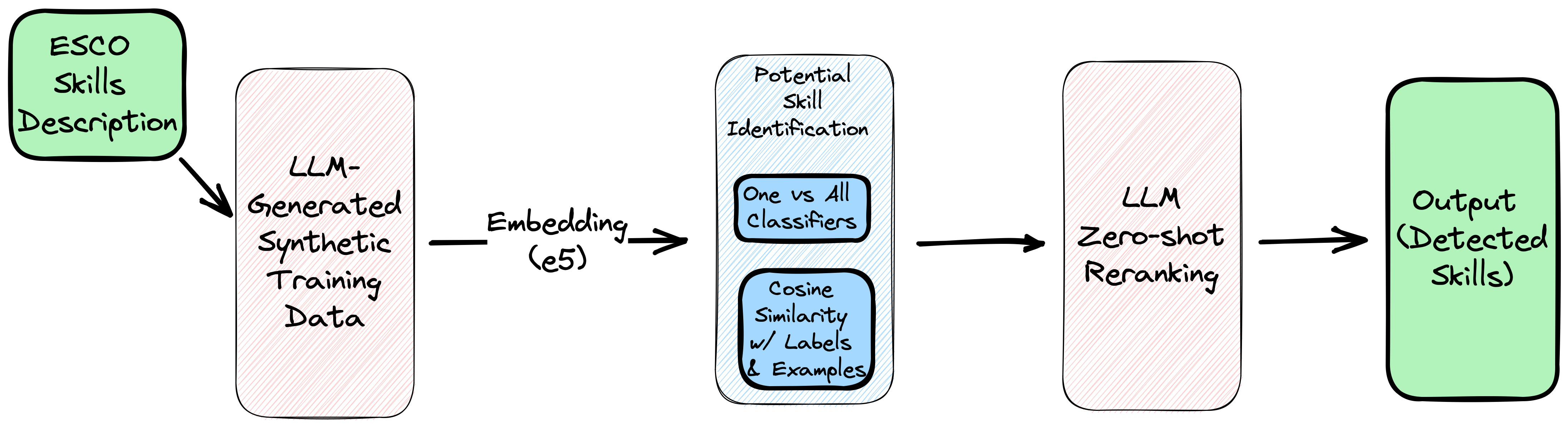
- Synthetic training data is generated by prompting GPT-3.5 to create diverse, realistic job descriptions containing all 13,890 ESCO skills.
- A dense retrieval model (e5) is used to generate initial candidate skill matches from job postings using semantic similarity.
- A linear classifier is trained on the synthetic data to predict potential skill mentions in job texts.
- GPT-4 performs zero-shot re-ranking of the candidate list by evaluating relevance and ranking them based on prompt-framed instructions.
- The re-ranking task is framed as a mock programming problem (e.g., 'return a list of matching skills') to improve reasoning and instruction-following, especially for weaker models.
- The pipeline combines synthetic data training, embedding-based retrieval, and LLM-powered re-ranking in an end-to-end, zero-shot setup.
Experimental results
Research questions
- RQ1Can LLMs generate high-quality synthetic training data that significantly improves zero-shot skill matching performance on the ESCO taxonomy?
- RQ2Does using a two-stage pipeline—candidate generation followed by LLM-based re-ranking—yield better results than single-stage approaches?
- RQ3Can framing the re-ranking task as a mock programming problem improve performance, particularly with less capable LLMs?
- RQ4How does the performance of the pipeline compare to prior distant supervision and weakly supervised methods in terms of RP@10?
- RQ5To what extent does the use of GPT-4 as a zero-shot reranker contribute to the overall performance gain?
Key findings
- Using synthetic data generated by GPT-3.5 improves the RP@10 score by 10 points over previous distant supervision methods.
- Adding GPT-4 as a zero-shot re-ranker increases the RP@10 score by over 22 points compared to prior state-of-the-art methods.
- Framing the re-ranking task as a mock programming problem leads to significant performance gains, especially when using weaker LLMs.
- The method achieves strong performance without any human-annotated data, relying solely on synthetic data and zero-shot LLM capabilities.
- The two-stage pipeline—candidate generation via classifier and retrieval, followed by LLM re-ranking—proves highly effective for extreme multi-label classification in low-resource settings.
- The approach is scalable and generalizable, with potential for integration into end-to-end job recommender systems.
Read this paper
Open the full text in the Nubint reader and ask about any passage as you read.
Read this paper on NubintThis review was generated by AI from the original paper. Please check the paper before citing it.