
[Paper Review] Large Language Models in Finance: A Survey
This survey provides a comprehensive overview of large language models (LLMs) in finance, evaluating techniques like zero-shot prompting, fine-tuning, and custom training on financial NLP tasks. It introduces a decision framework to guide practitioners in selecting LLM strategies based on data, compute, and performance constraints, offering a practical roadmap for responsible adoption in financial applications.
Recent advances in large language models (LLMs) have opened new possibilities for artificial intelligence applications in finance. In this paper, we provide a practical survey focused on two key aspects of utilizing LLMs for financial tasks: existing solutions and guidance for adoption. First, we review current approaches employing LLMs in finance, including leveraging pretrained models via zero-shot or few-shot learning, fine-tuning on domain-specific data, and training custom LLMs from scratch. We summarize key models and evaluate their performance improvements on financial natural language processing tasks. Second, we propose a decision framework to guide financial professionals in selecting the appropriate LLM solution based on their use case constraints around data, compute, and performance needs. The framework provides a pathway from lightweight experimentation to heavy investment in customized LLMs. Lastly, we discuss limitations and challenges around leveraging LLMs in financial applications. Overall, this survey aims to synthesize the state-of-the-art and provide a roadmap for responsibly applying LLMs to advance financial AI.
Motivation & Objective
- To synthesize the current state of large language models (LLMs) in financial applications, focusing on practical solutions and deployment strategies.
- To identify and evaluate key LLM techniques—such as zero-shot, few-shot, fine-tuning, and custom training—on financial NLP tasks.
- To address the gap in guidance for financial professionals by proposing a structured decision framework for selecting LLM solutions based on data, compute, and performance constraints.
- To highlight risks such as hallucination, bias, and lack of interpretability in LLMs within regulated financial environments.
- To provide a roadmap for responsible and scalable adoption of LLMs in finance, from lightweight experimentation to full customization.
Proposed method
- Surveying existing LLM applications in finance using a taxonomy of techniques: zero-shot/few-shot prompting, fine-tuning on domain-specific financial data, and training custom LLMs from scratch.
- Evaluating LLM performance on financial NLP tasks using standard metrics such as F1 score, precision, recall, MAPE, RMSE, and R², as well as domain-specific metrics like Sharpe Ratio and total profit in backtesting.
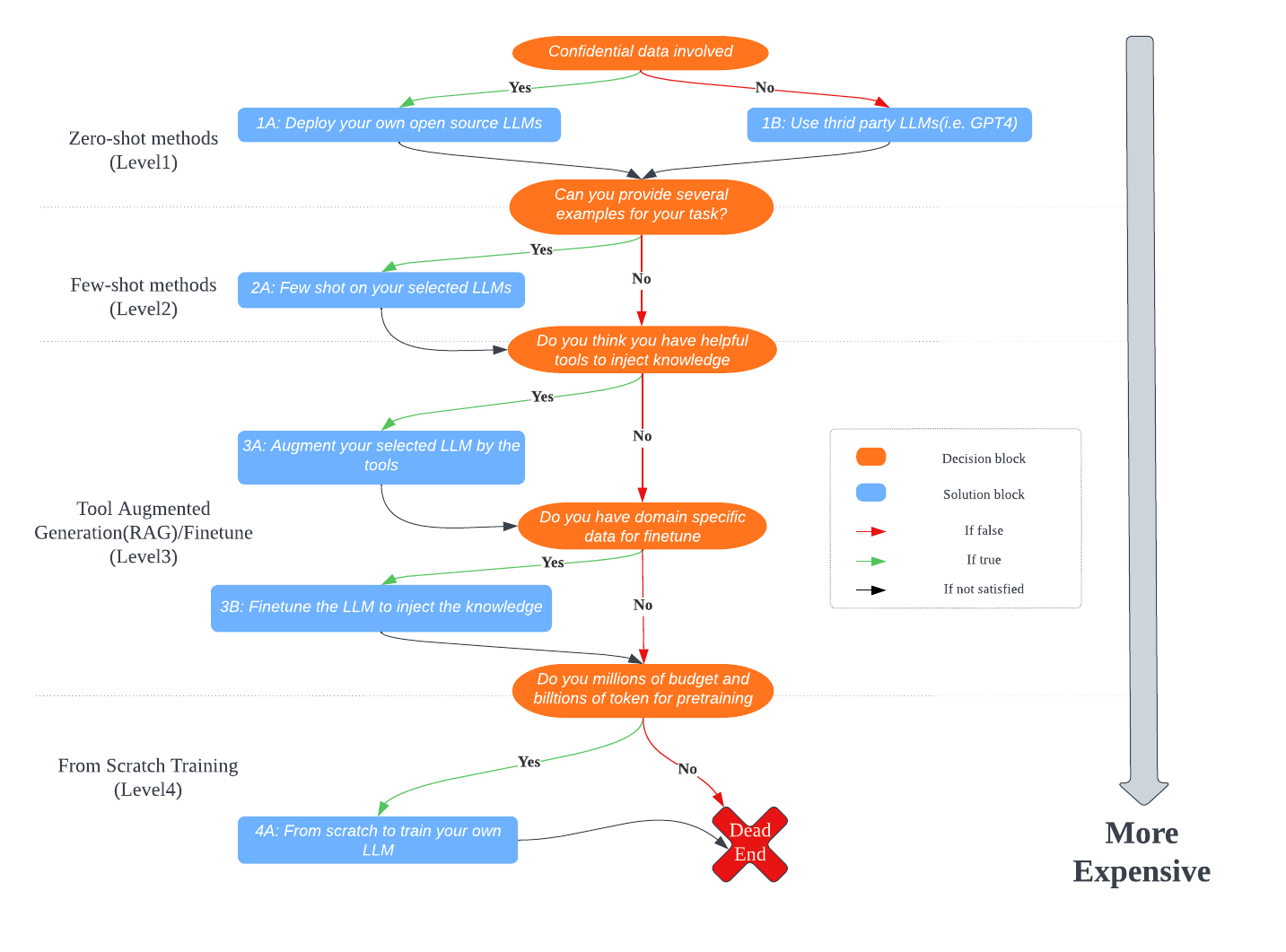
- Proposing a decision framework that guides practitioners through a progression from low-cost, off-the-shelf LLMs to high-investment, fine-tuned or custom models based on data availability, computational resources, and required performance.
- Applying retrieval-augmented generation (RAG) to reduce hallucination and improve factual accuracy in financial text generation.
- Using comprehensive evaluation systems—like the one from Liang et al. (2022)—to assess fairness, robustness, bias, and accuracy across multiple dimensions in LLM outputs.
- Analyzing limitations such as model hallucination, racial, gender, and religious biases, and the black-box nature of LLMs despite reasoning capabilities.
Experimental results
Research questions
- RQ1How do different LLM techniques—zero-shot, few-shot, fine-tuning, and custom training—perform on financial NLP tasks such as sentiment analysis, question answering, and summarization?
- RQ2What are the key trade-offs between cost, performance, and resource requirements when selecting an LLM strategy for financial applications?
- RQ3How can financial professionals systematically choose between off-the-shelf models, fine-tuned models, and custom LLMs based on their data and operational constraints?
- RQ4What are the primary risks of using LLMs in finance, including hallucination, bias, and lack of interpretability, and how can they be mitigated?
- RQ5To what extent do LLMs improve performance on financial tasks compared to general-purpose models, and how do performance metrics like Sharpe Ratio or profit align with accuracy metrics?
Key findings
- Fine-tuning general-purpose LLMs on domain-specific financial data leads to significant performance improvements on financial NLP tasks such as sentiment analysis, question answering, and summarization.
- Custom-trained LLMs outperform both general and fine-tuned models on specialized financial tasks, particularly when trained on large-scale, high-quality financial corpora.
- The proposed decision framework enables a scalable pathway from low-cost zero-shot inference to high-investment custom LLMs, aligning model choice with data availability, compute capacity, and performance needs.
- Retrieval-augmented generation (RAG) effectively reduces hallucination in financial text generation by grounding responses in external knowledge sources.
- Bias mitigation techniques such as content censorship and output restriction are effective in reducing racial, gender, and religious biases in LLM-generated financial content.
- Performance metrics like Sharpe Ratio and total profit in backtesting are critical for evaluating LLMs in trading applications, but must be aligned with accuracy metrics to prevent overfitting and ensure robustness.
Read this paper
Open the full text in the Nubint reader and ask about any passage as you read.
Read this paper on NubintThis review was generated by AI from the original paper. Please check the paper before citing it.