
[Paper Review] Large-scale multidisciplinary design optimization of the NASA lift-plus-cruise concept using a novel aircraft design framework
This paper presents CADDEE, a novel geometry-centric, differentiable aircraft design framework enabling large-scale multidisciplinary design optimization (MDO) of eVTOL aircraft. Using gradient-based optimization with over 100 design variables and low-fidelity physics models, CADDEE achieved an 11.4% reduction in gross weight for NASA's Lift+Cruise eVTOL concept in under one hour on a desktop computer, demonstrating its efficiency and scalability for early-phase eVTOL conceptual design.
The conceptual design of eVTOL aircraft is a high-dimensional optimization problem that involves large numbers of continuous design parameters. Therefore, eVTOL design method would benefit from numerical optimization algorithms capable of systematically searching these high-dimensional parameters spaces, using comprehensive and multidisciplinary models of the aircraft. By leveraging recent progress in sensitivity analysis methods, a computational framework called the Comprehensive Aircraft high-Dimensional DEsign Environment (CADDEE) has been developed for large-scale multidisciplinary design optimization (MDO) of electric air taxis. CADDEE uses a geometry-centric approach that propagates geometry changes in a differentiable manner to meshes for physics-based models of arbitrary fidelity level. The paper demonstrates the capabilities of this new aircraft design tool, by presenting large-scale MDO results for NASA's Lift+Cruise eVTOL concept. MDO with over 100 design variables, 17 constraints, and low-fidelity predictive models for key disciplines is demonstrated with an optimization time of less than one hour with a desktop computer. The results show a reduction in gross weight of 11.4% and suggest that CADDEE can be valuable in the conceptual design and optimization of eVTOL aircraft.
Motivation & Objective
- To address the limitations of traditional aircraft design frameworks in exploring the high-dimensional, uncharted design space of eVTOL vehicles.
- To develop a comprehensive, scalable MDO framework capable of handling hundreds of design variables with multidisciplinary physics-based models.
- To enable efficient, gradient-based optimization of eVTOL concepts using automated sensitivity analysis and differentiable geometry propagation.
- To validate the framework on a real-world eVTOL concept—NASA's Lift+Cruise—by identifying key design trade-offs and performance improvements.
- To demonstrate that low-fidelity models, when integrated with advanced sensitivity methods, can yield reliable and rapid optimization results in early conceptual design.
Proposed method
- CADDEE employs a geometry-centric design approach where changes to aircraft geometry are propagated differentially through smooth mappings to physics-based meshes and models.
- The framework uses an algebraic modeling language that automates adjoint-based sensitivity computation, enabling efficient gradient evaluation for large-scale optimization.
- Physics-based models for aerodynamics, propulsion, structures, and aeroacoustics are integrated at low fidelity, with key disciplines modeled using established methods like BEMT for rotors and XFOIL for airfoils.
- The optimization is solved using SNOPT, a sequential quadratic programming (SQP) algorithm, to handle the large number of variables and constraints efficiently.
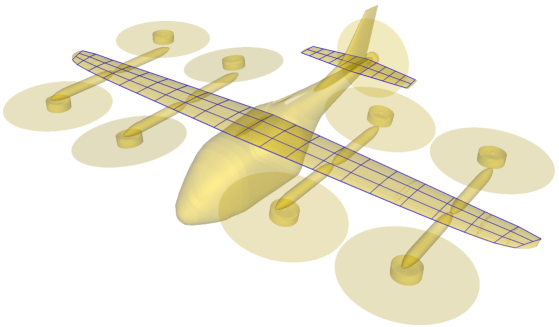
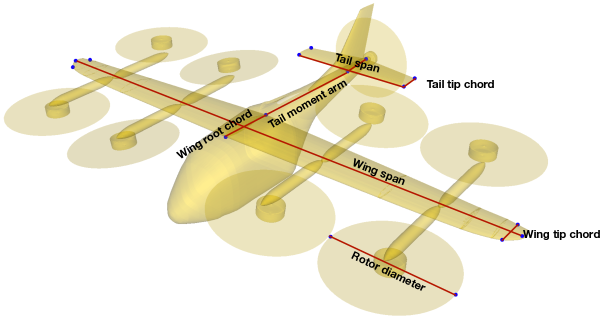
- Design variables include geometric parameters (e.g., wing span, rotor diameter, fuselage length), propulsion parameters (e.g., motor size, battery mass), and configuration layout.
- Constraints include rotor noise levels, structural weight, and handling qualities, with performance objectives focused on minimizing gross weight and maximizing range.
Experimental results
Research questions
- RQ1Can a differentiable, geometry-centric MDO framework efficiently explore high-dimensional design spaces for eVTOL aircraft with over 100 variables?
- RQ2To what extent can low-fidelity physics models, when combined with automated sensitivity analysis, produce reliable and rapid optimization results in early conceptual design?
- RQ3What are the dominant design drivers and limiting factors in the Lift+Cruise eVTOL configuration, such as rotor noise and battery technology?
- RQ4How does the framework’s computational efficiency compare to traditional methods when optimizing complex, multidisciplinary eVTOL concepts?
- RQ5Can the framework identify significant weight reductions and performance improvements in a single optimization run under realistic constraints?
Key findings
- The CADDEE framework achieved a 11.4% reduction in gross weight for the NASA Lift+Cruise eVTOL concept using over 100 design variables and 17 constraints.
- Optimization was completed in less than one hour on a standard desktop computer, demonstrating high computational efficiency.
- The framework successfully identified rotor noise and battery technology as key limiting factors in the design space, consistent with prior research.
- The use of differentiable geometry propagation enabled accurate and smooth sensitivity computation across all design variables, supporting robust gradient-based optimization.
- Low-fidelity models for propulsion, aerodynamics, and structures provided sufficient accuracy for early-phase optimization while maintaining computational tractability.
- The results validate CADDEE’s capability to perform large-scale, multidisciplinary optimization in the conceptual design phase, offering a scalable solution for emerging eVTOL platforms.
Read this paper
Open the full text in the Nubint reader and ask about any passage as you read.
Read this paper on NubintThis review was generated by AI from the original paper. Please check the paper before citing it.