
[Paper Review] Laser excitation of the $^{229}$Th nuclear isomeric transition in a solid-state host
This study reports the first laser spectroscopic observation of the 229Th nuclear isomeric transition in a solid-state host, specifically 229Th-doped LiSrAlF6 crystals, using a vacuum-ultraviolet laser system. A narrow, laser-linewidth-limited spectral feature at 148.38219(4) nm with a lifetime of 568(13) s is identified as the nuclear transition, confirming its energy at 8.355733(2) eV with high precision, marking a critical step toward a nuclear optical clock.
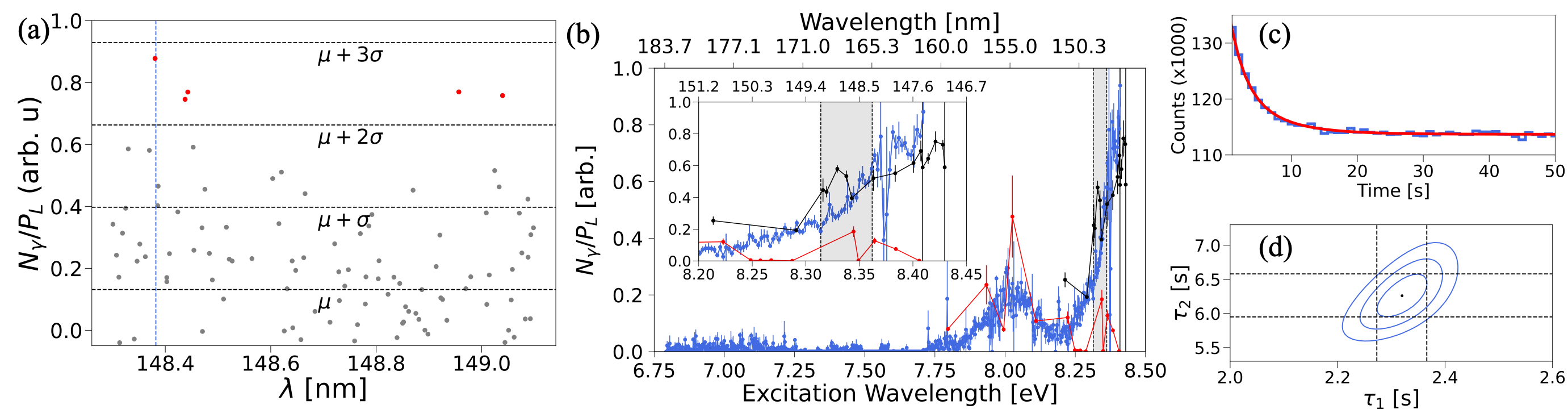
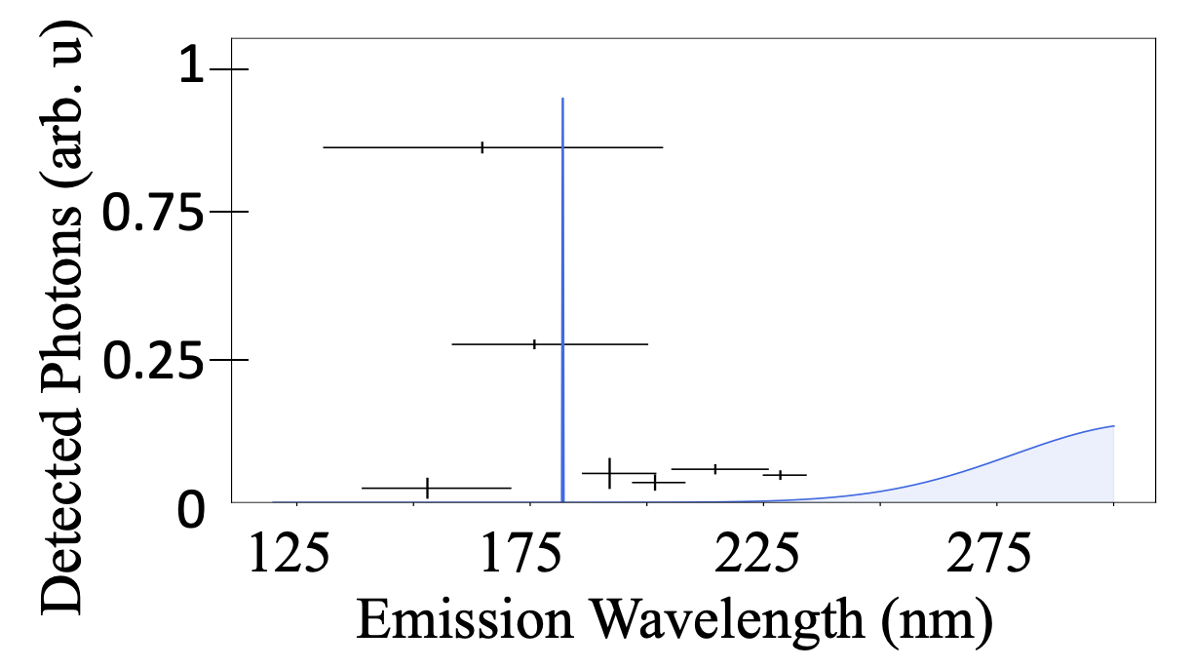
LiSrAlF$_6$ crystals doped with $^{229}$Th are used in a laser-based search for the nuclear isomeric transition. Two spectroscopic features near the nuclear transition energy are observed. The first is a broad excitation feature that produces red-shifted fluorescence that decays with a timescale of a few seconds. The second is a narrow, laser-linewidth-limited spectral feature at $148.38219(4)_{ extrm{stat}}(20)_{ extrm{sys}}$ nm ($2020407.3(5)_{ extrm{stat}}(30)_{ extrm{sys}}$ GHz) that decays with a lifetime of $568(13)_{ extrm{stat}}(20)_{ extrm{sys}}$ s. This feature is assigned to the excitation of the $^{229}$Th nuclear isomeric state, whose energy is found to be $8.355733(2)_{ extrm{stat}}(10)_{ extrm{sys}}$ eV in $^{229}$Th: hor:LiSrAlF$_6$.
Motivation & Objective
- To detect and precisely measure the 229Th nuclear isomeric transition in a solid-state crystal host using laser spectroscopy.
- To resolve long-standing uncertainty in the energy of the 229Th isomeric state with laser spectroscopic precision.
- To investigate the role of crystal environment and electron-nuclear coupling in the observed transition and fluorescence dynamics.
- To validate the feasibility of using doped insulators as platforms for future nuclear optical clocks.
- To distinguish nuclear transition signals from background fluorescence and chemical effects using isotopic controls (232Th-doped and undoped crystals).
Proposed method
- A vacuum-ultraviolet (VUV) laser system was used to excite 229Th-doped LiSrAlF6 crystals across the 147.43–182.52 nm range (6.793–8.410 eV).
- Fluorescence emission was monitored over time to identify spectral features and decay dynamics, with time-resolved measurements to extract lifetimes.
- Two distinct fluorescence components were observed: a broad feature with ~few-second decay and a narrow feature with laser-linewidth-limited linewidth.
- Isotopic controls (232Th-doped and undoped crystals) were used to confirm the nuclear origin of the narrow spectral feature.
- Ab initio crystal structure calculations were performed to model the coupling between the nuclear isomeric state and electronic/phononic degrees of freedom in the host lattice.
- A theoretical model was developed to explain the observed red-shifted fluorescence via hyperfine interaction (HFI)-mediated coupling between the nuclear state and valence band electron-hole excitations.
Experimental results
Research questions
- RQ1Can the 229Th nuclear isomeric transition be directly observed and precisely measured using laser spectroscopy in a solid-state host?
- RQ2What is the precise energy and lifetime of the 229Th nuclear isomeric state in LiSrAlF6, and how does it compare to previous measurements?
- RQ3Why is only a fraction of the 229Th doping population contributing to the narrow, laser-linewidth-limited transition?
- RQ4What is the origin of the broad, red-shifted fluorescence observed in 229Th-doped crystals?
- RQ5How do electron-nuclear and vibronic couplings in the crystal host affect the radiative decay rate and spectral properties of the nuclear transition?
Key findings
- A narrow, laser-linewidth-limited spectral feature at 148.38219(4) nm (statistical) ±20 nm (systematic) was observed, assigned to the 229Th nuclear isomeric transition.
- The transition exhibits a lifetime of 568(13) s (statistical) ±20 s (systematic), consistent with a long-lived nuclear isomeric state.
- The energy of the 229Th nuclear isomeric state in LiSrAlF6 was determined to be 8.355733(2) eV (statistical) ±10 meV (systematic).
- The narrow feature was absent in 232Th-doped and undoped LiSrAlF6 crystals, confirming its assignment to 229Th nuclear excitation.
- Broad fluorescence with ~few-second decay was observed in 229Th-doped crystals but not in 232Th-doped or undoped crystals, indicating a non-radiative decay pathway involving electronic and lattice degrees of freedom.
- Ab initio calculations and a theoretical model suggest that hyperfine interaction mediates coupling between the nuclear isomeric state and valence band electron-hole excitations, explaining the red-shifted fluorescence and partial quenching of the nuclear transition.
Read this paper
Open the full text in the Nubint reader and ask about any passage as you read.
Read this paper on NubintThis review was generated by AI from the original paper. Please check the paper before citing it.