
[Paper Review] Laser-induced topological spin switching in a 2D van der Waals magnet
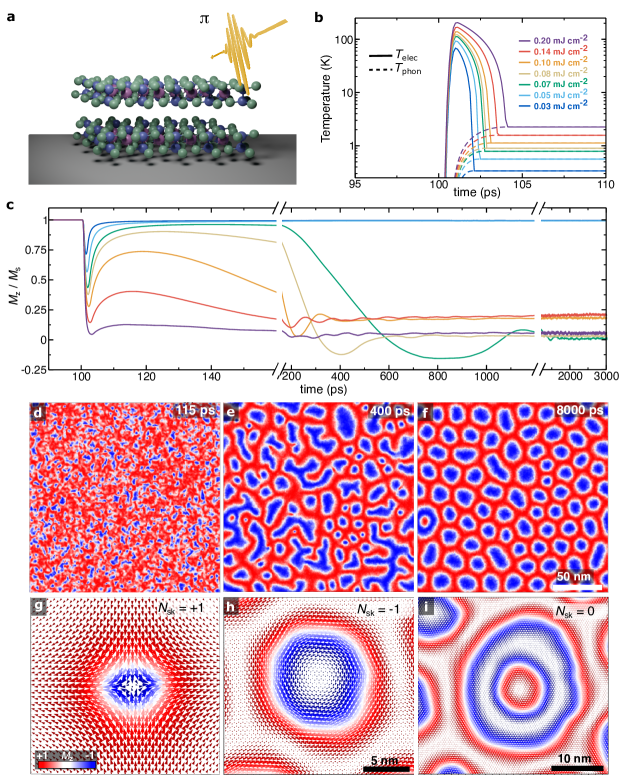
This study demonstrates laser-induced, reversible topological spin switching in 2D CrGeTe₃ van der Waals magnets using femtosecond laser pulses. By exploiting laser-driven electron heating and spin dynamics, the researchers achieve ultrafast, tunable generation and toggle switching between skyrmions, anti-skyrmions, skyrmioniums, and stripe domains within picoseconds, with control via laser energy and external magnetic fields.
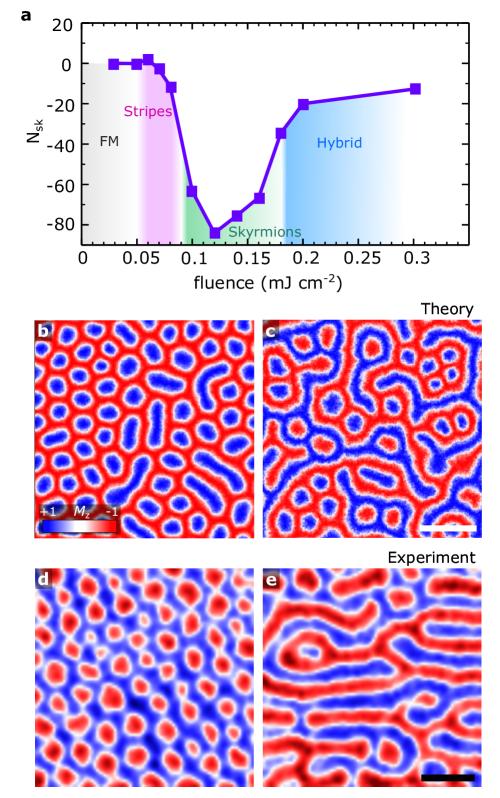
Two-dimensional (2D) van der Waals (vdW) magnets represent one of the most promising horizons for energy-efficient spintronic applications because their broad range of electronic, magnetic and topological properties. Of particular interest is the control of the magnetic properties of 2D materials by femtosecond laser pulses which can provide a real path for low-power consumption device platforms in data storage industries. However, little is known about the interplay between light and spin properties in vdW layers. Here, combining large-scale spin dynamics simulations including biquadratic exchange interactions and wide-field Kerr microscopy (WFKM), we show that ultrafast laser excitation can not only generate different type of spin textures in CrGeTe$_3$ vdW magnets but also induce a reversible transformation between them in a toggle-switch mechanism. Our calculations show that skyrmions, anti-skyrmions, skyrmioniums and stripe domains can be generated via high-intense laser pulses within the picosecond regime. The effect is tunable with the laser energy where different spin behaviours can be selected, such as fast demagnetisation process ($\sim$250 fs) important for information technologies. The phase transformation between the different topological spin textures is obtained as additional laser pulses are applied to the system where the polarisation and final state of the spins can be controlled by external magnetic fields. We experimentally confirmed the creation, manipulation and toggle switching phenomena in CrGeTe$_3$ due to the unique aspect of laser-induced heating of electrons. Our results indicate laser-driven spin textures on 2D magnets as a pathway towards ultrafast reconfigurable architecture at the atomistic level.
Motivation & Objective
- To explore the feasibility of using ultrafast laser pulses to induce and control topological spin textures in 2D van der Waals magnets.
- To investigate the interplay between light excitation and spin dynamics in centrosymmetric CrGeTe₃, a material where such effects were previously unreported.
- To demonstrate experimentally and theoretically that laser pulses can generate and reversibly switch between distinct topological spin states with high tunability.
- To establish a pathway for all-optical, ultrafast, and reconfigurable spintronic devices based on atomically thin magnetic materials.
Proposed method
- Large-scale spin dynamics simulations using the Landau-Lifshitz-Gilbert (LLG) equation coupled with a two-temperature model (2TM) to describe electron and lattice heating after femtosecond laser excitation.
- Incorporation of biquadratic exchange interactions and Dzyaloshinskii-Moriya interactions in the spin Hamiltonian to accurately model magnetic anisotropy and topological textures in CrGeTe₃.
- Wide-field Kerr microscopy (WFKM) in polar geometry to experimentally detect out-of-plane magnetization and image topological spin textures in real space.
- Use of 1035 nm linearly polarized laser pulses (300 fs, 1 MHz) focused to a 100 µm spot at 45° incidence to induce spin texture formation and switching.
- Topological charge calculation via the triangulation method on discrete spin lattices to identify skyrmions (N_sk = -1), anti-skyrmions (N_sk = +1), and skyrmioniums (N_sk = 0).
- Systematic variation of laser pulse energy and number of pulses to tune the resulting spin texture and verify reversibility under external magnetic fields.
Experimental results
Research questions
- RQ1Can ultrafast laser pulses induce the formation of topologically non-trivial spin textures such as skyrmions and anti-skyrmions in 2D van der Waals magnets like CrGeTe₃?
- RQ2Is the laser-induced transformation between different spin textures reversible and controllable via external magnetic fields?
- RQ3What is the role of laser pulse energy and number of pulses in determining the final spin texture and its topological character?
- RQ4How does the time evolution of spin dynamics after laser excitation lead to stable topological textures on the picosecond timescale?
- RQ5To what extent can the two-temperature model (2TM) coupled with LLG simulations accurately predict the experimental outcomes in ultrafast spintronic phenomena?
Key findings
- Ultrafast laser pulses (300 fs, 1035 nm) induce the formation of skyrmions, anti-skyrmions, skyrmioniums, and stripe domains in CrGeTe₃ within the picosecond regime.
- The topological spin textures are stable after thermal equilibration and can be reversibly switched between different states using additional laser pulses.
- The transformation between skyrmions and stripe domains is experimentally observed and confirmed via wide-field Kerr microscopy, with switching fidelity maintained over multiple cycles.
- Laser pulse energy enables tunable control over the final spin texture, with a fast demagnetization process occurring in ~250 fs, suitable for low-power information technologies.
- External magnetic fields control the polarity of the final spin state, enabling deterministic switching between chiralities of skyrmions and anti-skyrmions.
- Theoretical simulations using the LLG-2TM model show excellent agreement with experimental data, validating the approach for simulating long-timescale spin dynamics after ultrafast excitation.
Read this paper
Open the full text in the Nubint reader and ask about any passage as you read.
Read this paper on NubintThis review was generated by AI from the original paper. Please check the paper before citing it.