
[Paper Review] Last One Standing: A Comparative Analysis of Security and Privacy of Soft Prompt Tuning, LoRA, and In-Context Learning
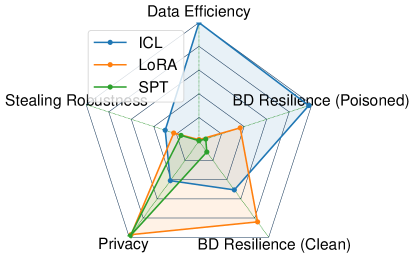
This paper conducts a systematic comparative analysis of Soft Prompt Tuning (SPT), LoRA, and In-Context Learning (ICL) in terms of their privacy and security properties. It evaluates their resilience against membership inference, backdoor, and model stealing attacks across three LLM architectures and four NLP datasets, revealing that no single method is universally secure or private, with ICL being most vulnerable to membership inference, LoRA/SPT more susceptible to backdoors, and all three vulnerable to model stealing.
Large Language Models (LLMs) are powerful tools for natural language processing, enabling novel applications and user experiences. However, to achieve optimal performance, LLMs often require adaptation with private data, which poses privacy and security challenges. Several techniques have been proposed to adapt LLMs with private data, such as Low-Rank Adaptation (LoRA), Soft Prompt Tuning (SPT), and In-Context Learning (ICL), but their comparative privacy and security properties have not been systematically investigated. In this work, we fill this gap by evaluating the robustness of LoRA, SPT, and ICL against three types of well-established attacks: membership inference, which exposes data leakage (privacy); backdoor, which injects malicious behavior (security); and model stealing, which can violate intellectual property (privacy and security). Our results show that there is no silver bullet for privacy and security in LLM adaptation and each technique has different strengths and weaknesses.
Motivation & Objective
- To systematically evaluate the privacy and security properties of three prominent LLM adaptation techniques: SPT, LoRA, and ICL.
- To assess their resilience against three major threats: membership inference attacks (privacy), backdoor attacks (security), and model stealing attacks (privacy and security).
- To identify the strengths and weaknesses of each method in real-world deployment scenarios involving private or sensitive data.
- To provide actionable insights for practitioners on selecting adaptation techniques based on threat models and threat surfaces.
Proposed method
- The study evaluates SPT, LoRA, and ICL on three LLM architectures: GPT2, GPT2-XL, and LLaMA.
- It uses four benchmark NLP datasets: DBPedia, AGNews, TREC, and SST-2 to assess performance across diverse tasks.
- Membership inference attacks (MIAs) are applied to measure data leakage risks, with attack success rates used as a privacy metric.
- Backdoor attacks are evaluated by poisoning training data with triggers and measuring attack success rate (ASR) and utility degradation.
- Model stealing attacks are simulated by measuring how easily an adversary can replicate the adapted model using query-based or data-based imitation.
- Experiments vary poisoning rates (0.25, 0.5, 0.75) and test trigger placement (first vs. last demonstration) to assess robustness.
Experimental results
Research questions
- RQ1How do SPT, LoRA, and ICL compare in their resilience to membership inference attacks?
- RQ2What is the susceptibility of each adaptation method to backdoor attacks under varying poisoning rates?
- RQ3How vulnerable are these methods to model stealing attacks, especially when using synthetic data like GPT-3.5-generated examples?
- RQ4Does the location of poisoned examples within the input prompt affect backdoor success in ICL?
- RQ5How do model size and architecture influence the security and privacy properties of these adaptation techniques?
Key findings
- ICL shows the highest vulnerability to membership inference attacks, with significantly higher success rates compared to LoRA and SPT.
- LoRA and SPT exhibit increasing attack success rates with higher poisoning rates in backdoor attacks, while ICL remains close to random guessing across all poisoning levels.
- All three methods are highly vulnerable to model stealing attacks, with GPT-3.5-generated data enabling high-fidelity model replication.
- The location of poisoned examples (first vs. last in prompt) has a minimal impact on backdoor success in ICL, indicating limited influence of input order on trigger effectiveness.
- SPT and LoRA show strong backdoor success rates, especially at higher poisoning rates, while ICL remains robust due to reliance on intrinsic model knowledge over few-shot demonstrations.
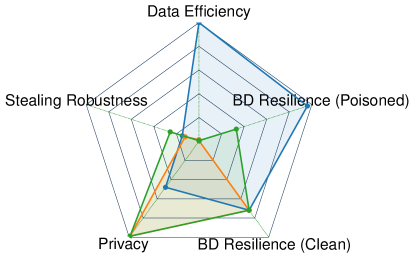
- Despite their computational efficiency, none of the methods offer a universal privacy or security advantage, highlighting the need for tailored defenses.
Read this paper
Open the full text in the Nubint reader and ask about any passage as you read.
Read this paper on NubintThis review was generated by AI from the original paper. Please check the paper before citing it.