
[Paper Review] LCCNet: LiDAR and Camera Self-Calibration using Cost Volume Network
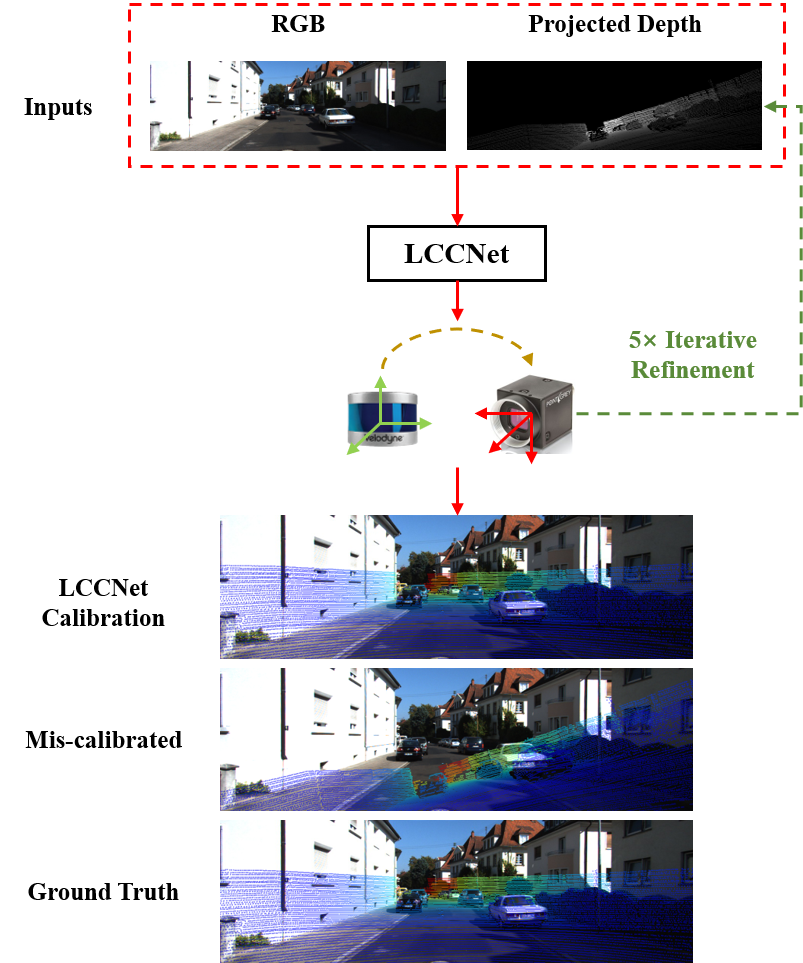
LCCNet is an end-to-end deep learning framework for online LiDAR-camera self-calibration that uses a cost volume layer to model cross-sensor feature correlations between RGB and depth images. It achieves a mean absolute calibration error of 0.297 cm in translation and 0.017° in rotation under large miscalibration ranges (±1.5m, ±20°), outperforming state-of-the-art learning-based methods with real-time inference at 24ms per iteration on a single GPU.
In this paper, we propose a novel online self-calibration approach for Light Detection and Ranging (LiDAR) and camera sensors. Compared to the previous CNN-based methods that concatenate the feature maps of the RGB image and decalibrated depth image, we exploit the cost volume inspired by the PWC-Net for feature matching. Besides the smooth L1-Loss of the predicted extrinsic calibration parameters, an additional point cloud loss is applied. Instead of regress the extrinsic parameters between LiDAR and camera directly, we predict the decalibrated deviation from initial calibration to the ground truth. During inference, the calibration error decreases further with the usage of iterative refinement and the temporal filtering approach. The evaluation results on the KITTI dataset illustrate that our approach outperforms CNN-based state-of-the-art methods in terms of a mean absolute calibration error of 0.297cm in translation and 0.017° in rotation with miscalibration magnitudes of up to 1.5m and 20°.
Motivation & Objective
- To address the limitations of manual, marker-based LiDAR-camera calibration, which is time-consuming and unsuitable for real-world deployment.
- To develop an online, self-calibrating method that maintains high accuracy despite sensor drift during autonomous vehicle operation.
- To improve calibration accuracy and robustness over existing learning-based methods by modeling cross-sensor feature correlations explicitly.
- To enable real-time inference with low latency for deployment in dynamic autonomous driving environments.
Proposed method
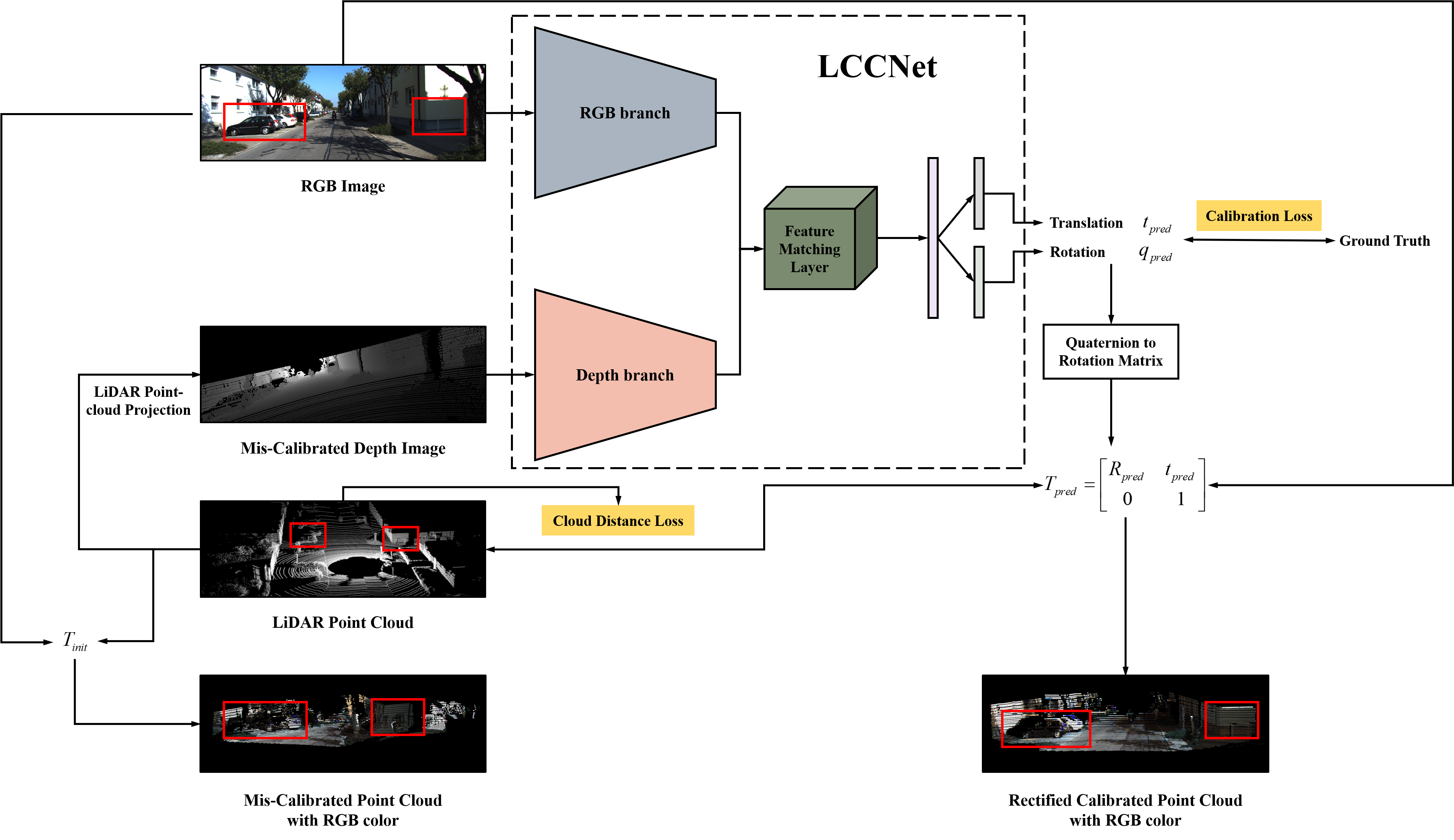
- LCCNet employs a three-part architecture: a feature extraction network, a cost volume layer for matching RGB and depth features, and a global feature aggregation network for regression.
- The cost volume layer encodes the correlation between RGB image features and depth features projected from LiDAR point clouds, enabling structured feature matching.
- Instead of regressing absolute extrinsic parameters, the network predicts the deviation from an initial calibration to the ground truth, improving training stability.
- A multi-task loss is used: smooth L1-loss on predicted extrinsic parameters and a self-supervised point cloud distance loss to enhance geometric consistency.
- Iterative refinement is applied during inference, where the network re-projects point clouds using predicted parameters and refines estimates over multiple iterations.
- Temporal filtering across multiple frames further reduces calibration error, improving robustness and accuracy.
Experimental results
Research questions
- RQ1Can a deep learning model achieve accurate, end-to-end LiDAR-camera self-calibration without relying on artificial markers or manual setup?
- RQ2How can cross-sensor feature correlation between RGB and depth images be effectively modeled to improve calibration accuracy?
- RQ3Can iterative refinement and multi-frame analysis significantly reduce calibration error in real-time applications?
- RQ4Does incorporating a self-supervised point cloud distance loss improve robustness to initial calibration errors and sensor drift?
Key findings
- LCCNet achieves a mean absolute translation error of 0.297 cm (X: 0.262 cm, Y: 0.271 cm, Z: 0.357 cm) and a mean absolute rotation error of 0.017° (roll: 0.020°, pitch: 0.012°, yaw: 0.019°) on the KITTI-odometry dataset.
- The method maintains high accuracy even under large miscalibration ranges of ±1.5 m in translation and ±20° in rotation, outperforming prior learning-based methods.
- The network runs in 24 ms per iteration on a single GPU, demonstrating real-time inference capability suitable for online deployment.
- Iterative refinement with five iterations and multi-frame temporal filtering significantly reduces calibration error, improving robustness to initial parameter deviation.
- The self-supervised point cloud distance loss enhances generalization and reduces sensitivity to initial calibration errors, as shown by consistent error distributions across different initializations.
- LCCNet surpasses state-of-the-art methods such as Regnet and Calibnet in both accuracy and robustness, especially under large miscalibration conditions.
Read this paper
Open the full text in the Nubint reader and ask about any passage as you read.
Read this paper on NubintThis review was generated by AI from the original paper. Please check the paper before citing it.