
[Paper Review] Learning an evolved mixture model for task-free continual learning
This paper proposes the Evolved Mixture Model (EEM), a task-free continual learning framework that dynamically expands its architecture using Hilbert Schmidt Independence Criterion (HSIC) to detect data distribution shifts and trigger expert addition. It combines VAE-based experts with two dropout mechanisms to manage memory and avoid catastrophic forgetting, achieving state-of-the-art performance on MNIST, CIFAR, and ImageNet benchmarks without task boundaries.
Recently, continual learning (CL) has gained significant interest because it enables deep learning models to acquire new knowledge without forgetting previously learnt information. However, most existing works require knowing the task identities and boundaries, which is not realistic in a real context. In this paper, we address a more challenging and realistic setting in CL, namely the Task-Free Continual Learning (TFCL) in which a model is trained on non-stationary data streams with no explicit task information. To address TFCL, we introduce an evolved mixture model whose network architecture is dynamically expanded to adapt to the data distribution shift. We implement this expansion mechanism by evaluating the probability distance between the knowledge stored in each mixture model component and the current memory buffer using the Hilbert Schmidt Independence Criterion (HSIC). We further introduce two simple dropout mechanisms to selectively remove stored examples in order to avoid memory overload while preserving memory diversity. Empirical results demonstrate that the proposed approach achieves excellent performance.
Motivation & Objective
- To address the challenge of continual learning without task identities or boundaries, a realistic but underexplored setting in lifelong AI.
- To overcome memory overload and negative backward transfer in memory-based continual learning by introducing selective sample dropout mechanisms.
- To enable dynamic model expansion in response to data distribution shifts without relying on task labels.
- To develop a scalable, infinite-capacity continual learning system that preserves knowledge across non-stationary data streams.
- To demonstrate the effectiveness of HSIC as an unsupervised signal for mixture model expansion in the absence of class labels.
Proposed method
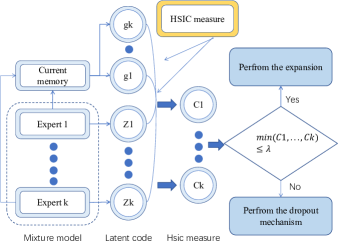
- The model uses a mixture of VAE-based experts for representation learning and a classifier for prediction, forming a dynamic ensemble architecture.
- A novel expansion mechanism evaluates the HSIC between each expert's knowledge and the current memory buffer to detect distribution shifts and trigger new expert creation.
- Two dropout mechanisms selectively remove stored examples from the memory buffer to prevent overload and maintain diversity.
- The expansion threshold is controlled by a hyperparameter λ, which balances model complexity and performance.
- The classifier is updated using a batch of 10 samples per step, with all prior data inaccessible, simulating a real-time streaming setting.
- The framework is trained end-to-end with no task boundaries, relying solely on the HSIC-based expansion signal and memory regularization.
Experimental results
Research questions
- RQ1Can a continual learning model dynamically expand its capacity in response to data distribution shifts without task labels?
- RQ2How effective is the HSIC criterion as an unsupervised signal for triggering model expansion in task-free settings?
- RQ3Can selective memory dropout mechanisms prevent memory overload while preserving knowledge diversity?
- RQ4Does the proposed Evolved Mixture Model outperform existing dynamic expansion and memory-based approaches in task-free continual learning?
- RQ5How does the model scale to large-scale, long-tailed data streams such as MINI-ImageNet?
Key findings
- On Split MNIST, EEM-SW achieved 96.79% accuracy, outperforming CoPE (93.94%) and CNDPM (93.23%).
- On Split CIFAR10, EEM-SW reached 58.81% accuracy, surpassing CoPE (48.92%) and CNDPM (45.21%).
- On Split CIFAR100, EEM-SW achieved 22.33% accuracy, exceeding CoPE (21.62%) and CNDPM (20.10%).
- On the large-scale Split MImageNet benchmark, EEM-SW achieved 28.90% accuracy, outperforming ER a (25.92%) and MIR (25.21%).
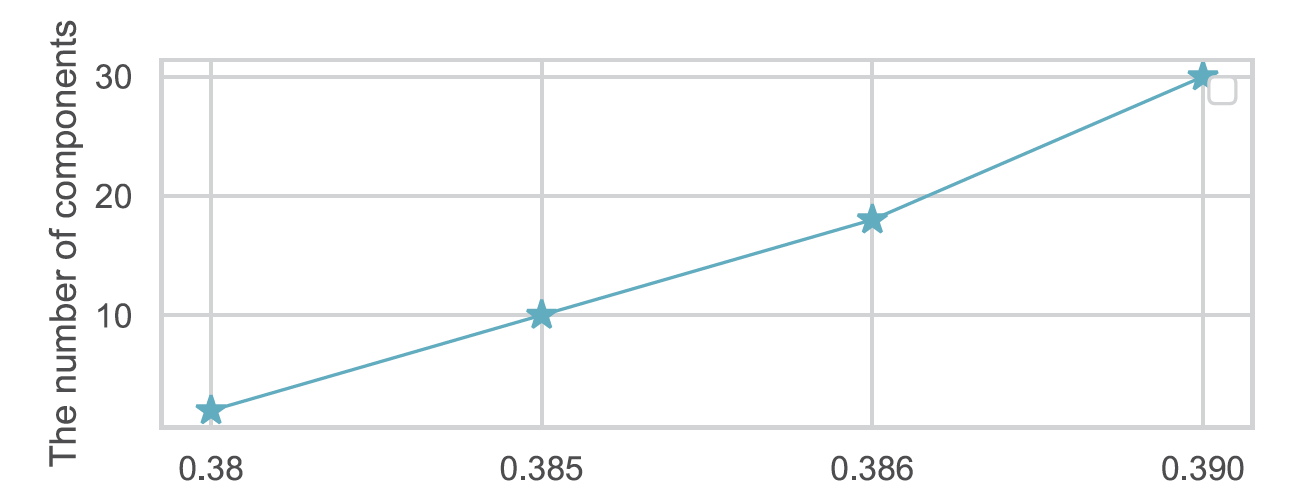
- The ablation study showed that increasing the HSIC threshold λ beyond an optimal point leads to diminishing returns in accuracy despite higher model complexity.
- The proposed dropout mechanisms effectively reduced memory overload while maintaining high performance across all benchmarks.
Read this paper
Open the full text in the Nubint reader and ask about any passage as you read.
Read this paper on NubintThis review was generated by AI from the original paper. Please check the paper before citing it.