
[Paper Review] Learning quantum states and unitaries of bounded gate complexity
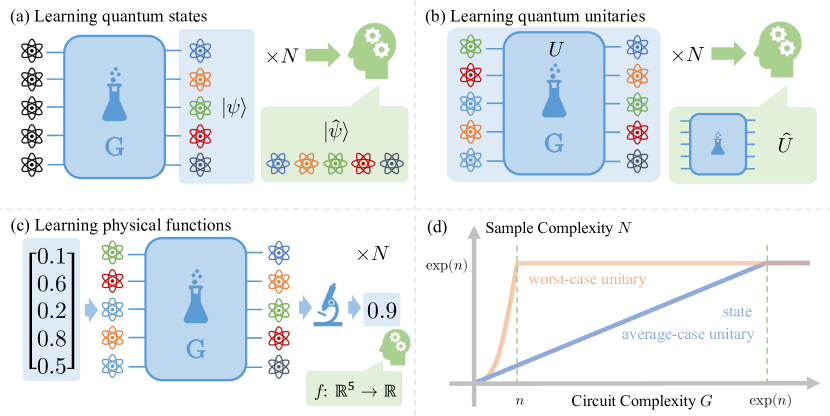
This paper establishes that quantum states and unitaries with bounded gate complexity $ G $ can be learned using sample and query complexities that scale linearly with $ G $, making learning efficient in terms of data requirements. However, under standard cryptographic assumptions, the computational complexity of learning such states and unitaries scales exponentially in $ G $, revealing a fundamental trade-off between data efficiency and computational hardness.
While quantum state tomography is notoriously hard, most states hold little interest to practically-minded tomographers. Given that states and unitaries appearing in Nature are of bounded gate complexity, it is natural to ask if efficient learning becomes possible. In this work, we prove that to learn a state generated by a quantum circuit with $G$ two-qubit gates to a small trace distance, a sample complexity scaling linearly in $G$ is necessary and sufficient. We also prove that the optimal query complexity to learn a unitary generated by $G$ gates to a small average-case error scales linearly in $G$. While sample-efficient learning can be achieved, we show that under reasonable cryptographic conjectures, the computational complexity for learning states and unitaries of gate complexity $G$ must scale exponentially in $G$. We illustrate how these results establish fundamental limitations on the expressivity of quantum machine learning models and provide new perspectives on no-free-lunch theorems in unitary learning. Together, our results answer how the complexity of learning quantum states and unitaries relate to the complexity of creating these states and unitaries.
Motivation & Objective
- To determine whether quantum states and unitaries with bounded gate complexity $ G $ can be learned efficiently, given that most states in nature are physically realizable with limited circuit depth.
- To establish tight sample and query complexity bounds for learning quantum states and unitaries under trace distance and average-case error metrics.
- To investigate the computational complexity of learning bounded-complexity quantum states and unitaries, particularly under cryptographic hardness assumptions.
- To clarify the distinction between average-case and worst-case learning of unitaries, showing an exponential separation in query complexity.
- To explore the implications for quantum machine learning models and no-free-lunch theorems in quantum process learning.
Proposed method
- Proposes a learning algorithm for pure quantum states generated by $ G $ two-qubit gates that achieves trace distance $ ilde{O}( rac{1}{ ext{poly}(G)}) $ using $ O(G) $ samples, up to logarithmic factors.
- Introduces a query-based algorithm for learning unitaries composed of $ G $ two-qubit gates to within average-case error $ ilde{O}( rac{1}{ ext{poly}(G)}) $, requiring $ O(G) $ queries.
- Employs tools from unitary $ t $-designs and metric entropy theory to derive lower bounds on the number of distinguishable unitaries in $ G $-gate brickwork circuits.
- Uses Markov’s inequality and moment bounds for approximate unitary $ t $-designs to show that the metric entropy of $ G $-gate circuits is $ ilde{ heta}(tn) $, where $ t $ is the design order.
- Applies probabilistic constructions to show that a set of $ M riangleq ilde{ heta}( rac{1}{ ext{poly}(t)}) $ unitaries can be packed such that pairwise Frobenius distance is bounded below, establishing a lower bound on metric entropy.
- Demonstrates that learning unitaries in diamond distance (worst-case) requires exponentially many queries in $ G $, while average-case learning remains linear in $ G $, establishing an exponential separation.
Experimental results
Research questions
- RQ1Can quantum states and unitaries of bounded gate complexity $ G $ be learned with sample/query complexity scaling linearly in $ G $?
- RQ2What is the optimal trade-off between sample/query complexity and computational complexity in learning bounded-complexity quantum states and unitaries?
- RQ3Is there an exponential separation between average-case and worst-case learning of unitaries in terms of query complexity?
- RQ4How does the computational hardness of learning bounded-complexity quantum states and unitaries relate to cryptographic assumptions like Ring-LWE?
- RQ5What are the fundamental limitations on the expressivity of quantum machine learning models due to the complexity of learning underlying quantum processes?
Key findings
- The sample complexity for learning a $ G $-gate quantum state to within trace distance $ ilde{O}( rac{1}{ ext{poly}(G)}) $ is $ O(G) $, up to logarithmic factors, and this bound is tight.
- The query complexity for learning a $ G $-gate unitary to within average-case error $ ilde{O}( rac{1}{ ext{poly}(G)}) $ scales linearly with $ G $, and this is optimal up to logarithmic factors.
- Learning unitaries in diamond distance (worst-case) requires query complexity that scales exponentially in $ G $, establishing an exponential separation between worst-case and average-case learning.
- Under the quantum subexponential hardness of Ring-Learning-with-Errors (RingLWE), any quantum algorithm that learns $ G $-gate states or unitaries in $ ilde{O}(G) $ samples must run in time that scales exponentially in $ G $.
- A phase transition in computational hardness occurs at $ G riangleq ilde{ heta}( ext{poly}( ext{polylog}(n))) $, where $ ext{poly}(n) $-time algorithms exist only for $ G = O( ext{polylog}(n)) $, indicating a sharp threshold before exponential sample complexity kicks in.
- The metric entropy of $ G $-gate brickwork circuits is lower bounded by $ ilde{ heta}(tn) $ when they form $ ilde{O}(1) $-approximate $ t $-designs, showing that the number of distinguishable unitaries grows with $ t $ and $ n $.
Read this paper
Open the full text in the Nubint reader and ask about any passage as you read.
Read this paper on NubintThis review was generated by AI from the original paper. Please check the paper before citing it.