
[Paper Review] Learning Sequential Acquisition Policies for Robot-Assisted Feeding
VAPORS is a hierarchical framework for robot-assisted feeding that learns high-level sequential acquisition policies in simulation using latent plate dynamics from segmented images, then executes these plans via vision-parameterized low-level primitives in the real world. It achieves superior plate clearance efficiency and user preference over baselines, generalizing to unseen sauces, toppings, and out-of-distribution dishes like DoorDash noodles with 64% clearance on average.
A robot providing mealtime assistance must perform specialized maneuvers with various utensils in order to pick up and feed a range of food items. Beyond these dexterous low-level skills, an assistive robot must also plan these strategies in sequence over a long horizon to clear a plate and complete a meal. Previous methods in robot-assisted feeding introduce highly specialized primitives for food handling without a means to compose them together. Meanwhile, existing approaches to long-horizon manipulation lack the flexibility to embed highly specialized primitives into their frameworks. We propose Visual Action Planning OveR Sequences (VAPORS), a framework for long-horizon food acquisition. VAPORS learns a policy for high-level action selection by leveraging learned latent plate dynamics in simulation. To carry out sequential plans in the real world, VAPORS delegates action execution to visually parameterized primitives. We validate our approach on complex real-world acquisition trials involving noodle acquisition and bimanual scooping of jelly beans. Across 38 plates, VAPORS acquires much more efficiently than baselines, generalizes across realistic plate variations such as toppings and sauces, and qualitatively appeals to user feeding preferences in a survey conducted across 49 individuals. Code, datasets, videos, and supplementary materials can be found on our website: https://sites.google.com/view/vaporsbot.
Motivation & Objective
- To address the challenge of long-horizon, multi-step food acquisition in robot-assisted feeding, where robots must compose specialized manipulation strategies over time.
- To bridge the sim-to-real gap by learning high-level planning in simulation using image-based latent dynamics, while relying on real-world vision for low-level primitive execution.
- To enable generalization across diverse food variations such as sauces, toppings, and out-of-distribution dishes like delivered noodles.
- To improve user experience by mimicking human-like feeding strategies, such as clustering food before acquisition.
- To demonstrate that hierarchical planning with specialized, vision-parameterized primitives enables efficient and intuitive plate clearance.
Proposed method
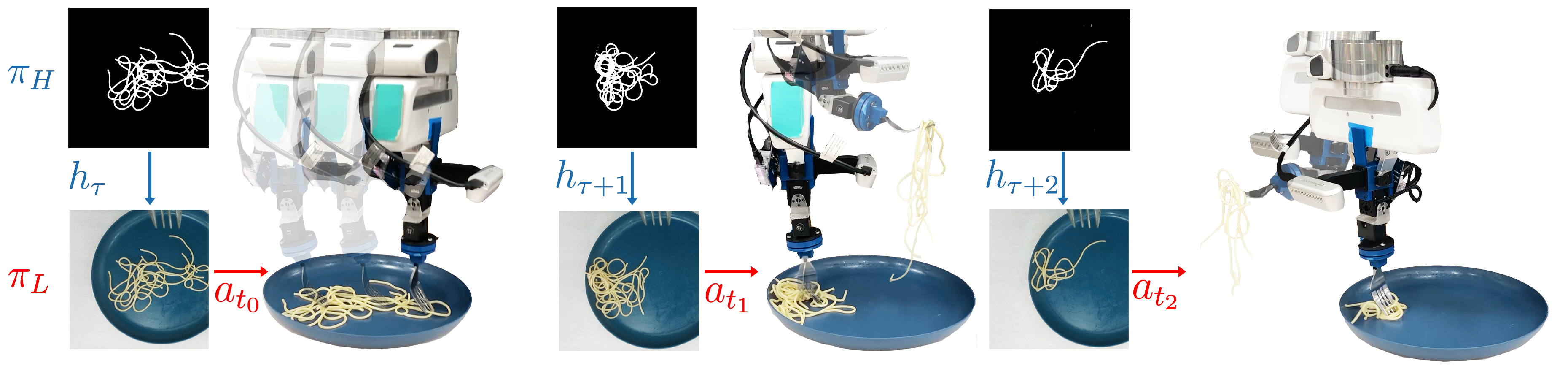
- VAPORS uses a high-level policy trained in simulation via model-based reinforcement learning to select among discrete manipulation strategies (e.g., twirling, scooping) based on segmented image observations of the plate.
- The high-level policy learns to model latent plate dynamics from image representations, optimizing for both food acquisition and rearrangement.
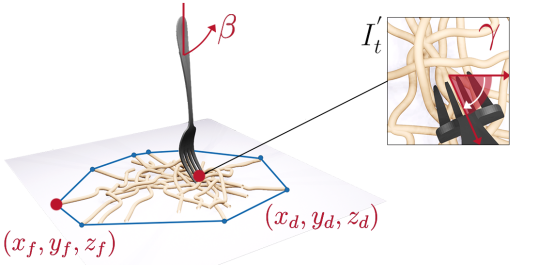
- Low-level actions are executed using vision-parameterized primitives—such as fork twirling or bimanual scooping—trained on real-world data using pose estimation and segmentation.
- The framework decouples high-level planning (in simulation) from low-level execution (in reality), enabling scalable policy learning and real-world adaptability.
- Segmented image inputs are used as state representations to ensure transferability between simulation and real-world environments.
- The system plans sequences of actions in a hierarchical manner, where the high-level policy selects the next strategy and the low-level policy executes it with visual feedback.
Experimental results
Research questions
- RQ1Can a hierarchical reinforcement learning framework effectively learn long-horizon food acquisition policies that compose multiple specialized manipulation strategies?
- RQ2Can high-level planning in simulation—using image-based latent dynamics—generalize to real-world plate clearance with unseen food variations?
- RQ3Does the use of vision-parameterized low-level primitives improve performance and user preference compared to heuristic or single-primitive baselines?
- RQ4To what extent can the system generalize to out-of-distribution plates with sauces, toppings, and complex food arrangements?
- RQ5How do users perceive the robot’s feeding behavior in terms of efficiency, naturalness, and intuitiveness compared to baseline methods?
Key findings
- VAPORS achieved 90% plate clearance on plain noodles (Tier 1), 68% on sauced noodles (Tier 2), and 64% on DoorDash noodles (Tier 3), demonstrating strong zero-shot generalization.
- The system showed statistically significant higher user preference ratings (p < 0.05) across multiple criteria, with users noting it mimicked natural feeding behaviors.
- Users found VAPORS more efficient and intuitive than baselines, particularly appreciating its ability to cluster food before acquisition.
- Failure modes were primarily due to misperception (18–25% of failures), followed by slips (23% in Tier 3), especially with sauced or slippery foods.
- VAPORS outperformed both Acquire-Only and Heuristic baselines in both quantitative clearance and qualitative user feedback.
- The framework successfully executed complex sequences involving bimanual scooping and noodle twirling in real-world trials, validating its dexterous manipulation capabilities.
Read this paper
Open the full text in the Nubint reader and ask about any passage as you read.
Read this paper on NubintThis review was generated by AI from the original paper. Please check the paper before citing it.