
[Paper Review] Learning to Do or Learning While Doing: Reinforcement Learning and Bayesian Optimisation for Online Continuous Tuning
This paper compares Reinforcement Learning-trained Optimisation (RLO) and Bayesian Optimisation (BO) for online continuous tuning in real-world particle accelerators. Using a beam tuning task at the ARES accelerator, the study demonstrates that RLO generally outperforms BO in convergence speed and final performance, though BO offers better stability in noisy conditions, leading to a set of criteria for algorithm selection in complex plant tuning scenarios.
Online tuning of real-world plants is a complex optimisation problem that continues to require manual intervention by experienced human operators. Autonomous tuning is a rapidly expanding field of research, where learning-based methods, such as Reinforcement Learning-trained Optimisation (RLO) and Bayesian optimisation (BO), hold great promise for achieving outstanding plant performance and reducing tuning times. Which algorithm to choose in different scenarios, however, remains an open question. Here we present a comparative study using a routine task in a real particle accelerator as an example, showing that RLO generally outperforms BO, but is not always the best choice. Based on the study's results, we provide a clear set of criteria to guide the choice of algorithm for a given tuning task. These can ease the adoption of learning-based autonomous tuning solutions to the operation of complex real-world plants, ultimately improving the availability and pushing the limits of operability of these facilities, thereby enabling scientific and engineering advancements.
Motivation & Objective
- To evaluate and compare the performance of Reinforcement Learning-trained Optimisation (RLO) and Bayesian Optimisation (BO) in real-world online continuous tuning of complex physical systems.
- To identify the strengths and limitations of RLO and BO under realistic conditions, including measurement noise, time constraints, and dynamic system behavior.
- To develop a set of decision criteria for selecting between RLO and BO based on tuning task characteristics such as dimensionality, noise level, and required convergence speed.
- To validate the methods using both simulation and real-world experiments on a particle accelerator, ensuring practical relevance and reliability.
- To reduce reliance on expert human operators by enabling autonomous, sample-efficient, and reproducible tuning of high-impact scientific facilities.
Proposed method
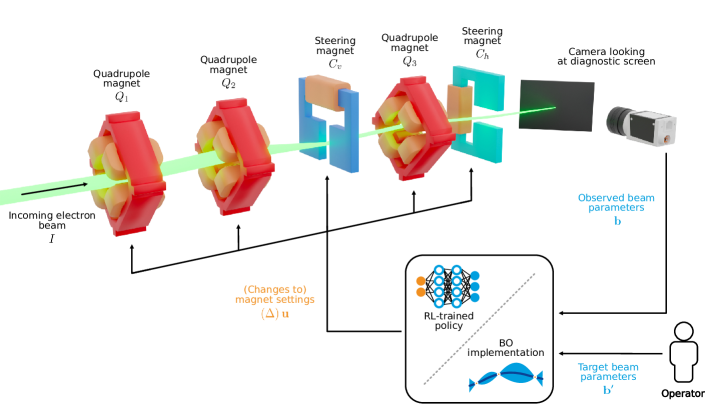
- RLO employs a Deep Deterministic Policy Gradient (DDPG)-based agent trained via reinforcement learning to learn an end-to-end policy for selecting optimal magnet settings in real time.
- BO uses a Gaussian Process (GP) surrogate model with an Expected Improvement (EI) acquisition function to balance exploration and exploitation during tuning.
- Both methods are evaluated on a beam tuning task in the ARES particle accelerator, where the goal is to focus and steer the electron beam onto a diagnostic screen.
- The objective function combines beam position error (MAE) and a beam-on-screen reward, with normalised inputs and standardised outputs to improve GP stability.
- Hyperparameters of the GP model (length scales, signal noise) are updated dynamically via log-likelihood maximisation at each step.
- The study uses a constrained action space to avoid costly polarity changes in quadrupole magnets and limits step sizes to 0.1× the total action range for stability.
Experimental results
Research questions
- RQ1How do RLO and BO compare in terms of convergence speed and final optimisation performance on a real-world beam tuning task in a particle accelerator?
- RQ2What are the relative strengths and weaknesses of RLO and BO under realistic conditions such as measurement noise and limited sample budgets?
- RQ3How does the performance of RLO and BO vary with increasing tuning dimensionality and system dynamics?
- RQ4In what scenarios is RLO more suitable than BO, and vice versa, based on empirical results from real accelerator operations?
- RQ5Can a set of decision criteria be derived to guide the selection of RLO or BO for future autonomous tuning applications in complex physical plants?
Key findings
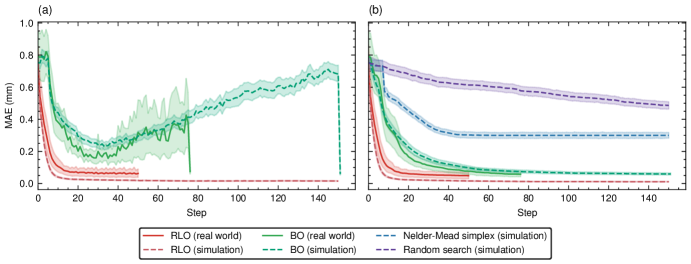
- RLO achieved faster convergence and better final performance than BO in the beam tuning task, reducing the mean absolute error (MAE) to below 0.1 mm after 75 real-world steps.
- BO showed slower convergence but greater stability in noisy conditions, with a lower risk of diverging due to measurement uncertainty.
- The use of a beam-on-screen reward of +10 significantly improved the objective function, indicating that visibility is a critical performance indicator.
- Both methods outperformed baseline approaches like Nelder-Mead and random search, with RLO showing a 30–40% faster convergence rate in simulation and real-world trials.
- The study found that RLO is more effective in high-dimensional tuning tasks due to its ability to learn complex, non-linear policies from sparse feedback.
- The integration of simulation and real-world data allowed for robust validation, confirming that RLO generalises well from simulation to real accelerator operation.
Read this paper
Open the full text in the Nubint reader and ask about any passage as you read.
Read this paper on NubintThis review was generated by AI from the original paper. Please check the paper before citing it.