
[Paper Review] Learning to Model and Plan for Wheeled Mobility on Vertically Challenging Terrain
This paper proposes a learning-based approach to model and plan wheeled robot motion on vertically challenging terrain by learning 3D vehicle-terrain forward dynamics in SE(3). Using a novel cost function in 3D planning, the wm-vct planner improves navigation success by up to 60% and reduces unstable chassis roll and pitch by 46% compared to baselines on two wheeled robots in complex off-road environments.
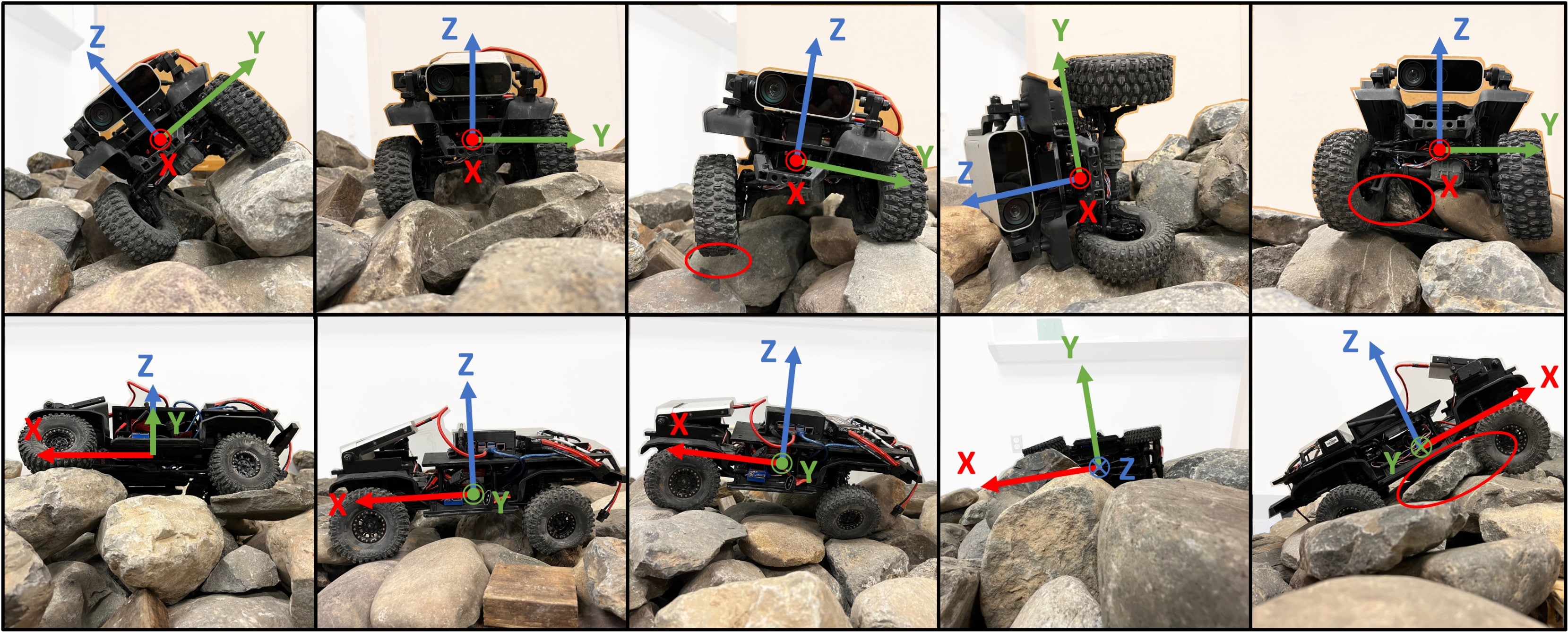
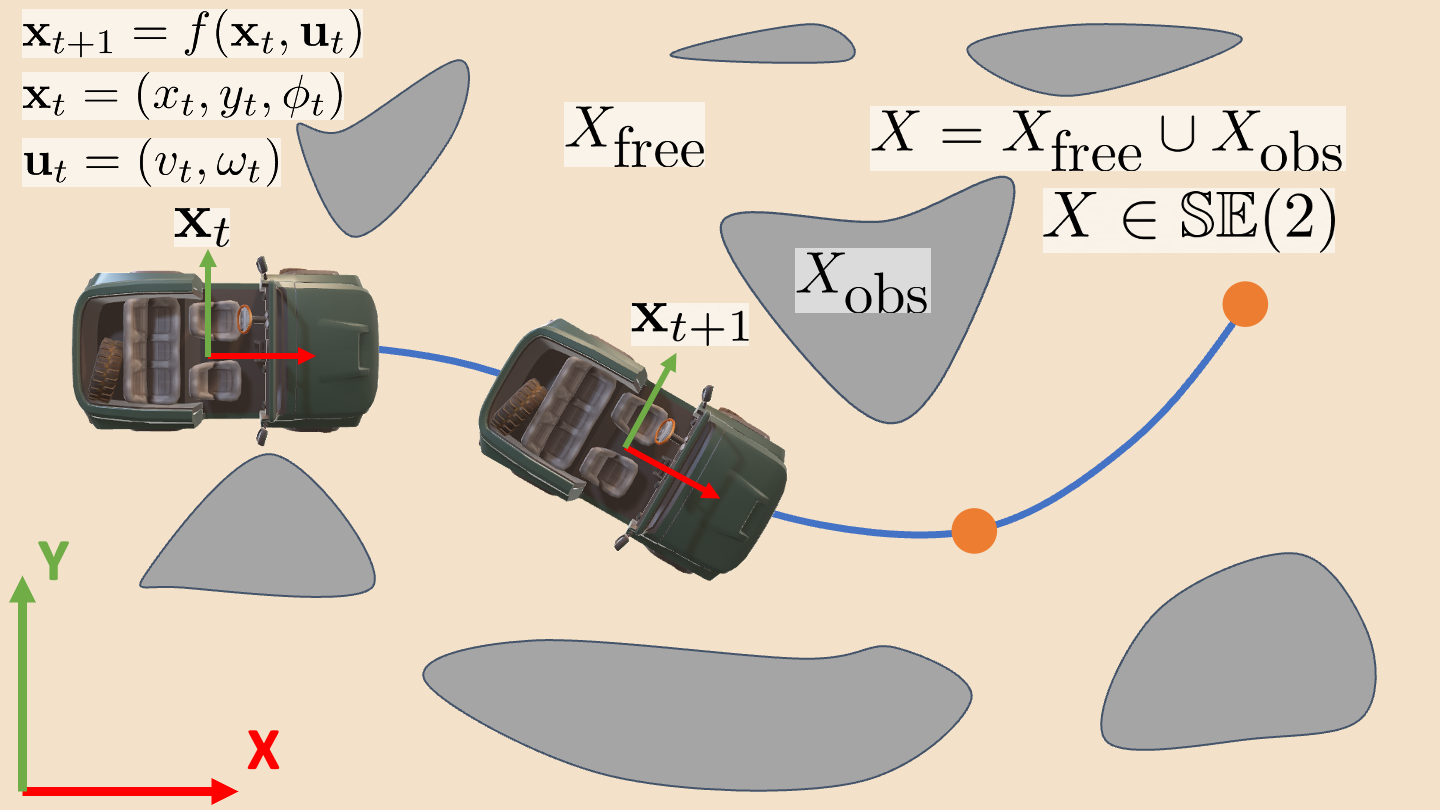
Most autonomous navigation systems assume wheeled robots are rigid bodies and their 2D planar workspaces can be divided into free spaces and obstacles. However, recent wheeled mobility research, showing that wheeled platforms have the potential of moving over vertically challenging terrain (e.g., rocky outcroppings, rugged boulders, and fallen tree trunks), invalidate both assumptions. Navigating off-road vehicle chassis with long suspension travel and low tire pressure in places where the boundary between obstacles and free spaces is blurry requires precise 3D modeling of the interaction between the chassis and the terrain, which is complicated by suspension and tire deformation, varying tire-terrain friction, vehicle weight distribution and momentum, etc. In this paper, we present a learning approach to model wheeled mobility, i.e., in terms of vehicle-terrain forward dynamics, and plan feasible, stable, and efficient motion to drive over vertically challenging terrain without rolling over or getting stuck. We present physical experiments on two wheeled robots and show that planning using our learned model can achieve up to 60% improvement in navigation success rate and 46% reduction in unstable chassis roll and pitch angles.
Motivation & Objective
- To address the limitations of traditional 2D rigid-body motion planning in vertically challenging terrain where obstacles are not clearly separated from free space.
- To model the complex, non-rigid interactions between wheeled robots and 3D terrain, including suspension deformation, tire-terrain friction, and dynamic weight distribution.
- To develop a planning framework that ensures stable, efficient, and collision-free navigation over previously non-traversable obstacles such as boulders and fallen trees.
- To enable generalization to unseen outdoor environments where terrain features differ from training data.
Proposed method
- A data-driven forward dynamics model is trained to predict 6-DoF vehicle state trajectories in SE(3) based on current vehicle state, control inputs, and terrain elevation maps.
- The wm-vct planner uses a sampling-based receding-horizon approach with trajectory rollouts through the learned dynamics model.
- A novel 3D cost function is designed to penalize high roll and pitch angles and potential immobilization, promoting stability during planning.
- The planner integrates the learned dynamics into a RRT*-based motion planner to generate feasible, stable, and efficient trajectories.
- The method is evaluated on two wheeled robot platforms (V6W and V4W) across controlled testbeds and real outdoor environments.
- The approach generalizes to unseen outdoor terrains without fine-tuning, demonstrating robustness to out-of-distribution terrain features.
Experimental results
Research questions
- RQ1Can a learned forward dynamics model in SE(3) accurately predict wheeled robot motion over complex 3D terrain with suspension and tire deformation?
- RQ2How does incorporating 3D dynamics into a planning cost function improve stability and success rate on vertically challenging terrain compared to 2D rigid-body assumptions?
- RQ3To what extent can the learned model generalize to unseen outdoor environments with large, irregular obstacles not present in the training data?
- RQ4How does the wm-vct planner compare in performance and stability to existing baselines such as behavior cloning and other state-of-the-art planners in real-world off-road scenarios?
Key findings
- The wm-vct planner achieved up to 60% higher navigation success rate than the best baseline (behavior cloning) on both V6W and V4W robots across three difficulty levels of testbed environments.
- The wm-vct planner reduced unstable chassis roll and pitch angles by up to 46% compared to behavior cloning, especially in medium and difficult environments.
- In the difficult testbed environment, behavior cloning failed in four out of five trials due to roll-over or immobilization, while wm-vct succeeded in four out of five trials.
- On the four-wheeled V4W platform, which is less mechanically capable, wm-vct still outperformed behavior cloning in both success rate and stability metrics.
- The planner successfully generalized to unseen outdoor terrain with large, irregular rocks, where behavior cloning failed due to excessive roll angles leading to roll-over.
- Outdoor demonstrations confirmed that wm-vct enables stable navigation over previously non-traversable obstacles, while behavior cloning failed due to aggressive, unstable trajectories.
Read this paper
Open the full text in the Nubint reader and ask about any passage as you read.
Read this paper on NubintThis review was generated by AI from the original paper. Please check the paper before citing it.