
[Paper Review] Les Houches Lectures on Community Ecology: From Niche Theory to Statistical Mechanics
A survey connecting niche theory and statistical physics in community ecology, detailing Consumer Resource Models and Generalized Lotka-Volterra models, and exploring high-dimensional analysis with cavity methods and random matrix theory.
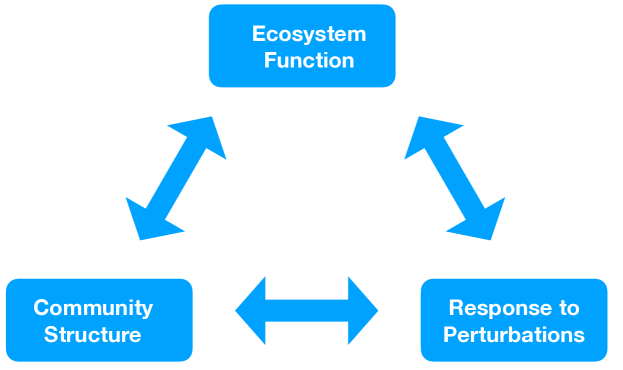
Ecosystems are among the most interesting and well-studied examples of self-organized complex systems. Community ecology, the study of how species interact with each other and the environment, has a rich tradition. Over the last few years, there has been a growing theoretical and experimental interest in these problems from the physics and quantitative biology communities. Here, we give an overview of community ecology, highlighting the deep connections between ecology and statistical physics. We start by introducing the two classes of mathematical models that have served as the workhorses of community ecology: Consumer Resource Models (CRM) and the generalized Lotka-Volterra models (GLV). We place a special emphasis on graphical methods and general principles. We then review recent works showing a deep and surprising connection between ecological dynamics and constrained optimization. We then shift our focus by analyzing these same models in "high-dimensions" (i.e. in the limit where the number of species and resources in the ecosystem becomes large) and discuss how such complex ecosystems can be analyzed using methods from the statistical physics of disordered systems such as the cavity method and Random Matrix Theory.
Motivation & Objective
- Introduce core principles of community ecology and the role of niche theory in shaping communities.
- Present and contrast two main modeling frameworks: Consumer Resource Models (CRMs) and Generalized Lotka-Volterra (GLV) models.
- Explain how ecological dynamics connect to constrained optimization and high-dimensional statistical physics methods.
- Discuss graphical methods for coexistence, stability, and the geometry of resource-consumer interactions.
- Highlight how high-dimensional analysis and disordered systems techniques illuminate ecosystem behavior.
Proposed method
- Describe and analyze CRMs and GLVs as foundational models of community ecology.
- Use graphical representations such as zero net growth isoclines (ZNGIs) and coexistence cones to derive coexistence and stability criteria.
- Derive GLV equations from a linear-response expansion around fixed points using elasticity analogies.
- Discuss generalized MacArthur resource models and essential/substitutable resources with corresponding supply and impact vectors.
- Introduce high-dimensional analysis via concepts from random matrix theory and the cavity method.
Experimental results
Research questions
- RQ1How do CRMs and GLVs encode ecological interactions and environmental mediation in community assembly?
- RQ2Under what geometric and dynamical conditions do multiple species stably coexist in CRMs and in GLV frameworks?
- RQ3How do high-dimensional limits (large number of species and resources) alter stability and diversity under niche theory?
- RQ4What is the relationship between niche theory and optimization principles in ecological dynamics?
- RQ5How can techniques from statistical physics (e.g., cavity method, Random Matrix Theory) be applied to analyze large ecological networks?
Key findings
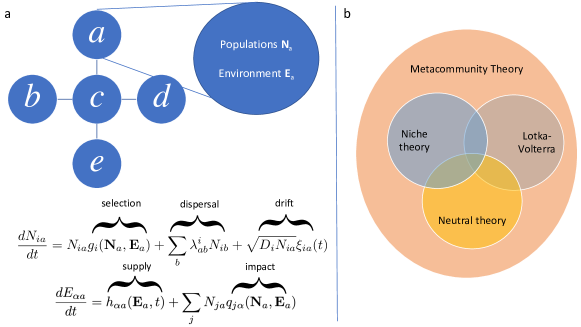
- CRMs and GLVs provide complementary perspectives: CRMs emphasize environment-mediated interactions, while GLVs capture species–species interactions.
- Coexistence in CRMs can be understood geometrically via ZNGIs, supply points, and cones formed by negative impact vectors, with the competitive exclusion principle limiting stable coexistence to the number of resources.
- Externally supplied resources modify cone geometry, reducing fixed-point coexistence regions and affecting saturation of the competitive exclusion bound in high dimensions.
- Essential resources (non-substitutable) can lead to hyperbolic ZNGIs and potentially unstable fixed points depending on biomass stoichiometry, allowing for complex dynamics beyond simple coexistence.
- GLV derivations from ecological dynamics reveal that effective interspecific interactions depend on environmental mediation and can include higher-order effects when deriving from resource-explicit models.
- In high-dimensional settings, tools from Random Matrix Theory and the cavity method provide a framework to analyze stability and diversity in complex ecosystems.
Read this paper
Open the full text in the Nubint reader and ask about any passage as you read.
Read this paper on NubintThis review was generated by AI from the original paper. Please check the paper before citing it.