
[Paper Review] LF-YOLO: A Lighter and Faster YOLO for Weld Defect Detection of X-ray Image
This paper proposes LF-YOLO, a lightweight and fast YOLO-based model for weld defect detection in X-ray images, using a novel Reinforced Multiscale Feature (RMF) module combining parameter-free and parameter-based multi-scale feature extraction, and an Efficient Feature Extraction (EFE) module for low-computation backbone learning. The method achieves 92.9% mAP50 with 61.5 FPS and 4.0 GFLOPs, demonstrating strong performance and efficiency on both custom and public datasets.
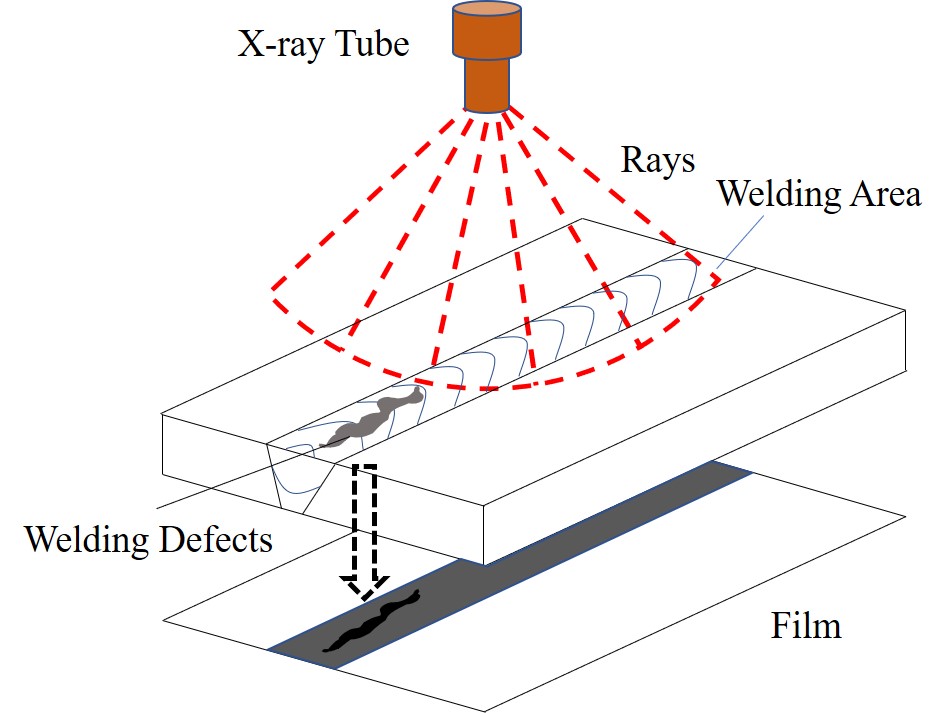
X-ray image plays an important role in manufacturing industry for quality assurance, because it can reflect the internal condition of weld region. However, the shape and scale of different defect types vary greatly, which makes it challenging for model to detect weld defects. In this paper, we propose a weld defect detection method based on convolution neural network, namely Lighter and Faster YOLO (LF-YOLO). In particularly, a reinforced multiscale feature (RMF) module is designed to implement both parameter-based and parameter-free multi-scale information extracting operation. RMF enables the extracted feature map capable to represent more plentiful information, which is achieved by superior hierarchical fusion structure. To improve the performance of detection network, we propose an efficient feature extraction (EFE) module. EFE processes input data with extremely low consumption, and improves the practicability of whole network in actual industry. Experimental results show that our weld defect detection network achieves satisfactory balance between performance and consumption, and reaches 92.9 mean average precision mAP50 with 61.5 frames per second (FPS). To further prove the ability of our method, we test it on public dataset MS COCO, and the results show that our LF-YOLO has a outstanding versatility detection performance. The code is available at https://github.com/lmomoy/LF-YOLO.
Motivation & Objective
- To address the challenge of detecting highly variable-scale and low-contrast weld defects in X-ray images using deep learning.
- To design a lightweight and fast object detection model suitable for real-time industrial applications.
- To improve multi-scale feature representation by combining parameter-free and parameter-based feature fusion strategies.
- To develop an efficient backbone module that maintains high feature representation with minimal computational cost.
- To validate the model's generalization capability on public datasets like MS COCO.
Proposed method
- Proposes a Reinforced Multiscale Feature (RMF) module that first applies max-pooling at multiple scales (parameter-free) and then applies learnable convolutions (parameter-based) to extract hierarchical features.
- Integrates the RMF module into a YOLO-based detector to enhance feature representation across varying defect scales and shapes.
- Designs an Efficient Feature Extraction (EFE) module as the backbone unit, using depthwise separable convolutions and channel-squeeze operations to reduce FLOPs and parameters.
- Employs a hierarchical fusion strategy in RMF to combine multi-scale features from different levels for improved detection robustness.
- Trains the model end-to-end on a custom X-ray weld defect dataset and evaluates it on MS COCO for generalization testing.
- Uses ablation studies to validate the contribution of each component, including RMF and EFE, in isolation and combination.
Experimental results
Research questions
- RQ1Can a hybrid multi-scale feature extraction strategy combining parameter-free and parameter-based operations improve detection accuracy for small and irregularly shaped weld defects?
- RQ2To what extent can a lightweight backbone module like EFE maintain detection performance while reducing FLOPs and parameters?
- RQ3How does the proposed LF-YOLO model compare in speed and accuracy to existing YOLO and two-stage detectors on both custom and public datasets?
- RQ4Does the RMF module effectively capture both local and global context for complex weld defect patterns with blurred boundaries and texture similarity?
- RQ5Can the model generalize well to standard object detection benchmarks like MS COCO without fine-tuning?
Key findings
- LF-YOLO achieves 92.9% mAP50 on the custom X-ray weld defect dataset with only 4.0 GFLOPs and 7.3M parameters, demonstrating a strong speed-accuracy trade-off.
- The model runs at 61.5 FPS, making it suitable for real-time industrial inspection systems.
- The ablation study confirms that both the RMF and EFE modules contribute significantly, with the full model achieving 90.7% mAP50 when both are used.
- On the MS COCO dataset, the LF-YOLO×1.25 version achieves 50.3% mAP50, outperforming SSD and YOLOv3 in speed-efficiency while remaining competitive with Faster R-CNN.
- Visualization of feature maps shows that the EFE module effectively captures fine-grained texture and boundary details, even in low-contrast regions.
- Removing either the SPP or GDConv component in RMF leads to a drop in mAP50, confirming the necessity of both parameter-free and parameter-based stages.

Read this paper
Open the full text in the Nubint reader and ask about any passage as you read.
Read this paper on NubintThis review was generated by AI from the original paper. Please check the paper before citing it.