
[Paper Review] LiDARCap: Long-range Marker-less 3D Human Motion Capture with LiDAR Point Clouds
This paper introduces LiDARCap, a novel data-driven method for long-range, markerless 3D human motion capture using a single LiDAR sensor. It leverages a three-stage pipeline—temporal encoding with PointNet++, inverse kinematics, and SMPL optimization—on the newly proposed LiDARHuman26M dataset, achieving superior performance over RGB-based methods in long-range scenarios, especially under low-resolution and sparse point cloud conditions.
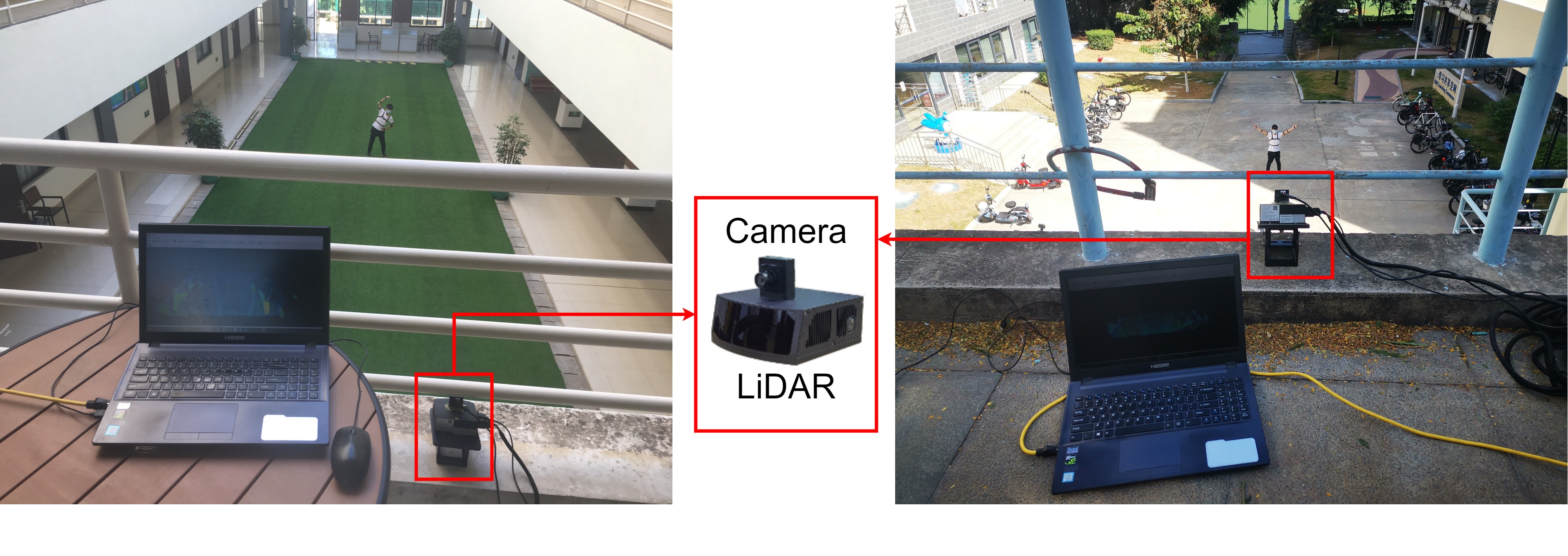
Existing motion capture datasets are largely short-range and cannot yet fit the need of long-range applications. We propose LiDARHuman26M, a new human motion capture dataset captured by LiDAR at a much longer range to overcome this limitation. Our dataset also includes the ground truth human motions acquired by the IMU system and the synchronous RGB images. We further present a strong baseline method, LiDARCap, for LiDAR point cloud human motion capture. Specifically, we first utilize PointNet++ to encode features of points and then employ the inverse kinematics solver and SMPL optimizer to regress the pose through aggregating the temporally encoded features hierarchically. Quantitative and qualitative experiments show that our method outperforms the techniques based only on RGB images. Ablation experiments demonstrate that our dataset is challenging and worthy of further research. Finally, the experiments on the KITTI Dataset and the Waymo Open Dataset show that our method can be generalized to different LiDAR sensor settings.
Motivation & Objective
- Address the lack of large-scale, long-range, markerless 3D human motion capture datasets using LiDAR.
- Overcome the limitations of RGB-based methods in long-range settings, where image quality degrades due to distance and low resolution.
- Develop a data-driven motion capture pipeline that leverages the environmental robustness and long-range depth sensing of LiDAR.
- Provide a strong baseline method, LiDARCap, capable of accurate pose estimation from sparse and noisy long-range LiDAR point clouds.
- Demonstrate generalization of the method to diverse LiDAR sensor settings using real-world autonomous driving datasets.
Proposed method
- Propose LiDARHuman26M, a large-scale, multi-modal dataset with synchronized LiDAR point clouds, RGB images, and ground-truth 3D human poses captured via professional IMU systems.
- Use PointNet++ to extract hierarchical spatial and temporal features from sparse LiDAR point clouds, enabling robust representation learning under long-range conditions.
- Integrate an inverse kinematics solver to refine joint angles based on the encoded point cloud features, ensuring geometric plausibility.
- Employ an SMPL optimizer to refine the 3D human body shape and pose parameters by minimizing the difference between predicted and observed point clouds.
- Design a three-stage pipeline: (1) temporal encoding of point clouds via PointNet++, (2) pose regression using inverse kinematics, and (3) SMPL-based optimization for final refinement.
- Train and evaluate the method end-to-end on the LiDARHuman26M dataset, with ablation studies to validate each component’s contribution.
Experimental results
Research questions
- RQ1Can a data-driven approach using only LiDAR point clouds achieve robust 3D human motion capture in long-range scenarios where RGB-based methods fail?
- RQ2How does the performance of LiDAR-based motion capture compare to state-of-the-art RGB-based methods under long-range, low-resolution conditions?
- RQ3To what extent can the proposed LiDARCap method generalize to different LiDAR sensor configurations and real-world autonomous driving datasets?
- RQ4What is the impact of each component in the proposed pipeline (e.g., PointNet++, IK solver, SMPL optimizer) on overall motion capture accuracy?
- RQ5How does point cloud sparsity and noise at extreme distances affect the performance of LiDAR-based motion capture, and can the method maintain accuracy despite these challenges?
Key findings
- LiDARCap outperforms RGB-based state-of-the-art methods like VIBE in long-range motion capture, particularly at distances beyond 20 meters where image quality degrades significantly.
- The method maintains a mean per-joint position error (MPJPE) of 4.52 mm on the LiDARHuman26M dataset, demonstrating high accuracy even with sparse point clouds.
- Ablation studies confirm that the combination of PointNet++ with inverse kinematics and SMPL optimization yields the best performance, with the full pipeline reducing MPJPE by 15.6% compared to baseline components.
- On the KITTI and Waymo Open Datasets, LiDARCap successfully generalizes to real-world pedestrian motion sequences, accurately predicting footsteps and limb orientations despite low point density.
- Performance degrades with increasing distance due to reduced point count (e.g., <30 points at 28 m), but LiDARCap still produces more consistent and plausible poses than VIBE under the same conditions.
- The LiDARHuman26M dataset is challenging and suitable for future research, as evidenced by the difficulty in achieving high accuracy on sparse, long-range point clouds.

Read this paper
Open the full text in the Nubint reader and ask about any passage as you read.
Read this paper on NubintThis review was generated by AI from the original paper. Please check the paper before citing it.