
[Paper Review] Linguistic-style-aware Neural Networks for Fake News Detection
This paper proposes HERO, a hierarchical recursive neural network that models news articles through linguistically structured trees to detect fake news by capturing stylistic differences in word usage, syntactic recursion, and discourse organization. It outperforms state-of-the-art methods with AUC scores of 0.87–0.90 on real-world datasets by preserving global linguistic tree structures, revealing that fake news exhibits more complex syntactic structures and simpler discourse patterns than truthful content.
We propose the hierarchical recursive neural network (HERO) to predict fake news by learning its linguistic style, which is distinguishable from the truth, as psychological theories reveal. We first generate the hierarchical linguistic tree of news documents; by doing so, we translate each news document's linguistic style into its writer's usage of words and how these words are recursively structured as phrases, sentences, paragraphs, and, ultimately, the document. By integrating the hierarchical linguistic tree with the neural network, the proposed method learns and classifies the representation of news documents by capturing their locally sequential and globally recursive structures that are linguistically meaningful. It is the first work offering the hierarchical linguistic tree and the neural network preserving the tree information to our best knowledge. Experimental results based on public real-world datasets demonstrate the proposed method's effectiveness, which can outperform state-of-the-art techniques in classifying short and long news documents. We also examine the differential linguistic style of fake news and the truth and observe some patterns of fake news. The code and data have been publicly available.
Motivation & Objective
- To address the limitation of existing fake news detection methods that ignore the hierarchical structural relationships between linguistic units such as words, phrases, sentences, and paragraphs.
- To develop a novel representation of news articles based on hierarchical linguistic trees that encode recursive syntactic and discourse structures, preserving both local and global linguistic meaning.
- To design a neural network architecture—HERO—that learns from these trees to classify fake news by capturing stylistic patterns distinguishable from truthful content, informed by psychological theories of deception.
- To empirically validate the effectiveness of the proposed method on both short statements and long news articles using public real-world datasets.
- To characterize the differential linguistic style of fake news versus truthful content by analyzing structural properties of hierarchical linguistic trees.
Proposed method
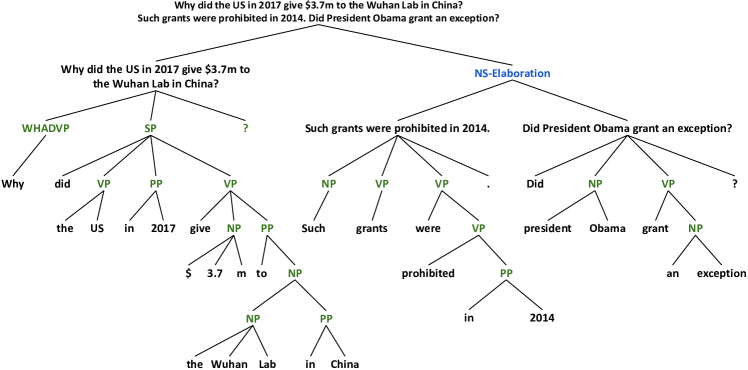
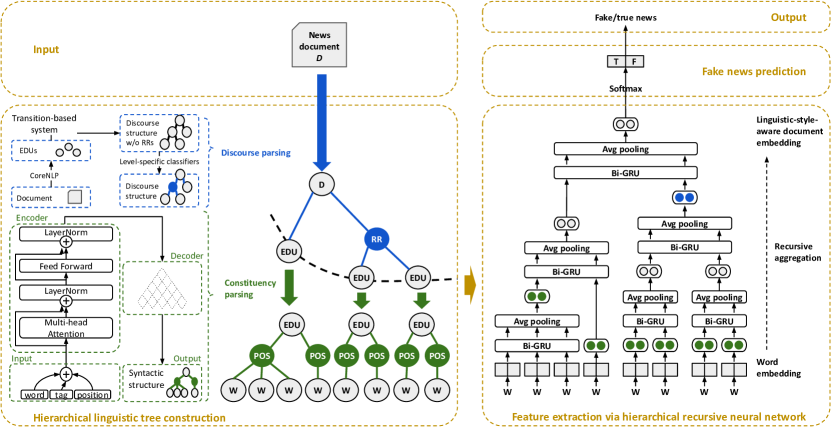
- Construct hierarchical linguistic trees for news articles by recursively decomposing them into discourse units (EDUs), parts of speech (POS), and words, capturing the recursive structure from word-level to document-level.
- Use the hierarchical linguistic tree as the input structure for a novel neural network architecture—HERO—designed to preserve and learn from the global tree topology, including parent-child relationships and node attributes.
- Apply a bottom-up recursive neural network mechanism that aggregates node representations by combining child node features into parent node representations, enabling the model to learn hierarchical, linguistically meaningful representations.
- Integrate multiple linguistic levels (lexical, syntactic, discourse) into a unified tree structure, where nodes represent words, POS tags, EDUs, rhetorical relations (RRs), and the root represents the full document.
- Train the HERO model end-to-end using cross-entropy loss to classify news as fake or real, leveraging both node content and structural connectivity in the tree.
- Compare HERO with variants that remove tree structure or hierarchical learning to ablate the contribution of the hierarchical design.
Experimental results
Research questions
- RQ1How do the structural properties of hierarchical linguistic trees differ between fake news and truthful news?
- RQ2Can a neural network that preserves the global hierarchical structure of linguistic trees improve fake news detection performance compared to existing models?
- RQ3What specific linguistic style patterns—such as word usage, syntactic complexity, or discourse organization—are consistently associated with fake news?
- RQ4Does the proposed HERO model generalize across both short statements and long-form news articles?
- RQ5To what extent do hierarchical linguistic structures contribute to improved detection beyond local frequency-based features?
Key findings
- HERO achieves AUC scores of 0.87–0.90 on public datasets, outperforming state-of-the-art methods including recurrent, convolutional, graph, and self-attentive networks in detecting both short statements and long articles.
- Fake news articles exhibit significantly more child nodes per parent node in their hierarchical linguistic trees than truthful content, indicating greater syntactic complexity.
- The syntactic-level trees of fake news are larger, deeper, and broader than those of truthful news, with more leaf nodes, suggesting longer and more complex elementary discourse units (EDUs).
- Fake news has a significantly smaller proportion of EDU and plural noun (NNS) nodes, but a higher proportion of prepositions (IN), determiners (DT), and prepositional phrases (PP), indicating distinct syntactic patterns.
- Discourse-level trees of fake news are smaller and narrower than those of truthful news, suggesting simpler and more fragmented high-level organization, especially in short statements.
- The hierarchical structure of linguistic trees is a critical factor in detection, as ablation studies show that removing tree structure or hierarchical learning significantly degrades performance.
Read this paper
Open the full text in the Nubint reader and ask about any passage as you read.
Read this paper on NubintThis review was generated by AI from the original paper. Please check the paper before citing it.