
[Paper Review] LLM Discussion: Enhancing the Creativity of Large Language Models via Discussion Framework and Role-Play
This work proposes LLM Discussion, a three-phase discussion framework with role-play among multiple LLMs to boost creativity, evaluated on AUT, Instances, Similarities, and Scientific Creativity with both LLM and human evaluators, outperforming baselines.
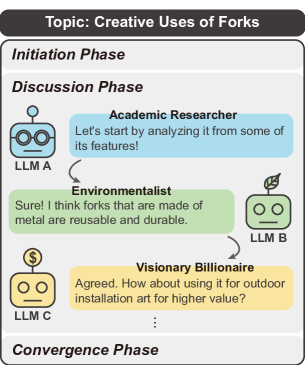
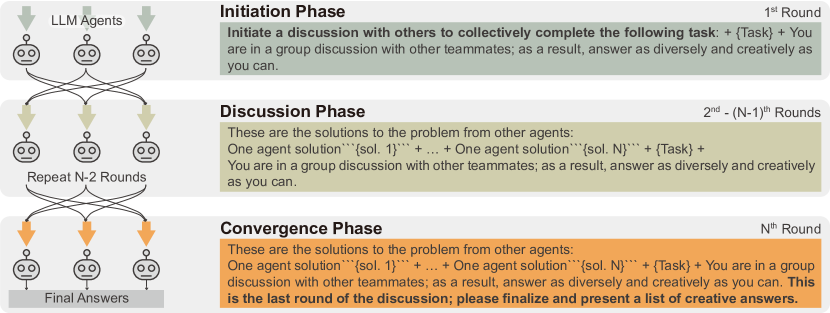
Large language models (LLMs) have shown exceptional proficiency in natural language processing but often fall short of generating creative and original responses to open-ended questions. To enhance LLM creativity, our key insight is to emulate the human process of inducing collective creativity through engaging discussions with participants from diverse backgrounds and perspectives. To this end, we propose LLM Discussion, a three-phase discussion framework that facilitates vigorous and diverging idea exchanges and ensures convergence to creative answers. Moreover, we adopt a role-playing technique by assigning distinct roles to LLMs to combat the homogeneity of LLMs. We evaluate the efficacy of the proposed framework with the Alternative Uses Test, Similarities Test, Instances Test, and Scientific Creativity Test through both LLM evaluation and human study. The results show that our proposed framework outperforms single-LLM approaches and existing multi-LLM frameworks across various creativity metrics. The code is available at https://github.com/lawraa/LLM-Discussion.
Motivation & Objective
- Motivate an approach to boost LLM creativity through collaborative, multi-agent discussion.
- Address LLM limitations in multi-turn engagement and homogeneous thinking.
- Design a three-phase initiation, discussion, and convergence framework to foster divergent and convergent thinking.
- Incorporate role-play with diverse LLM roles (and Six Thinking Hats) to increase perspective diversity.
- Evaluate using Wallach-Kogan Creativity Tests and a Scientific Creativity Test, with both LLM and human assessments.
Proposed method
- Three-phase discussion framework with initiation, discussion, and convergence prompts to guide divergent and convergent thinking.
- Role-generation to create diverse LLM roles and perspectives, leveraging Six Thinking Hats for varied viewpoints.
- Role-play integration: assign fixed roles to LLMs and remind them of roles at each round.
- Creativity benchmarks: Alternative Uses Task (AUT), Instances, Similarities, and Scientific Creativity Test.
- Evaluation via TTCT-based metrics: Originality and Elaboration (primary), plus Fluency and Flexibility.
- Baselines include Single Agent prompting, Brainstorm-then-Select (BTS), and LLM Debate.
Experimental results
Research questions
- RQ1Does a multi-LLM discussion with role-play improve creativity metrics compared to existing baselines?
- RQ2How do factors like prompt design, number of discussion rounds, and number of participating LLMs affect creativity outcomes?
- RQ3What is the correlation between LLM-based creativity evaluation and human judgments?
- RQ4Can the proposed framework sustain divergent thinking across rounds and converge to high-quality creative conclusions?
Key findings
- LLM Discussion outperforms baselines in Originality and Elaboration across AUT, Instances, Similarities, and Scientific Creativity tests.
- Role-play and the three-phase discussion framework promote collaborative dynamics and reduce homogeneous thinking among LLMs.
- Five discussion rounds with four LLMs yield the best overall performance.
- Human evaluations align with LLM evaluations for Originality and Elaboration, with strong correlations to average human judgments for several metrics.
- Kendall’s tau indicates strong correlation between LLM evaluations and average human evaluations for Originality, Fluency, and Flexibility, and a moderate correlation for Elaboration.
Read this paper
Open the full text in the Nubint reader and ask about any passage as you read.
Read this paper on NubintThis review was generated by AI from the original paper. Please check the paper before citing it.