
[Paper Review] LM-IGTD: a 2D image generator for low-dimensional and mixed-type tabular data to leverage the potential of convolutional neural networks
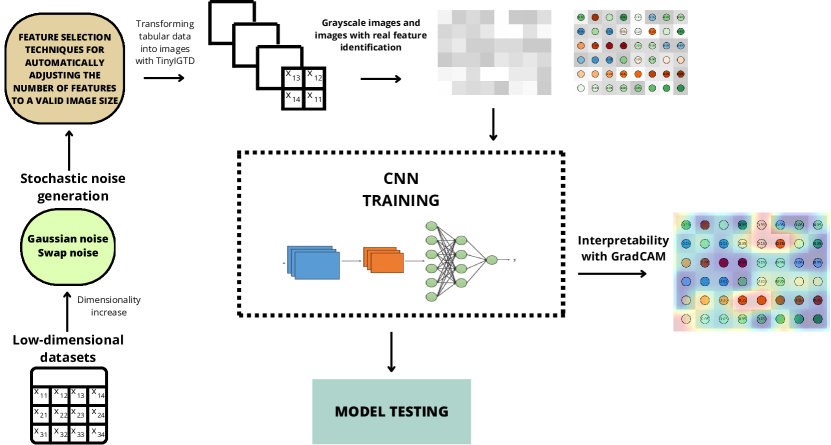
LM-IGTD is a novel 2D image generation method for low-dimensional and mixed-type tabular data that enhances feature representation through stochastic noise generation and a modified IGTD approach. It enables high-performance CNN-based classification by preserving feature integrity, enabling interpretability via feature mapping and Grad-CAM, and outperforming traditional ML models on 5 out of 12 datasets.
Tabular data have been extensively used in different knowledge domains. Convolutional neural networks (CNNs) have been successfully used in many applications where important information about data is embedded in the order of features (images), outperforming predictive results of traditional models. Recently, several researchers have proposed transforming tabular data into images to leverage the potential of CNNs and obtain high results in predictive tasks such as classification and regression. In this paper, we present a novel and effective approach for transforming tabular data into images, addressing the inherent limitations associated with low-dimensional and mixed-type datasets. Our method, named Low Mixed-Image Generator for Tabular Data (LM-IGTD), integrates a stochastic feature generation process and a modified version of the IGTD. We introduce an automatic and interpretable end-to-end pipeline, enabling the creation of images from tabular data. A mapping between original features and the generated images is established, and post hoc interpretability methods are employed to identify crucial areas of these images, enhancing interpretability for predictive tasks. An extensive evaluation of the tabular-to-image generation approach proposed on 12 low-dimensional and mixed-type datasets, including binary and multi-class classification scenarios. In particular, our method outperformed all traditional ML models trained on tabular data in five out of twelve datasets when using images generated with LM-IGTD and CNN. In the remaining datasets, LM-IGTD images and CNN consistently surpassed three out of four traditional ML models, achieving similar results to the fourth model.
Motivation & Objective
- Address the challenge of applying convolutional neural networks (CNNs) to low-dimensional and mixed-type tabular data, which lack spatial structure and suffer from data sparsity.
- Overcome limitations in existing tabular-to-image methods that underperform on low-dimensional and mixed-feature datasets due to insufficient feature dimensionality and poor image quality.
- Develop an end-to-end, interpretable pipeline that maps original tabular features to generated images and enables post-hoc interpretability using techniques like Grad-CAM.
- Enhance dataset dimensionality through stochastic noise generation while maintaining strong correlations with original features to preserve data structure and improve CNN performance.
Proposed method
- Integrate stochastic noise generation to artificially increase the dimensionality of low-dimensional tabular datasets, mitigating data sparsity and improving image representativeness.
- Adapt the Image Generator for Tabular Data (IGTD) method with type-specific distance measures for numerical and categorical features to handle mixed-type data effectively.
- Establish a precise mapping between original tabular features and their corresponding pixel regions in the generated 2D images to enable feature-level interpretability.
- Apply post-hoc interpretability techniques such as Grad-CAM to visualize attention regions in CNNs, identifying which image areas contribute most to predictions.
- Use a CNN-based classifier on the generated images to evaluate predictive performance, leveraging spatial feature learning capabilities of CNNs.
- Ensure end-to-end pipeline automation, including data preprocessing, image generation, model training, and interpretability analysis, for reproducibility and usability.
Experimental results
Research questions
- RQ1Can a tabular-to-image transformation method effectively handle low-dimensional and mixed-type tabular datasets, which are underexplored in existing image generation approaches?
- RQ2To what extent does stochastic noise generation improve the quality and informativeness of generated images for CNN-based learning on tabular data?
- RQ3How well can the proposed method preserve the structural relationships between original features and their image representations?
- RQ4Can the integration of feature mapping and Grad-CAM enhance model interpretability in CNNs trained on generated tabular images?
- RQ5Does the use of LM-IGTD-generated images lead to superior or competitive performance compared to traditional machine learning models on tabular data?
Key findings
- LM-IGTD outperformed all traditional machine learning models trained on raw tabular data in five out of twelve evaluated datasets when using CNNs on generated images.
- In the remaining seven datasets, LM-IGTD with CNN consistently surpassed three out of four traditional models, achieving performance comparable to the best-performing baseline model.
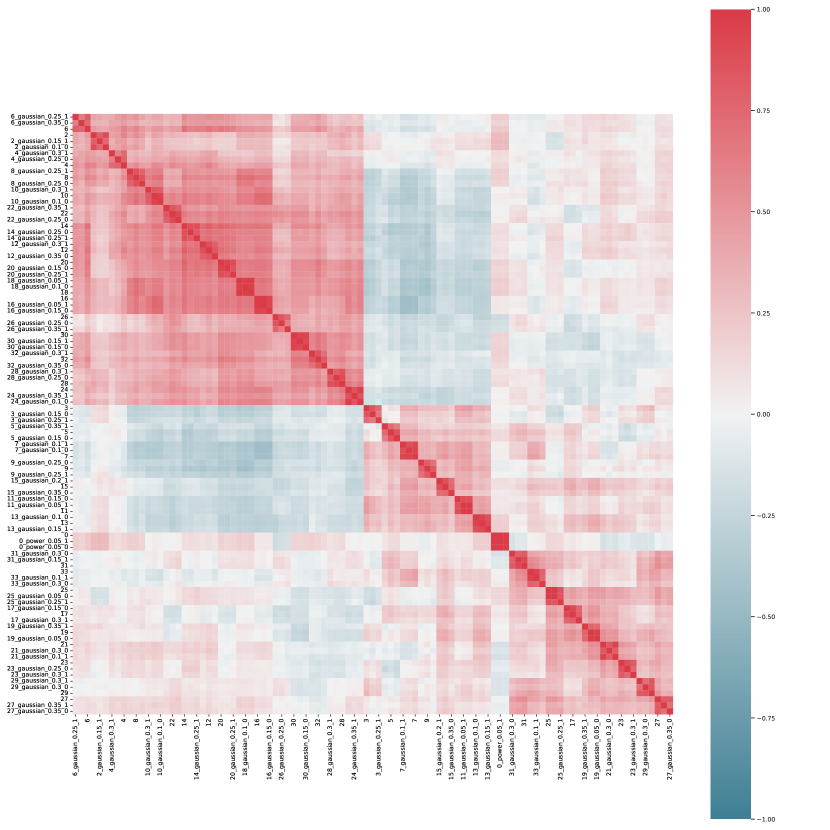
- The method successfully generated high-quality images even from low-dimensional datasets by introducing synthetic, correlated noise features that preserved data structure.
- The feature-to-pixel mapping enabled precise localization of original features within the generated images, enhancing model interpretability.
- Grad-CAM visualizations confirmed that the CNN focused on relevant image regions corresponding to important original features, such as 'Course' in the Tae dataset.
- The integration of type-specific distance measures for numerical and categorical features allowed accurate pairwise distance computation, improving image representation fidelity in mixed-type data.
Read this paper
Open the full text in the Nubint reader and ask about any passage as you read.
Read this paper on NubintThis review was generated by AI from the original paper. Please check the paper before citing it.