
[Paper Review] LMNet: Real-time Multiclass Object Detection on CPU using 3D LiDAR
LMNet is a real-time, single-stage 3D object detection network that uses only 3D LiDAR point clouds to detect vehicles, pedestrians, and cyclists on CPU. It employs dilated convolutions and multi-view point cloud projections to achieve up to 50 FPS on GPU and 10 FPS on Intel Core i5 CPU, making it suitable for real-time autonomous driving systems with open-sourced models and code.
This paper describes an optimized single-stage deep convolutional neural network to detect objects in urban environments, using nothing more than point cloud data. This feature enables our method to work regardless the time of the day and the lighting conditions.The proposed network structure employs dilated convolutions to gradually increase the perceptive field as depth increases, this helps to reduce the computation time by about 30%. The network input consists of five perspective representations of the unorganized point cloud data. The network outputs an objectness map and the bounding box offset values for each point. Our experiments showed that using reflection, range, and the position on each of the three axes helped to improve the location and orientation of the output bounding box. We carried out quantitative evaluations with the help of the KITTI dataset evaluation server. It achieved the fastest processing speed among the other contenders, making it suitable for real-time applications. We implemented and tested it on a real vehicle with a Velodyne HDL-64 mounted on top of it. We achieved execution times as fast as 50 FPS using desktop GPUs, and up to 10 FPS on a single Intel Core i5 CPU. The deploy implementation is open-sourced and it can be found as a feature branch inside the autonomous driving framework Autoware. Code is available at: https://github.com/CPFL/Autoware/tree/feature/cnn_lidar_detection
Motivation & Objective
- To develop a real-time, multi-class 3D object detection system using only LiDAR point cloud data for deployment on general-purpose CPUs.
- To achieve high inference speed without sacrificing detection accuracy, enabling real-time performance in autonomous vehicle systems.
- To design a lightweight, single-stage CNN architecture that processes 3D point clouds via multi-view projections and dilated convolutions.
- To implement and validate the network on a real vehicle equipped with a Velodyne HDL-64E LiDAR.
- To open-source the pre-trained models and inference code for broader research and deployment use.
Proposed method
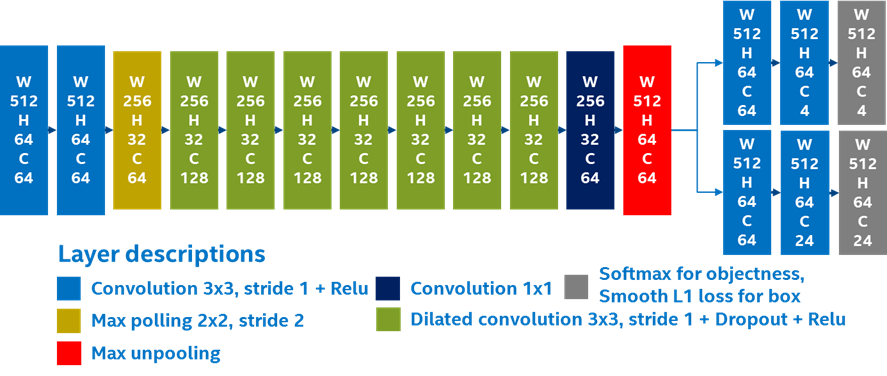
- The network takes five-channel input representations of unorganized point clouds: range, reflection, and x, y, z coordinates, projected into 2D perspective views.
- It uses a custom dilated convolutional layer stack with increasing dilation rates (1, 1, 2, 4, 8, 16, 32) to expand receptive fields progressively while reducing computation.
- The network outputs an objectness map and 3D bounding box offset predictions for each point, enabling per-point classification and regression.
- A dropout strategy and data augmentation are applied during training to improve generalization and reduce overfitting.
- The model is implemented using a Caffe fork optimized for Intel CPUs via Intel MKL, enabling efficient inference on general-purpose hardware.
- Input preprocessing includes point cloud projection using PCL and OpenCV, and the output is post-processed via non-maximum suppression to generate final detections.
Experimental results
Research questions
- RQ1Can a single-stage CNN achieve real-time 3D multi-class object detection using only LiDAR point cloud data on a general-purpose CPU?
- RQ2How does dilated convolutional architecture improve inference speed and receptive field coverage in 3D object detection without sacrificing accuracy?
- RQ3What is the performance of the model on real-world data compared to benchmark datasets like KITTI?
- RQ4Can the network maintain high detection accuracy while achieving sub-30ms inference times on consumer-grade hardware?
- RQ5How does the multi-view input encoding (range, reflection, and spatial coordinates) affect bounding box localization and orientation prediction?
Key findings
- LMNet achieved 50 FPS inference on a GTX 1080 GPU and 10 FPS on an Intel Core i5-6600K CPU, demonstrating real-time capability on general-purpose hardware.
- The model reached 15.24% average precision for cars, 11.46% for pedestrians, and 3.23% for cyclists in 3D detection on the KITTI dataset under moderate settings.
- The use of dilated convolutions increased the receptive field up to 127×127 while reducing computation by approximately 30% compared to standard convolutions.
- The network achieved 147 FPS (6.8ms inference time) on a Tesla P40, outperforming other state-of-the-art methods in speed.
- On a real vehicle with a Velodyne HDL-64E LiDAR, LMNet successfully classified and detected 3D objects in real-time, validating its deployment feasibility.
- The open-sourced implementation in Autoware and availability of pre-trained models enable reproducibility and broader adoption in autonomous driving research.

Read this paper
Open the full text in the Nubint reader and ask about any passage as you read.
Read this paper on NubintThis review was generated by AI from the original paper. Please check the paper before citing it.