
[Paper Review] Local Law 144: A Critical Analysis of Regression Metrics
This paper critically evaluates the regression bias metrics mandated by New York City's Local Law 144 for automated hiring tools, arguing that the proposed mean-based and median-based metrics fail to detect distributional bias. It introduces two improved metrics—AucDI and PfDI—that aggregate fairness across all thresholds, demonstrating through theoretical and real-world examples that these better capture hidden bias, especially at extreme quantiles.
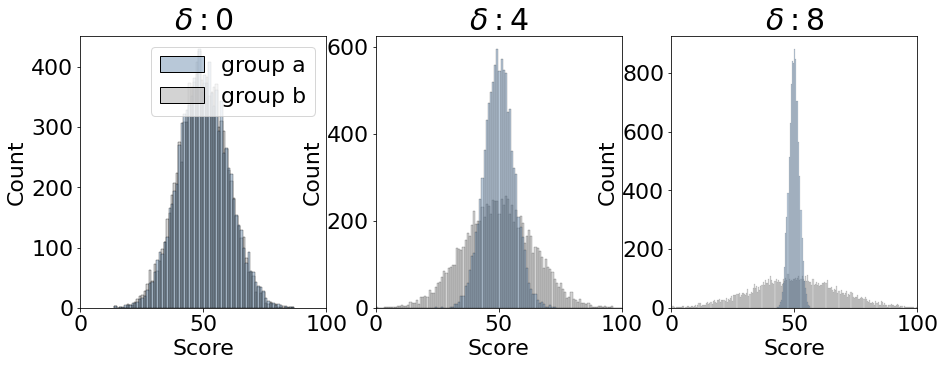
The use of automated decision tools in recruitment has received an increasing amount of attention. In November 2021, the New York City Council passed a legislation (Local Law 144) that mandates bias audits of Automated Employment Decision Tools. From 15th April 2023, companies that use automated tools for hiring or promoting employees are required to have these systems audited by an independent entity. Auditors are asked to compute bias metrics that compare outcomes for different groups, based on sex/gender and race/ethnicity categories at a minimum. Local Law 144 proposes novel bias metrics for regression tasks (scenarios where the automated system scores candidates with a continuous range of values). A previous version of the legislation proposed a bias metric that compared the mean scores of different groups. The new revised bias metric compares the proportion of candidates in each group that falls above the median. In this paper, we argue that both metrics fail to capture distributional differences over the whole domain, and therefore cannot reliably detect bias. We first introduce two metrics, as possible alternatives to the legislation metrics. We then compare these metrics over a range of theoretical examples, for which the legislation proposed metrics seem to underestimate bias. Finally, we study real data and show that the legislation metrics can similarly fail in a real-world recruitment application.
Motivation & Objective
- To evaluate the reliability of the two bias metrics proposed in NYC Local Law 144 for regression-based automated employment decision tools (AEDTs).
- To demonstrate that the mean-based and median-based metrics fail to detect distributional bias, especially when bias is concentrated at specific score thresholds.
- To introduce and validate two new fairness metrics—AucDI and PfDI—that aggregate bias across all possible thresholds to provide a more comprehensive fairness assessment.
- To compare the performance of all metrics on real-world recruitment data, showing that the law’s metrics can underdetermine bias in practice.
Proposed method
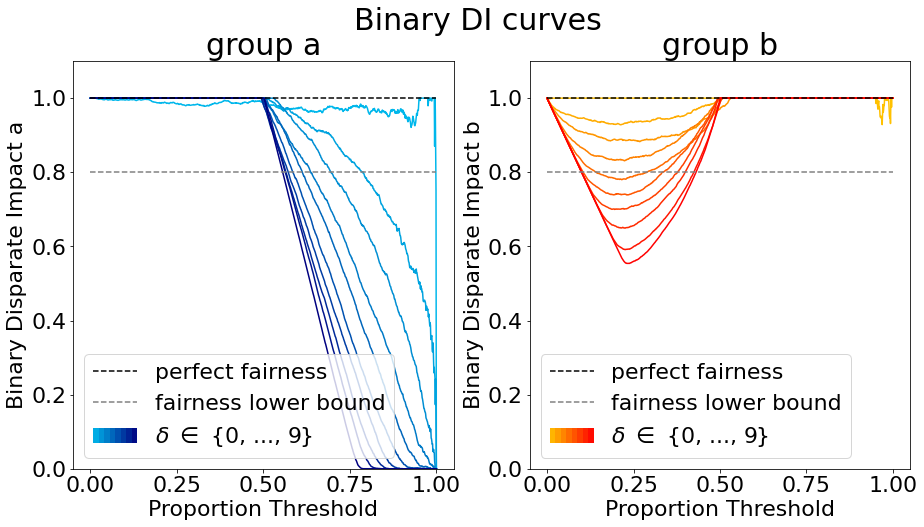
- Proposes AucDI, a metric that computes the area under the curve of disparate impact across all proportion thresholds, aggregating fairness information over the entire score distribution.
- Introduces PfDI, a probability-based metric that estimates the likelihood of achieving fair outcomes (DI ≥ 0.8) at a randomly selected threshold, with optional prior incorporation for contextual robustness.
- Applies both metrics to theoretical distributions with known bias, demonstrating their ability to detect bias where the law’s metrics fail.
- Evaluates all metrics—including MeanDI, MedDI, ThreshDI, AucDI, and PfDI—on real-world recruitment data to compare their sensitivity and reliability.
- Uses quantile-based domain transformation to enhance robustness to outliers and improve metric stability across different data regimes.
- Considers alternative binarization strategies (e.g., top-K selection, fixed score thresholds) and discusses trade-offs in metric design based on application context.
Experimental results
Research questions
- RQ1Do the regression bias metrics mandated by Local Law 144—MeanDI and MedDI—reliably detect distributional bias in AEDT outputs?
- RQ2Can alternative metrics that aggregate fairness across all thresholds detect bias that MeanDI and MedDI miss?
- RQ3How do AucDI and PfDI perform compared to existing metrics on real-world recruitment data?
- RQ4What role does the choice of thresholding strategy (e.g., fixed score, top-K, quantile-based) play in fairness metric reliability?
- RQ5Can statistical tests like the Kolmogorov-Smirnov test complement metric-based fairness assessments in real-world applications?
Key findings
- The MeanDI metric, based on ratio of group means, consistently underestimates bias and rarely triggers, even in clearly biased scenarios.
- The MedDI metric, based on proportion above the median, fails to detect bias that emerges only at higher score thresholds, such as the top 10% or 5% of candidates.
- AucDI effectively detects distributional bias by aggregating disparate impact across all proportion thresholds, showing strong sensitivity to hidden bias patterns.
- PfDI flags more cases of bias than other metrics and produces more extreme values, indicating higher sensitivity to fairness violations across thresholds.
- In real-world data, the law’s metrics fail to detect bias that is revealed only at specific quantiles, while AucDI and PfDI detect such bias consistently.
- The study concludes that using multiple metrics—especially AucDI and PfDI—is essential for a comprehensive fairness assessment, as no single metric captures all forms of bias.
Read this paper
Open the full text in the Nubint reader and ask about any passage as you read.
Read this paper on NubintThis review was generated by AI from the original paper. Please check the paper before citing it.