
[Paper Review] Log Probabilities Are a Reliable Estimate of Semantic Plausibility in Base and Instruction-Tuned Language Models
This paper investigates semantic plausibility estimation in base and instruction-tuned large language models (LLMs), demonstrating that log likelihood (LL) scores are a more reliable indicator of sentence plausibility than zero-shot prompting. Despite instruction tuning improving user alignment, it often degrades LL-based plausibility performance, while LL scores remain highly aligned with human judgments, especially in context-sensitive scenarios.
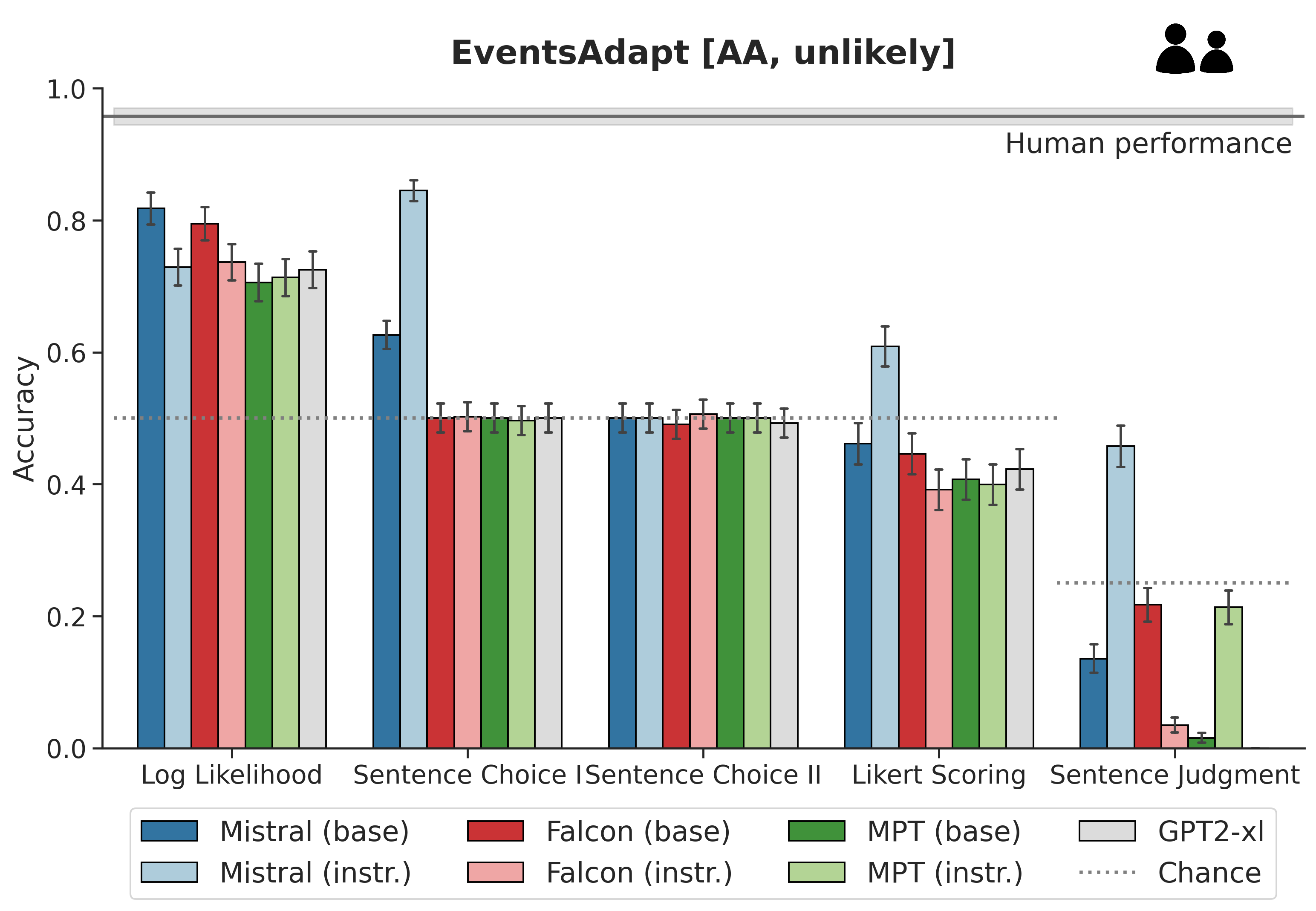
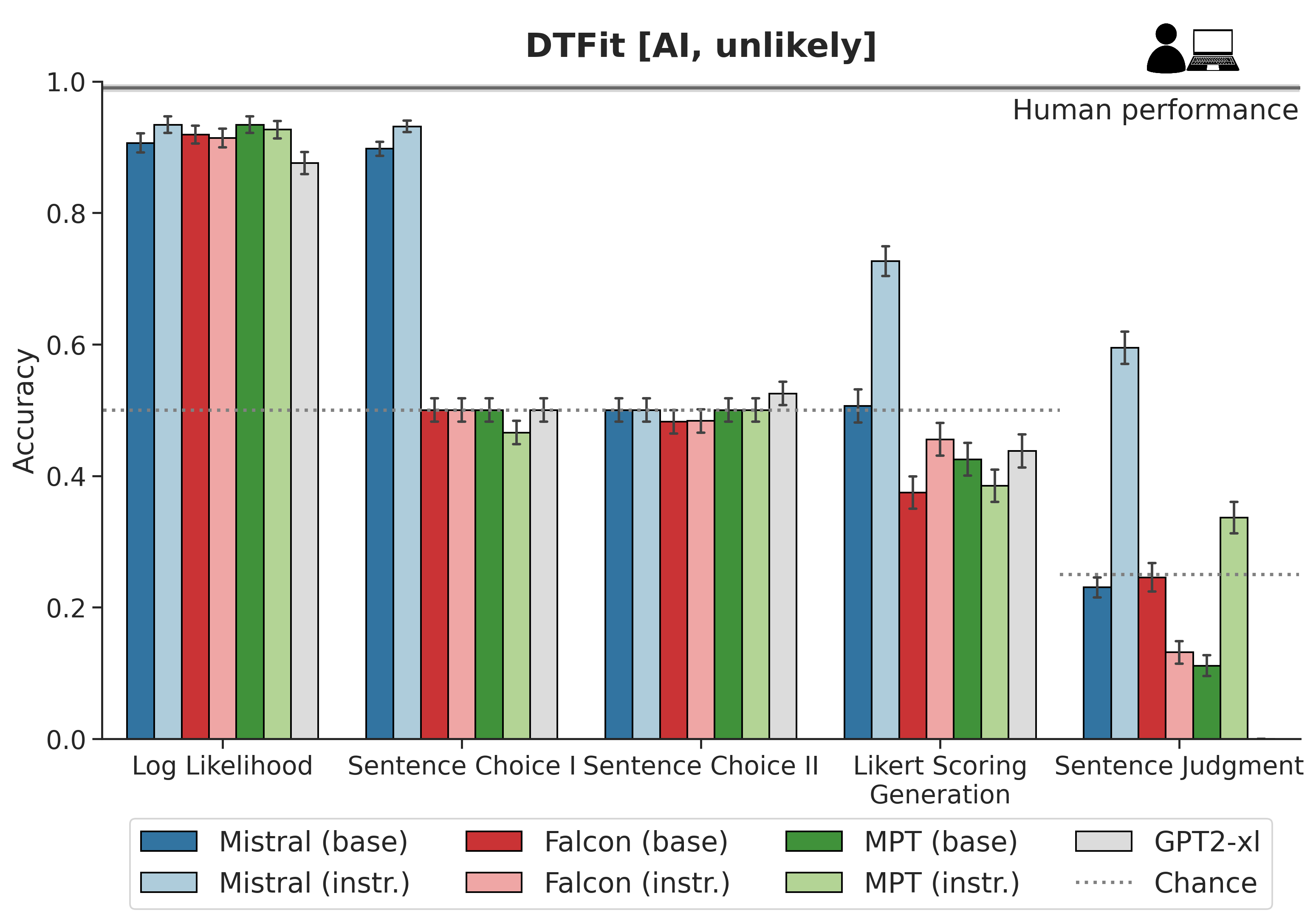
Semantic plausibility (e.g. knowing that "the actor won the award" is more likely than "the actor won the battle") serves as an effective proxy for general world knowledge. Language models (LMs) capture vast amounts of world knowledge by learning distributional patterns in text, accessible via log probabilities (LogProbs) they assign to plausible vs. implausible outputs. The new generation of instruction-tuned LMs can now also provide explicit estimates of plausibility via prompting. Here, we evaluate the effectiveness of LogProbs and basic prompting to measure semantic plausibility, both in single-sentence minimal pairs (Experiment 1) and short context-dependent scenarios (Experiment 2). We find that (i) in both base and instruction-tuned LMs, LogProbs offers a more reliable measure of semantic plausibility than direct zero-shot prompting, which yields inconsistent and often poor results; (ii) instruction-tuning generally does not alter the sensitivity of LogProbs to semantic plausibility (although sometimes decreases it); (iii) across models, context mostly modulates LogProbs in expected ways, as measured by three novel metrics of context-sensitive plausibility and their match to explicit human plausibility judgments. We conclude that, even in the era of prompt-based evaluations, LogProbs constitute a useful metric of semantic plausibility, both in base and instruction-tuned LMs.
Motivation & Objective
- To evaluate whether log likelihood (LL) scores or zero-shot prompting better estimate semantic plausibility in LLMs.
- To compare base models and instruction-tuned models in their ability to estimate plausibility via LL scores and prompting.
- To assess how context influences plausibility judgments in LLMs using both explicit prompting and implicit LL estimation.
- To determine whether LL scores can reliably model human-like sensitivity to contextual plausibility.
Proposed method
- The study uses a sentence plausibility task on English datasets, comparing base and instruction-tuned LLMs across multiple architectures.
- LL scores are computed directly from model probabilities without prompting, serving as an implicit measure of plausibility.
- Zero-shot prompting is used as an explicit method to query models about sentence plausibility.
- Contextual plausibility is evaluated by exposing models to full sentence-context pairs, measuring LL and prompting performance on target words.
- Human plausibility judgments are used as a gold standard for comparison across model outputs.
- Statistical analysis evaluates correlation between model outputs and human judgments, including context-sensitive patterns.
Experimental results
Research questions
- RQ1Do log likelihood scores provide a more reliable estimate of semantic plausibility than zero-shot prompting in base and instruction-tuned LLMs?
- RQ2How does instruction tuning affect the alignment of LLMs’ log likelihood scores with human plausibility judgments?
- RQ3Can LL scores effectively model context-sensitive plausibility, such as licensing effects in discourse?
- RQ4To what extent do LLMs' sentence-level LL scores reflect human-like sensitivity to semantic anomalies in context?
- RQ5Does the use of prompting systematically underestimate the model’s internal knowledge compared to direct LL estimation?
Key findings
- Log likelihood (LL) scores are the most reliable indicator of sentence plausibility across model architectures and datasets, outperforming zero-shot prompting.
- Instruction-tuned models exhibit worse LL-based performance on plausibility tasks than their base counterparts, indicating a degradation in implicit knowledge representation.
- LL scores show high performance on three metrics of context-sensitive plausibility and closely match human plausibility judgments in contextualized settings.
- Despite strong alignment in context-sensitive tasks, sentence-level LL scores often fail to distinguish semantically anomalous sentences from contextually licensed ones due to post-hoc likelihood rebalancing.
- Prompting results, while qualitatively matching human patterns in some cases, are less reliable than LL scores, especially when model access to internal probabilities is restricted.
- LL estimates remain a robust, zero-shot method for assessing implicit world knowledge in LLMs, even when prompting fails to capture the full scope of model knowledge.
Read this paper
Open the full text in the Nubint reader and ask about any passage as you read.
Read this paper on NubintThis review was generated by AI from the original paper. Please check the paper before citing it.