
[Paper Review] Logic-LM: Empowering Large Language Models with Symbolic Solvers for Faithful Logical Reasoning
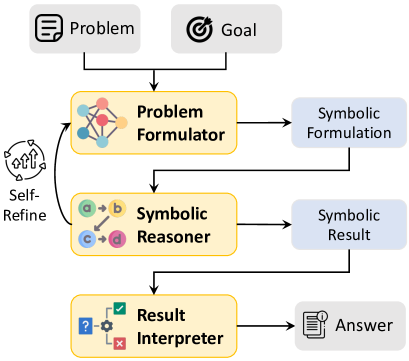
This paper proposes Logic-LM, a neuro-symbolic framework that enhances large language models (LLMs) with symbolic solvers to improve faithful logical reasoning. By using LLMs to translate natural language problems into symbolic logic, then applying deterministic symbolic inference engines, Logic-LM achieves a 39.2% average performance gain over standard prompting and 18.4% over chain-of-thought prompting across five logical reasoning datasets.
Large Language Models (LLMs) have shown human-like reasoning abilities but still struggle with complex logical problems. This paper introduces a novel framework, Logic-LM, which integrates LLMs with symbolic solvers to improve logical problem-solving. Our method first utilizes LLMs to translate a natural language problem into a symbolic formulation. Afterward, a deterministic symbolic solver performs inference on the formulated problem. We also introduce a self-refinement module, which utilizes the symbolic solver's error messages to revise symbolic formalizations. We demonstrate Logic-LM's effectiveness on five logical reasoning datasets: ProofWriter, PrOntoQA, FOLIO, LogicalDeduction, and AR-LSAT. On average, Logic-LM achieves a significant performance boost of 39.2% over using LLM alone with standard prompting and 18.4% over LLM with chain-of-thought prompting. Our findings suggest that Logic-LM, by combining LLMs with symbolic logic, offers a promising avenue for faithful logical reasoning. Code and data are publicly available at https://github.com/teacherpeterpan/Logic-LLM.
Motivation & Objective
- Address the issue of unfaithful reasoning in LLMs, where conclusions do not logically follow from reasoning steps.
- Overcome the limitations of purely neural reasoning by integrating symbolic logic systems that ensure logical fidelity.
- Leverage LLMs’ natural language understanding to generate accurate symbolic formulations of complex logical problems.
- Improve symbolic formalization accuracy through a self-refinement mechanism using error feedback from symbolic solvers.
- Demonstrate the effectiveness of combining LLMs with symbolic reasoning across diverse logical reasoning benchmarks.
Proposed method
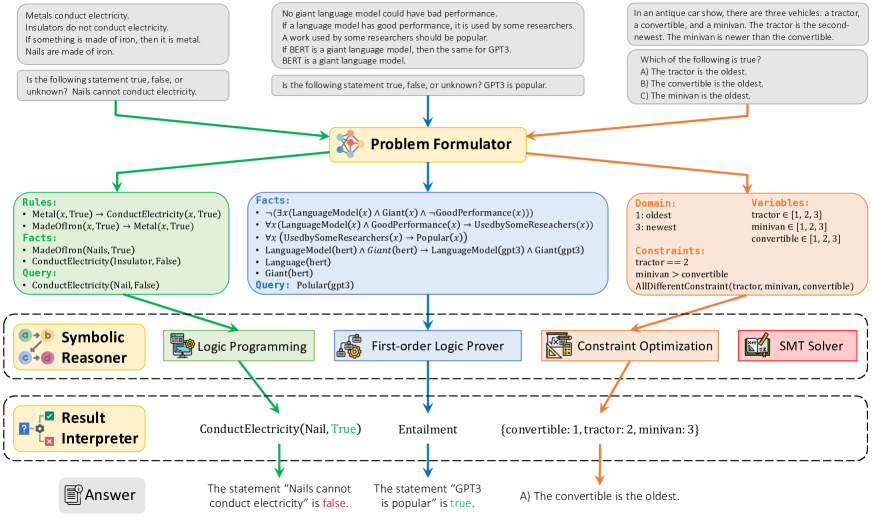
- Use a large language model (e.g., GPT-4) to translate natural language problems into symbolic logic representations (e.g., first-order logic, constraint satisfaction, SAT formulas).
- Employ domain-specific symbolic solvers—such as logic programming engines, FOL inference engines, constraint optimizers, and SAT solvers—for deterministic inference on the symbolic formulations.
- Introduce a self-refinement module that iteratively revises the symbolic formalization using error messages from the symbolic solver as feedback.
- Interpret the symbolic solver’s output and map it back to the original answer space for final prediction.
- Use few-shot in-context learning with demonstrations to guide the LLM in generating correct symbolic representations.
- Support multiple reasoning types including deductive reasoning, FOL reasoning, constraint satisfaction, and analytical reasoning via tailored symbolic tools.
Experimental results
Research questions
- RQ1Can combining LLMs with symbolic solvers significantly improve the faithfulness and accuracy of logical reasoning compared to standard prompting?
- RQ2How does the performance of the LLM-symbolic integration vary with increasing reasoning depth?
- RQ3To what extent can self-refinement using symbolic solver feedback improve the quality of symbolic formalizations?
- RQ4How effective is the framework across diverse logical reasoning tasks, including FOL, constraint satisfaction, and analytical reasoning?
- RQ5What are the primary failure modes in symbolic formalization by LLMs, and how do they impact overall reasoning performance?
Key findings
- Logic-LM achieves an average performance gain of 39.2% over standard prompting and 18.4% over chain-of-thought prompting across five logical reasoning datasets.
- The framework’s performance improves significantly with increasing reasoning depth, indicating strong scalability for complex problems.
- Self-refinement using symbolic solver error messages leads to measurable improvements in symbolic formalization accuracy.
- Error cases reveal that LLMs often misrepresent predicates, confuse spatial relations (e.g., 'above' vs. 'below'), or generate syntactically invalid FOL formulas.
- The method demonstrates robustness across diverse reasoning types, including deductive reasoning, FOL, CSP, and analytical reasoning.
- Despite challenges in symbolic formalization, the integration of symbolic solvers ensures logical faithfulness and transparency in reasoning outcomes.
Read this paper
Open the full text in the Nubint reader and ask about any passage as you read.
Read this paper on NubintThis review was generated by AI from the original paper. Please check the paper before citing it.