
[Paper Review] Low-cost singular value decomposition with optimal sensor placement
This paper introduces low-cost SVD (lcSVD), a computationally efficient variant of singular value decomposition that enables high-precision reconstruction of fluid dynamics datasets using minimal data points. By integrating optimal sensor placement (OS-lcSVD), it minimizes reconstruction error and reduces computational cost by up to 630× and memory usage by 37% compared to standard SVD, with errors below 0.5% in turbulent flows using optimally placed sensors.
This paper presents a new method capable of reconstructing datasets with great precision and very low computational cost using a novel variant of the singular value decomposition (SVD) algorithm that has been named low-cost SVD (lcSVD). This algorithm allows to reconstruct a dataset from a minimum amount of points, that can be selected randomly, equidistantly or can be calculated using the optimal sensor placement functionality that is also presented in this paper, which finds minimizing the reconstruction error to validate the calculated sensor positions. This method also allows to find the optimal number of sensors, aiding users in optimizing experimental data recollection. The method is tested in a series of datasets, which vary between experimental and numerical simulations, two- and three-dimensional data and laminar and turbulent flow, which have been used to demonstrate the capacity of this method based on its high reconstruction accuracy, robustness, and computational resource optimization. Maximum speed-up factors of 630 and memory reduction of 37% are found when compared to the application of standard SVD to the dataset. This method will be incorporated into ModelFLOWs-app's next version release.
Motivation & Objective
- To address the high computational and memory costs of standard SVD when processing large fluid mechanics datasets.
- To enable accurate data reconstruction from minimal, sparsely sampled data points—random, equidistant, or optimally placed.
- To develop a method that determines the optimal number of sensors and their positions to minimize reconstruction error.
- To reduce computational burden while maintaining high reconstruction fidelity in both experimental and numerical fluid dynamics data.
- To integrate the method into ModelFLOWs-app for broader application in data-driven fluid dynamics research.
Proposed method
- Proposes low-cost SVD (lcSVD), a modified SVD algorithm that reconstructs datasets using only a small subset of data points, significantly reducing computational load.
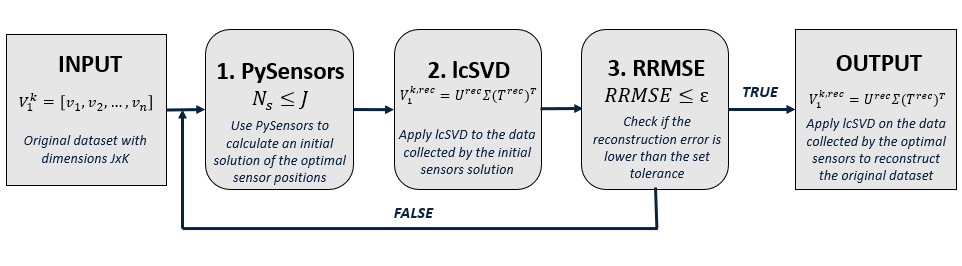
- Introduces optimal sensor placement (OS-lcSVD), an iterative algorithm that computes sensor positions minimizing reconstruction error for a given number of sensors.
- Uses the pysensors Python library to initialize sensor placement solutions, combining data-driven optimization with SVD-based reconstruction.
- Employs the elbow method and error tolerance thresholds to estimate the optimal number of sensors required for a desired reconstruction accuracy.
- Applies lcSVD and OS-lcSVD to diverse datasets, including 2D and 3D laminar and turbulent flows, to validate performance across data types.
- Uses memory_profiler to quantify memory consumption and compares execution times across SVD, lcSVD, and OS-lcSVD to evaluate efficiency.
Experimental results
Research questions
- RQ1Can a modified SVD algorithm reconstruct fluid dynamics datasets with high accuracy while drastically reducing computational cost?
- RQ2How does the performance of lcSVD compare to standard SVD in terms of speed, memory usage, and reconstruction error across different flow types?
- RQ3Can optimal sensor placement significantly reduce the number of sensors needed for accurate reconstruction without increasing error?
- RQ4What is the trade-off between computational cost and reconstruction accuracy when using OS-lcSVD versus lcSVD?
- RQ5To what extent can lcSVD and OS-lcSVD be generalized across experimental and numerical datasets of varying dimensionality and flow regimes?
Key findings
- lcSVD achieves a maximum computational speed-up of 630× over standard SVD when reconstructing turbulent boundary layer data using equidistant sampling.
- OS-lcSVD reduces memory consumption by up to 37% compared to standard SVD, with memory usage dropping from 19,438.3 MiB to 12,245.7 MiB in the 2D Cyl2600 dataset.
- Reconstruction errors remain below 0.5% when using OS-lcSVD with the minimum number of optimally placed sensors in turbulent flow datasets.
- The OS-lcSVD method increases computational cost by up to five times compared to lcSVD due to the optimization of sensor positions, but this is offset by superior data efficiency.
- The method successfully reconstructs both 2D and 3D laminar and turbulent flow datasets with high fidelity, demonstrating robustness across diverse data types.
- The lcSVD and OS-lcSVD algorithms will be integrated into the next release of ModelFLOWs-app, enhancing its utility for data-driven fluid dynamics applications.
Read this paper
Open the full text in the Nubint reader and ask about any passage as you read.
Read this paper on NubintThis review was generated by AI from the original paper. Please check the paper before citing it.