
[Paper Review] MAFormer: A Transformer Network with Multi-scale Attention Fusion for Visual Recognition
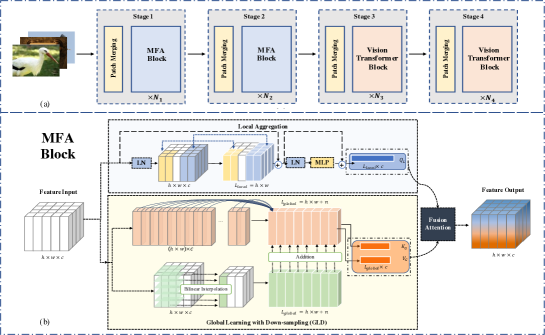
MAFormer proposes a dual-stream Transformer architecture with Multi-scale Attention Fusion (MAF) that jointly learns local fine-grained features via window attention and global coarse-grained features via a novel Global Learning with Down-sampling (GLD) module, dynamically fusing them through attention. It achieves state-of-the-art performance, attaining 85.9% Top-1 accuracy on ImageNet and surpassing prior models like CSWin and LV-ViT on object detection and instance segmentation with similar parameters.
Vision Transformer and its variants have demonstrated great potential in various computer vision tasks. But conventional vision transformers often focus on global dependency at a coarse level, which suffer from a learning challenge on global relationships and fine-grained representation at a token level. In this paper, we introduce Multi-scale Attention Fusion into transformer (MAFormer), which explores local aggregation and global feature extraction in a dual-stream framework for visual recognition. We develop a simple but effective module to explore the full potential of transformers for visual representation by learning fine-grained and coarse-grained features at a token level and dynamically fusing them. Our Multi-scale Attention Fusion (MAF) block consists of: i) a local window attention branch that learns short-range interactions within windows, aggregating fine-grained local features; ii) global feature extraction through a novel Global Learning with Down-sampling (GLD) operation to efficiently capture long-range context information within the whole image; iii) a fusion module that self-explores the integration of both features via attention. Our MAFormer achieves state-of-the-art performance on common vision tasks. In particular, MAFormer-L achieves 85.9$\%$ Top-1 accuracy on ImageNet, surpassing CSWin-B and LV-ViT-L by 1.7$\%$ and 0.6$\%$ respectively. On MSCOCO, MAFormer outperforms the prior art CSWin by 1.7$\%$ mAPs on object detection and 1.4$\%$ on instance segmentation with similar-sized parameters, demonstrating the potential to be a general backbone network.
Motivation & Objective
- To address the limitation of conventional Vision Transformers in capturing both fine-grained local and long-range global dependencies simultaneously.
- To overcome the incompatibility and training ambiguity between convolution and self-attention in hybrid models.
- To design a unified, end-to-end trainable framework that effectively fuses local and global features at the token level.
- To develop a general-purpose backbone for vision tasks that outperforms existing Vision Transformers and CNNs.
- To enable efficient long-range context modeling without the quadratic complexity of standard self-attention.
Proposed method
- Introduces a Multi-scale Attention Fusion (MAF) block with two parallel streams: a local window attention branch for short-range feature aggregation.
- Proposes a Global Learning with Down-sampling (GLD) module that captures long-range context from the full input image via downsampling and self-attention.
- Employs positional embeddings to encode token-level spatial location information in the global stream.
- Fuses local and global features through a learnable attention-based fusion module that enables co-adaptive training of both representations.
- Employs a dual-stream architecture where MAF blocks are used in early stages, followed by standard attention in deeper layers.
- Uses a simple, parameter-efficient design without additional modules or complex operations, relying on attention-based fusion for feature integration.
Experimental results
Research questions
- RQ1Can a dual-stream Transformer architecture effectively learn and fuse local and global representations at the token level for improved visual recognition?
- RQ2Does the proposed Global Learning with Down-sampling (GLD) module enable efficient long-range context modeling while maintaining computational efficiency?
- RQ3How does the Multi-scale Attention Fusion (MAF) mechanism improve feature representation compared to standard self-attention or late fusion strategies?
- RQ4To what extent does MAFormer outperform existing Vision Transformers and CNNs on dense prediction tasks like object detection and instance segmentation?
- RQ5Can MAFormer serve as a strong, general-purpose backbone for self-supervised pre-training in vision tasks?
Key findings
- MAFormer-L achieves 85.9% Top-1 accuracy on ImageNet, outperforming CSWin-B by 1.7% and LV-ViT-L by 0.6%.
- On MSCOCO object detection, MAFormer-B achieves 49.6% box mAP, surpassing CSWin by 1.7% with similar parameter count.
- On MSCOCO instance segmentation, MAFormer-B achieves 49.6% mask mAP, exceeding CSWin by 1.4% under the same configuration.
- On ADE20K semantic segmentation with UPerNet, MAFormer-B achieves 51.1% mIoU and 51.6% MS mIoU, outperforming Swin-Base by 3.0 and 2.5 percentage points respectively.
- MAFormer-S achieves 47.9% mIoU on ADE20K with Semantic FPN, 6.4 percentage points higher than Swin-T.
- Even with a 1x training schedule, MAFormer variants consistently outperform prior SOTA models across all benchmarks, demonstrating strong generalization and scalability.

Read this paper
Open the full text in the Nubint reader and ask about any passage as you read.
Read this paper on NubintThis review was generated by AI from the original paper. Please check the paper before citing it.