
[Paper Review] Magneto-Optical Detection of the Orbital Hall Effect in Chromium
The study uses longitudinal magneto-optical Kerr effect (MOKE) and ab initio calculations to directly detect current-induced orbital accumulation in Cr(001), quantifying the orbital Hall effect (OHE) and extracting an orbital diffusion length of 6.6 ± 0.6 nm.
The orbital Hall effect has been theoretically predicted but its direct observation is a challenge. Here, we report the magneto-optical detection of current-induced orbital accumulation at the surface of a light 3d transition metal, Cr. The orbital polarization is in-plane, transverse to the current direction, and scales linearly with current density, consistent with the orbital Hall effect. Comparing the thickness-dependent magneto-optical measurements with ab initio calculations, we estimate an orbital diffusion length in Cr of 6.6±0.6 nm.
Motivation & Objective
- Motivate and detect the orbital Hall effect (OHE) in a single non-magnetic metal to avoid interfacial spin-orbittorque complications.
- Demonstrate that MOKE can distinguish orbital accumulation from spin accumulation in a low-SOC metal.
- Quantitatively extract the orbital diffusion length and orbital Hall angle in Cr through thickness-dependent measurements and theory.
Proposed method
- Perform longitudinal MOKE on Cr(001) films (7.5–50 nm) under modulated current to detect current-induced orbital accumulation at surfaces.
- Use 800 nm light at 45 degrees incidence with Kerr rotation readout, including polarity reversal and sample rotation tests to identify OHE/SHE origin.
- Compare thickness-dependent Kerr signals with ab initio calculations of OHE, SHE, and MOKE in Cr to extract diffusion lengths and Kerr contributions.
- Model thickness dependence of Kerr rotation with orbital/spin diffusion formalisms and Fuchs–Sondheimer resistivity to separate orbital and spin transport effects.
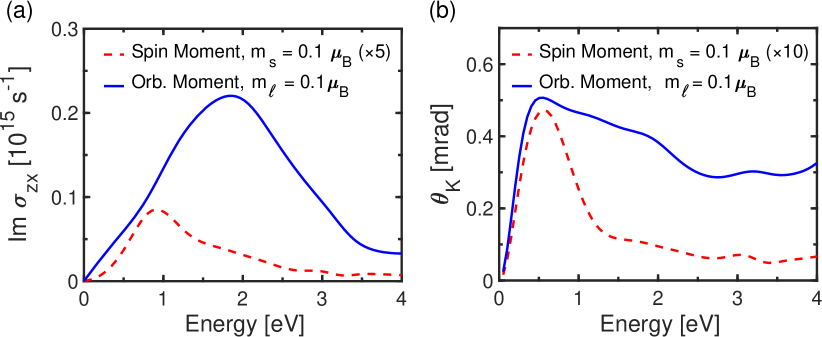
- Compute ab initio σzx^OH and σzx^SH, along with bulk Kerr-contributions ΦK^bulk,o and ΦK^bulk,s, to predict MOKE signals and fit to experimental data.
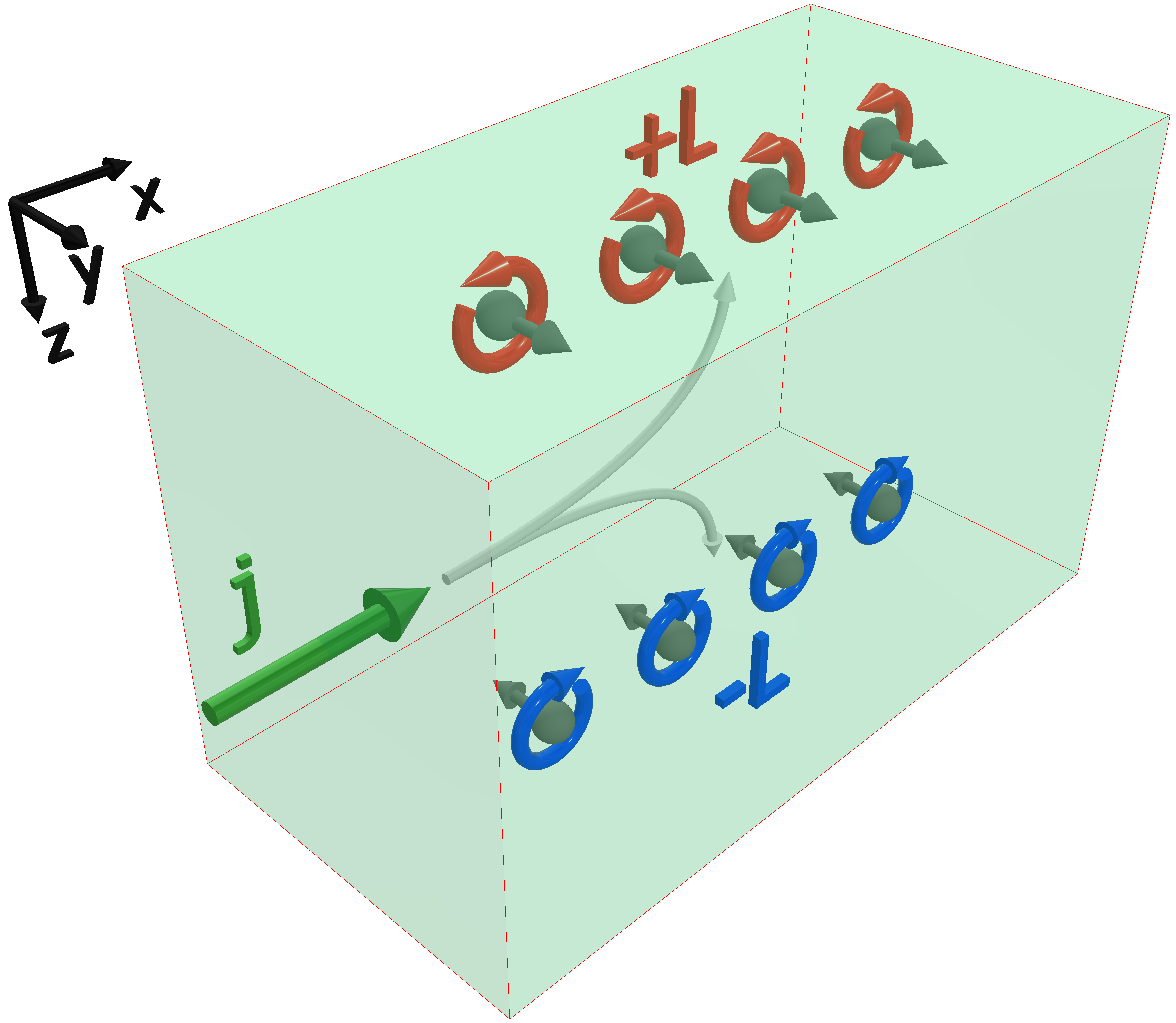
Experimental results
Research questions
- RQ1Can the OHE be directly detected in a single non-magnetic layer using MOKE without interfacial spin-orbit artifacts?
- RQ2What is the magnitude of current-induced orbital accumulation in Cr, and what is its diffusion length?
- RQ3How does the thickness of Cr influence the MOKE signal due to OHE versus SHE, and can this disentangle orbital from spin contributions?
- RQ4What are the ab initio values for orbital Hall conductivity and Kerr-response, and how do they compare with experimental measurements?
Key findings
- Measured current-induced Kerr rotation on Cr(001) surfaces is of a few nanoradians and scales linearly with current density.
- Control measurements (incidence reversal, Cr/MgO interface, Cr vs Pt) support an orbital accumulation origin rather than spin or interfacial effects.
- Thickness-dependent fits yield an orbital diffusion length l_o = 6.6 ± 0.6 nm and an average value from two methods around 6.5–6.6 nm.
- Ab initio calculations show σzx^OH ≈ 7000 (ħ/e) Ω^-1 cm^-1, σzx^SH ≈ -70 (ħ/e) Ω^-1 cm^-1, indicating a dominant orbital contribution to the Kerr signal.
- Calculated Kerr response from orbital polarization is more than ten times larger than that from spin polarization, consistent with the measured signals.
- Estimated orbital Hall angle in Cr, θ^OH ≈ 0.28, using ab initio OH conductivity and film resistivity.
Read this paper
Open the full text in the Nubint reader and ask about any passage as you read.
Read this paper on NubintThis review was generated by AI from the original paper. Please check the paper before citing it.