
[Paper Review] Mapping the galaxy-halo connection to the galaxy bias: implication to the HOD-informed prior
This study investigates how different Halo Occupation Distribution (HOD) models—particularly those including halo concentration-dependent assembly bias—affect the prior distributions of galaxy bias parameters, especially quadratic bias $b_2$. Using high-precision measurements via the quadratic field method on HOD-based galaxy mock catalogs, the authors find that assembly bias significantly alters the distribution of $b_2$, implying that galaxy-halo connection models must be carefully accounted for in cosmological analyses to avoid biased constraints on cosmological parameters.
The galaxy bias parameters are crucial for modeling the large-scale structure in cosmology, yet uncertainties in these parameters often degrade the precision of cosmological constraints. In this work, we investigate how different Halo Occupation Distribution (HOD) models impact the priors of the galaxy bias parameters, particularly focusing on quadratic bias parameters. We generate galaxy mock catalogs using various HOD models, including a standard model and one incorporating halo concentration dependence to account for assembly bias, and measure the galaxy bias parameters with high precision using the quadratic field method. We show that the inclusion of assembly bias associated to halo concentration could significantly impact the distributions of quadratic galaxy bias parameters, especially $b_2$. Our findings suggest that accounting for assembly bias or other galaxy-halo connection models is important for obtaining accurate priors on the galaxy bias parameters, thereby improving the robustness of cosmological analyses with galaxy clustering.
Motivation & Objective
- To assess how variations in HOD models—especially those incorporating halo concentration dependence—impact the prior distributions of galaxy bias parameters.
- To improve the robustness of cosmological constraints by deriving tighter, more accurate priors on galaxy bias parameters using HOD-informed modeling.
- To evaluate the sensitivity of bias parameter distributions to the choice of galaxy-halo connection model, particularly in the context of quadratic bias $b_2$.
- To demonstrate the importance of accounting for assembly bias in HOD-based priors to mitigate prior volume effects and reduce bias in cosmological parameter estimation.
Proposed method
- Generates large-scale galaxy mock catalogs using multiple HOD models, including a standard model and one with halo concentration dependence to model assembly bias.
- Employs the quadratic field method to measure galaxy bias parameters with high precision by leveraging cross-correlations between galaxy density and quadratic combinations of the initial density field.
- Uses the Eulerian field-level comparison approach to reduce sample variance and improve statistical accuracy in bias estimation.
- Compares bias parameter distributions across different HOD models to assess sensitivity to galaxy-halo assignment and assembly bias effects.
- Validates the quadratic field method by comparing results with existing literature and separate universe simulations, confirming consistency in halo bias measurements.
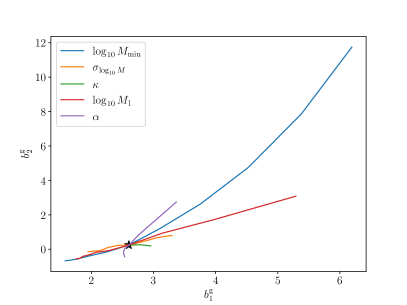
- Analyzes the scatter between different bias parameter combinations (e.g., $b_1^g$ vs. $b_2^g$ and $b_1^g$ vs. $b_{ ilde{G}_2}^g$) to identify robust basis combinations less sensitive to HOD details.
Experimental results
Research questions
- RQ1How does the inclusion of halo concentration dependence in the HOD model affect the distribution of quadratic galaxy bias parameters, particularly $b_2$?
- RQ2To what extent do different HOD models alter the prior distributions of galaxy bias parameters in cosmological clustering analyses?
- RQ3Are the resulting bias parameter priors robust across different galaxy-halo connection models, or are they sensitive to specific HOD assumptions?
- RQ4Can the quadratic field method provide a reliable and precise measurement of galaxy bias parameters for use in HOD-informed priors?
- RQ5Is there a combination of bias parameters that exhibits reduced sensitivity to HOD model details, suggesting a more robust basis for cosmological inference?
Key findings
- The inclusion of halo concentration-dependent assembly bias in the HOD model leads to a significant shift in the distribution of the quadratic bias parameter $b_2$.
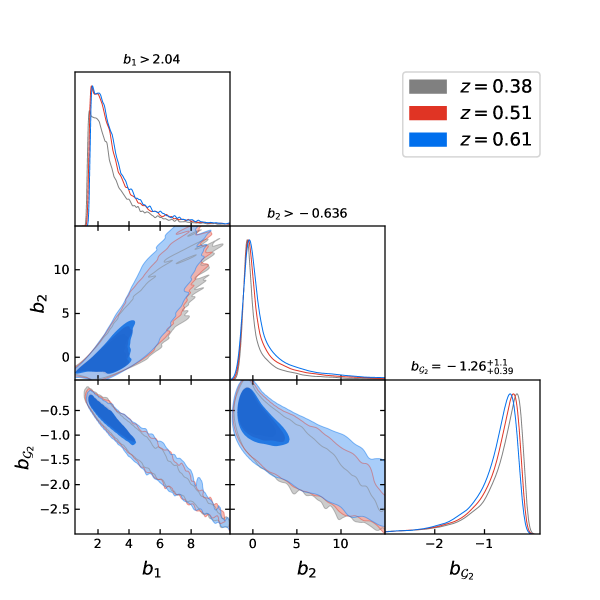
- The scatter in $b_2$ across different HOD models is larger than the scatter in linear bias $b_1$, indicating that $b_2$ is more sensitive to galaxy-halo connection modeling.
- The distribution of $b_2$ is strongly influenced by the presence of assembly bias, suggesting that neglecting such effects can lead to biased or imprecise priors.
- The quadratic field method enables high-precision bias measurements with reduced sample variance, validating its use for deriving robust priors.
- The comparison between $b_1^g$ and $b_2^g$ versus $b_1^g$ and $b_{ ilde{G}_2}^g$ reveals that the latter pair exhibits smaller scatter across HOD models, suggesting a more robust basis for bias parameter combinations.
- The measured halo bias parameters ($\tilde{b}_2^h$, $b_{K^2}^h$) are in excellent agreement with existing literature, confirming the reliability of the method and its consistency with separate universe simulations and bispectrum-based measurements.
Read this paper
Open the full text in the Nubint reader and ask about any passage as you read.
Read this paper on NubintThis review was generated by AI from the original paper. Please check the paper before citing it.