
[Paper Review] Measuring agreement among several raters classifying subjects into one or more (hierarchical) categories: A generalization of Fleiss' kappa
This paper introduces a generalized Fleiss' kappa statistic that measures inter-rater reliability when multiple raters classify subjects into one or more nominal categories, including hierarchical and weighted categories. It extends Fleiss' kappa by accounting for agreement in both selections and non-selections, ensuring chance-corrected reliability even when raters assign multiple categories, and maintains consistency with Fleiss' kappa under single-category classification.
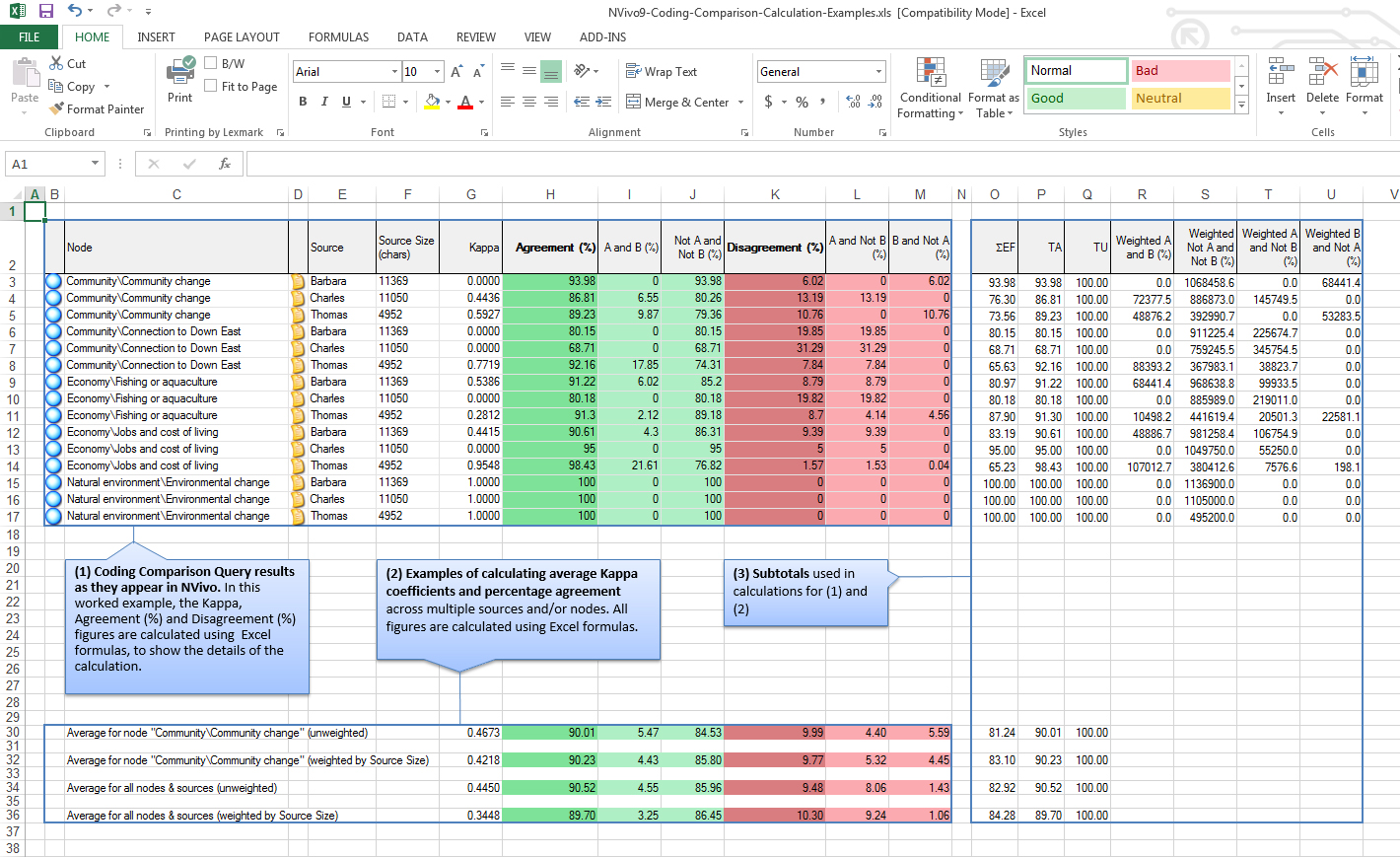
Cohen's and Fleiss' kappa are well-known measures of inter-rater agreement, but they restrict each rater to selecting only one category per subject. This limitation is consequential in contexts where subjects may belong to multiple categories, such as psychiatric diagnoses involving multiple disorders or classifying interview snippets into multiple codes of a codebook. We propose a generalized version of Fleiss' kappa, which accommodates multiple raters assigning subjects to one or more nominal categories. Our proposed $κ$ statistic can incorporate category weights based on their importance and account for hierarchical category structures, such as primary disorders with sub-disorders. The new $κ$ statistic can also manage missing data and variations in the number of raters per subject or category. We review existing methods that allow for multiple category assignments and detail the derivation of our measure, proving its equivalence to Fleiss' kappa when raters select a single category per subject. The paper discusses the assumptions, premises, and potential paradoxes of the new measure, as well as the range of possible values and guidelines for interpretation. The measure was developed to investigate the reliability of a new mathematics assessment method, of which an example is elaborated. The paper concludes with a worked-out example of psychiatrists diagnosing patients with multiple disorders. All calculations are provided as R script and an Excel sheet to facilitate access to the new $κ$ tatistic.
Motivation & Objective
- To address the limitation of existing inter-rater reliability measures like Cohen’s and Fleiss’ kappa, which require raters to assign exactly one category per subject.
- To develop a chance-corrected reliability measure that allows multiple category assignments while preserving interpretability and statistical rigor.
- To incorporate hierarchical dependencies between categories (e.g., primary and sub-disorders) and weighted importance of categories in the agreement calculation.
- To ensure the measure remains consistent with Fleiss’ kappa when only one category is assigned per subject.
- To enable practical use in research contexts such as psychiatric diagnosis and educational assessment where multiple diagnoses or criteria are common.
Proposed method
- The proposed kappa statistic computes observed agreement $ P_o $ as the average pairwise agreement across raters, adjusted for multiple category assignments.
- It defines expected agreement by chance $ P_e $ based on marginal probabilities of category assignments across all raters and subjects.
- The measure uses a symmetric agreement definition: two raters agree if they both select or both omit the same category, regardless of category count.
- It generalizes Fleiss’ formula by allowing $ x_{ic} $ to represent the number of raters assigning category $ c $ to subject $ i $, even when $ \sum_c x_{ic} > J $.
- The method supports weighted categories (e.g., by clinical importance) and hierarchical structures (e.g., subcategories only available if parent category is selected).
- The approach handles missing data and varying numbers of raters per subject or category, ensuring robustness in real-world data.
Experimental results
Research questions
- RQ1How can inter-rater reliability be measured when raters assign multiple categories to each subject, rather than just one?
- RQ2What is the appropriate chance-corrected agreement coefficient when categories are hierarchical or weighted?
- RQ3How does the proposed measure compare to existing methods like proportional overlap or chance-corrected correlations in terms of consistency and interpretability?
- RQ4Can the proposed statistic maintain equivalence with Fleiss’ kappa when only one category is assigned per subject?
- RQ5What are the practical implications of ignoring agreement in non-selection (i.e., both raters omitting a category) in reliability analysis?
Key findings
- The proposed kappa statistic reduces to Fleiss’ kappa when each subject is assigned exactly one category by all raters, ensuring consistency with established methods.
- The measure accounts for agreement in both selections and omissions, avoiding the bias introduced by methods that ignore non-selection.
- The method supports hierarchical category structures, such as primary psychiatric disorders with associated sub-disorders, by modeling dependencies between categories.
- Weighted categories can be incorporated, allowing researchers to assign different importance levels to categories based on context.
- The approach handles missing data and variable rater counts per subject or category, increasing practical applicability.
- The authors plan to release an R package to facilitate adoption, and a simulation study is envisioned to show lower root-mean-square error than alternative methods.
Read this paper
Open the full text in the Nubint reader and ask about any passage as you read.
Read this paper on NubintThis review was generated by AI from the original paper. Please check the paper before citing it.