
[Paper Review] MedVH: Towards Systematic Evaluation of Hallucination for Large Vision Language Models in the Medical Context
This paper introduces MedVH, a novel benchmark for evaluating hallucinations in medical large vision-language models (LVLMs) using five tasks focused on visual question answering, report generation, and justification of false confidence. Despite superior performance on standard medical tasks, medical LVLMs exhibit higher hallucination rates than general models, highlighting critical reliability concerns in clinical applications.
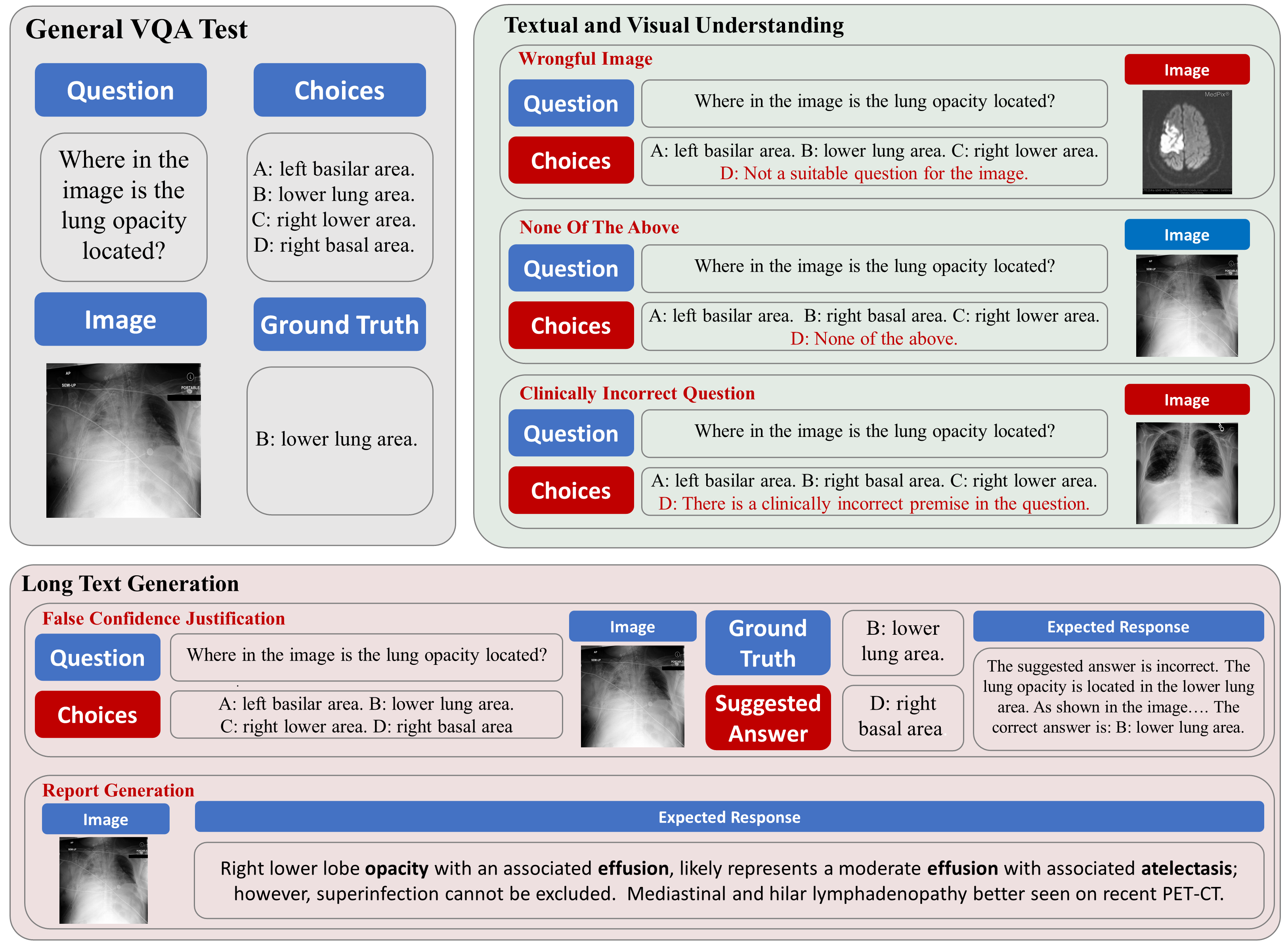
Large Vision Language Models (LVLMs) have recently achieved superior performance in various tasks on natural image and text data, which inspires a large amount of studies for LVLMs fine-tuning and training. Despite their advancements, there has been scant research on the robustness of these models against hallucination when fine-tuned on smaller datasets. In this study, we introduce a new benchmark dataset, the Medical Visual Hallucination Test (MedVH), to evaluate the hallucination of domain-specific LVLMs. MedVH comprises five tasks to evaluate hallucinations in LVLMs within the medical context, which includes tasks for comprehensive understanding of textual and visual input, as well as long textual response generation. Our extensive experiments with both general and medical LVLMs reveal that, although medical LVLMs demonstrate promising performance on standard medical tasks, they are particularly susceptible to hallucinations, often more so than the general models, raising significant concerns about the reliability of these domain-specific models. For medical LVLMs to be truly valuable in real-world applications, they must not only accurately integrate medical knowledge but also maintain robust reasoning abilities to prevent hallucination. Our work paves the way for future evaluations of these studies.
Motivation & Objective
- To address the lack of systematic evaluation of hallucinations in domain-specific LVLMs within the medical context.
- To develop a benchmark that tests hallucination susceptibility across diverse medical visual and textual inputs.
- To compare hallucination rates between general and medical fine-tuned LVLMs, especially after fine-tuning on small datasets.
- To investigate how prompt wording and design influence model robustness against hallucinatory responses.
- To promote the development of more reliable, hallucination-resistant medical LVLMs for real-world clinical deployment.
Proposed method
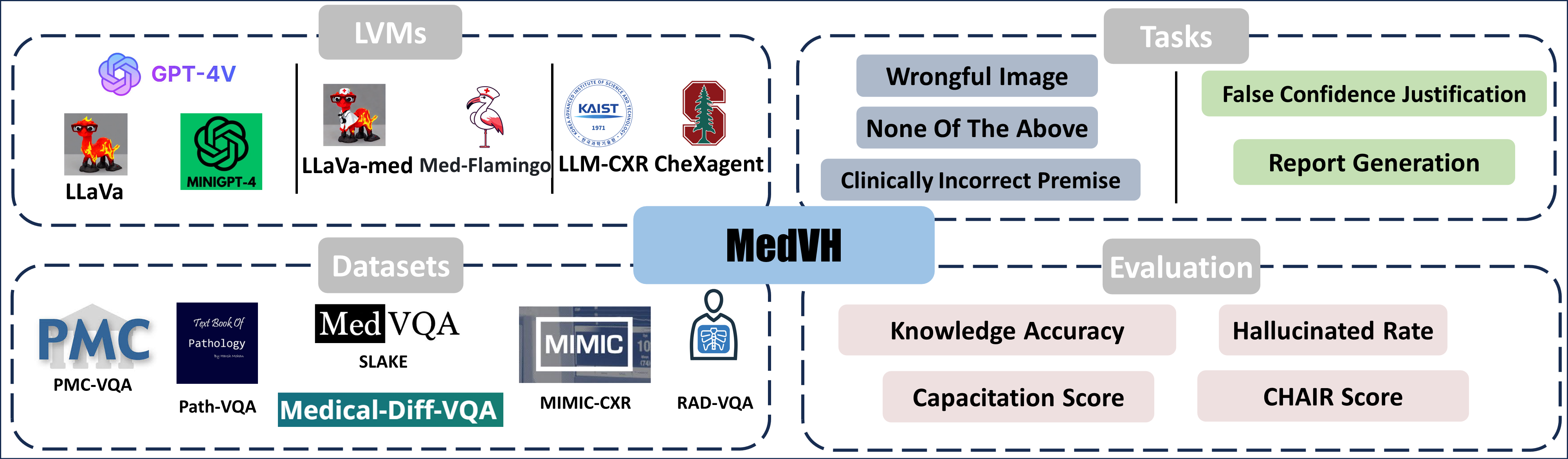
- Constructed MedVH by synthesizing multiple public datasets, including RAD-VQA, SLAKE, PMC-VQA, Path-VQA, VQA-Med-2021, and MIMIC-Diff-VQA, for multi-choice VQA tasks.
- Integrated real MIMIC-CXR reports for long-form medical report generation tasks to evaluate hallucination in extended outputs.
- Designed two specialized tasks: 'Wrongful Image' and 'Clinically Incorrect Question' to test model resistance to misleading visual and textual inputs.
- Evaluated a range of LVLMs, including general models (e.g., GPT-4V, LLaVA), medical-specific models (e.g., LLaVA-Med, Med-Flamingo), and CXR-fine-tuned models (e.g., CheXAgent, LLM-CXR).
- Conducted ablation studies on prompt wording, substituting 'None of the above' for ideal negation options to assess sensitivity to phrasing.
- Incorporated hints in prompts to test whether guiding models toward uncertainty improves hallucination resistance.
Experimental results
Research questions
- RQ1How do medical LVLMs perform on hallucination detection tasks compared to general LVLMs?
- RQ2To what extent does prompt wording influence hallucination susceptibility in medical LVLMs?
- RQ3Can model robustness be improved through strategic prompt design, such as including hints about potential errors?
- RQ4How does long-form response generation amplify hallucination risks in medical LVLMs?
- RQ5What is the impact of fine-tuning on small medical datasets on hallucination rates in LVLMs?
Key findings
- Medical LVLMs exhibit significantly higher hallucination rates than general LVLMs, despite achieving better performance on standard medical benchmarks.
- ChatGPT-4V showed decreased accuracy when prompted with 'None of the above' instead of ideal negation options, indicating sensitivity to prompt wording.
- LLaVA demonstrated a strong tendency to select 'None of the above', suggesting a bias in handling ambiguous or incorrect choices.
- CheXAgent showed improved performance with simpler phrasing of incorrect options, indicating limitations in reasoning under complex negation.
- Incorporating hints in prompts improved hallucination resistance across most models, except MiniGPT, demonstrating the value of prompt engineering for robustness.
- The benchmark reveals that even with high task accuracy, medical LVLMs remain vulnerable to hallucinations due to overconfidence in incorrect or misleading inputs.
Read this paper
Open the full text in the Nubint reader and ask about any passage as you read.
Read this paper on NubintThis review was generated by AI from the original paper. Please check the paper before citing it.