
[Paper Review] Memory in Plain Sight: Surveying the Uncanny Resemblances of Associative Memories and Diffusion Models
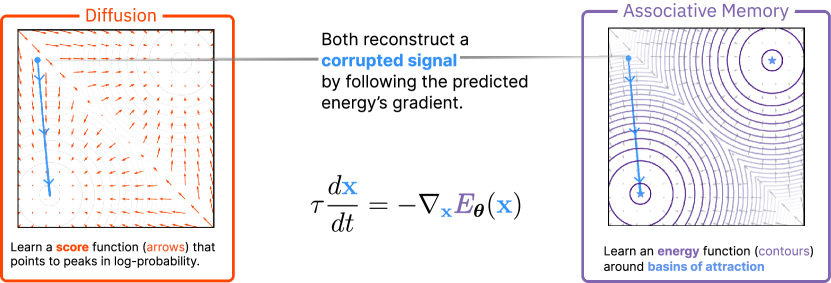
This paper reveals a deep mathematical equivalence between diffusion models and associative memories, showing that both operate as gradient descent on a Lyapunov energy function toward fixed-point attractors. By framing diffusion models as energy-based systems akin to Hopfield networks, the work enables theoretical guarantees on convergence, memory capacity, and optimization, while unifying generative modeling and memory retrieval under a common dynamical systems framework.
The generative process of Diffusion Models (DMs) has recently set state-of-the-art on many AI generation benchmarks. Though the generative process is traditionally understood as an "iterative denoiser", there is no universally accepted language to describe it. We introduce a novel perspective to describe DMs using the mathematical language of memory retrieval from the field of energy-based Associative Memories (AMs), making efforts to keep our presentation approachable to newcomers to both of these fields. Unifying these two fields provides insight that DMs can be seen as a particular kind of AM where Lyapunov stability guarantees are bypassed by intelligently engineering the dynamics (i.e., the noise and step size schedules) of the denoising process. Finally, we present a growing body of evidence that records DMs exhibiting empirical behavior we would expect from AMs, and conclude by discussing research opportunities that are revealed by understanding DMs as a form of energy-based memory.
Motivation & Objective
- To establish a formal mathematical connection between diffusion models and associative memories using dynamical systems and ODEs.
- To demonstrate that diffusion models' reverse denoising process is equivalent to energy gradient descent in associative memories.
- To reveal theoretical advantages of associative memories—such as guaranteed convergence to fixed points—that are missing in standard diffusion models.
- To inspire new research directions in generative modeling by reinterpreting diffusion and transformer architectures through the lens of associative memory theory.
- To provide a theoretical foundation for understanding scaling laws in large models via memory capacity in energy-based systems.
Proposed method
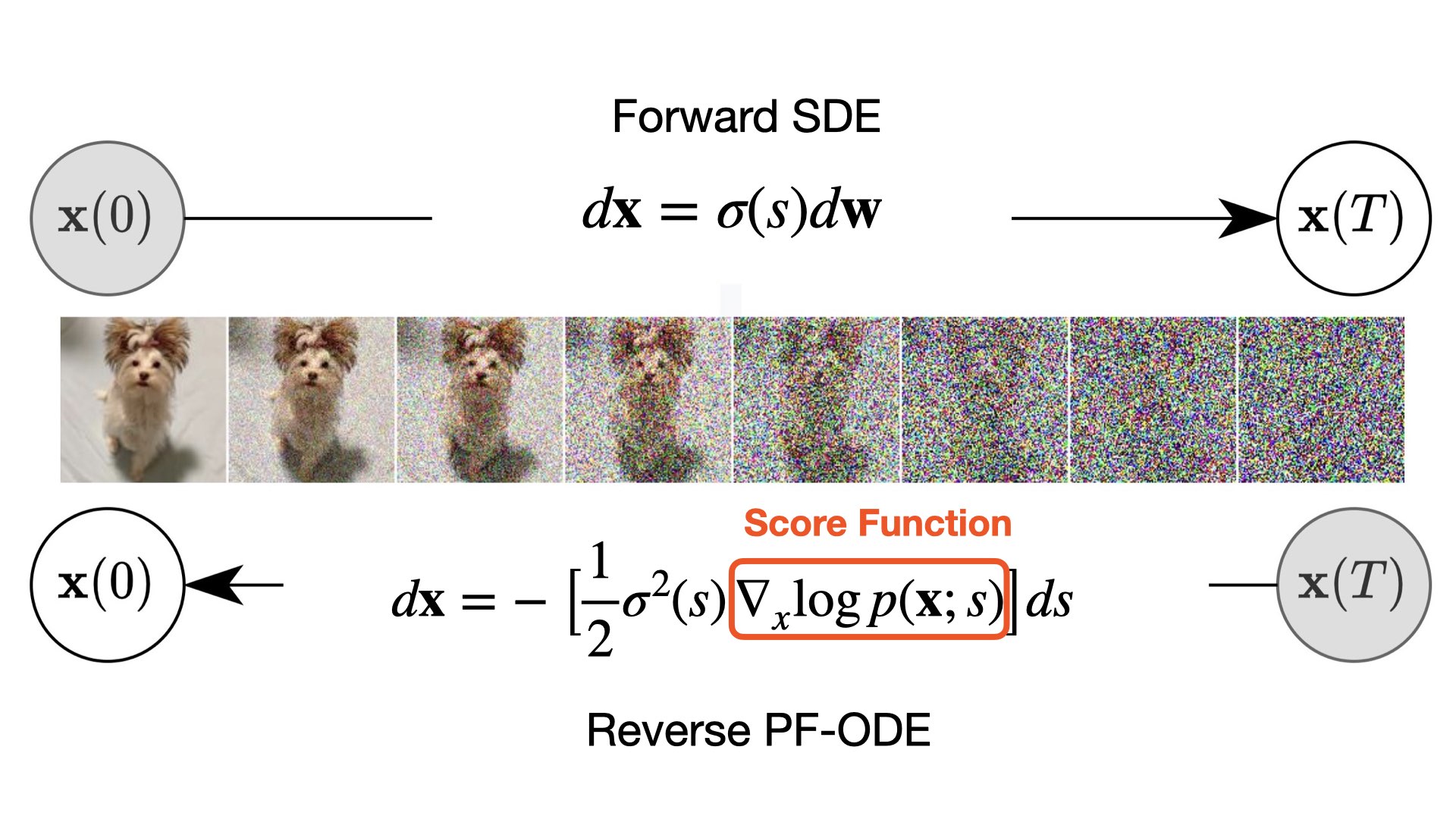
- Formalizing diffusion models as continuous-time ODEs to expose their equivalence to gradient descent on a Lyapunov energy function.
- Mapping the reverse denoising process of diffusion models to the memory retrieval dynamics of associative memories, which converge to local minima of the energy landscape.
- Using the energy function derived from the score-based model to define a Lyapunov function, ensuring stability and convergence in the reverse process.
- Applying established optimization techniques from deep learning—such as ADAM and L-BFGS—to the sampling process of diffusion models by treating it as gradient descent on energy.
- Extending the analogy to Transformers by showing that attention mechanisms resemble single-step updates of dense associative memories, leading to the proposal of an 'Energy Transformer' block.
- Analyzing memory capacity and scaling laws in terms of the number of stored fixed points in the energy landscape, linking model size and performance to associative memory capacity.
Experimental results
Research questions
- RQ1How do the reverse denoising dynamics of diffusion models relate to the memory retrieval dynamics of associative memories?
- RQ2What theoretical guarantees (e.g., convergence) are inherent in associative memories but missing in standard diffusion models?
- RQ3Can the sampling process of diffusion models be reinterpreted as gradient descent on an energy function, and what optimization benefits follow?
- RQ4To what extent do modern architectures like Transformers resemble associative memories in their computational dynamics?
- RQ5How can memory capacity and scaling laws in large models be theoretically understood through the lens of associative memory theory?
Key findings
- The reverse denoising process in diffusion models is mathematically equivalent to gradient descent on a Lyapunov energy function, just like in associative memories.
- Unlike diffusion models, associative memories guarantee convergence to fixed points (local minima), providing a theoretical stability advantage.
- The energy function in associative memories can be directly computed and optimized, enabling new analysis and training techniques not available in standard diffusion models.
- Diffusion models can be reinterpreted as continuous-time dynamical systems that converge to attractors, allowing for theoretical characterization of memory capacity and stability.
- The sampling process of diffusion models can be accelerated using advanced optimization methods like ADAM and L-BFGS by framing it as energy gradient descent.
- Transformers' attention mechanism closely resembles a single-step update of a dense associative memory, suggesting a deeper theoretical link between attention and memory retrieval.
Read this paper
Open the full text in the Nubint reader and ask about any passage as you read.
Read this paper on NubintThis review was generated by AI from the original paper. Please check the paper before citing it.