
[Paper Review] MetaFed: Federated Learning among Federations with Cyclic Knowledge Distillation for Personalized Healthcare
MetaFed proposes a serverless federated learning framework for cross-federation collaboration in healthcare using cyclic knowledge distillation to enable personalized models without a central server. It achieves state-of-the-art performance with up to 16.11% higher accuracy than FedAvg and FedProx on real-world Parkinson’s disease tremor detection, while reducing communication costs and handling data heterogeneity effectively.
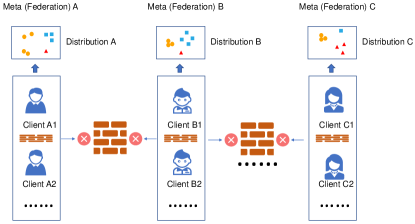
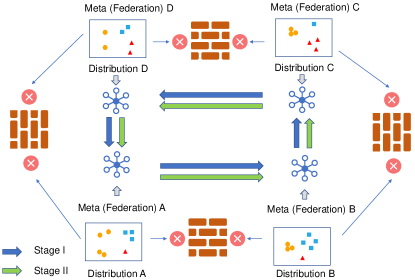
Federated learning has attracted increasing attention to building models without accessing the raw user data, especially in healthcare. In real applications, different federations can seldom work together due to possible reasons such as data heterogeneity and distrust/inexistence of the central server. In this paper, we propose a novel framework called MetaFed to facilitate trustworthy FL between different federations. MetaFed obtains a personalized model for each federation without a central server via the proposed Cyclic Knowledge Distillation. Specifically, MetaFed treats each federation as a meta distribution and aggregates knowledge of each federation in a cyclic manner. The training is split into two parts: common knowledge accumulation and personalization. Comprehensive experiments on three benchmarks demonstrate that MetaFed without a server achieves better accuracy compared to state-of-the-art methods (e.g., 10%+ accuracy improvement compared to the baseline for PAMAP2) with fewer communication costs.
Motivation & Objective
- To address the challenge of federated learning across independent medical institutions (federations) without a central server or trust in higher-level coordination.
- To overcome data heterogeneity—especially feature and label shifts—across federations in healthcare applications.
- To develop a personalized federated learning framework that preserves data privacy while enabling knowledge sharing between federations.
- To reduce communication costs and improve model accuracy in real-world healthcare scenarios, such as Parkinson’s disease monitoring.
- To provide a scalable, extensible framework applicable to diverse healthcare applications beyond the evaluated benchmarks.
Proposed method
- MetaFed treats each federation as a meta distribution and uses cyclic knowledge distillation to iteratively transfer common knowledge across federations in a serverless manner.
- The framework operates in two stages: common knowledge accumulation using fixed hyperparameters, followed by personalization with adapted hyperparameters.
- Knowledge distillation is applied between federations in a cyclic order, where each federation's model acts as a teacher for the next, preserving privacy by sharing only distilled knowledge.
- The method leverages model distillation to align representations and mitigate feature and label shifts across heterogeneous data distributions.
- The framework is extensible and can integrate with existing FL methods like FedAvg or FedProx for intra-federation training.
- A CNN-based model with two convolutional layers, batch normalization, and fully connected layers is used for time-series classification in real healthcare applications.
Experimental results
Research questions
- RQ1Can federated learning be effectively extended across independent federations without a central server or trust in a governing authority?
- RQ2How can common knowledge be accumulated and personalized models be learned across federations with high data heterogeneity?
- RQ3Can cyclic knowledge distillation outperform existing FL methods in terms of accuracy and communication efficiency in real healthcare applications?
- RQ4How does MetaFed perform under feature shifts (e.g., sensor differences) and label shifts (e.g., data distribution changes) in medical time-series data?
- RQ5Can MetaFed be practically deployed in real-world healthcare systems like mobile PD assessment tools?
Key findings
- MetaFed achieved an average accuracy of 87.42% on Parkinson’s disease tremor detection, outperforming FedAvg (71.31%), FedProx (71.32%), and FedBN (80.94%) on the same benchmark.
- On the PAMAP2 dataset, MetaFed improved accuracy by over 10% compared to the baseline, demonstrating strong performance on human activity recognition.
- In the PD tremor application, MetaFed achieved a 16.11% accuracy gain over FedAvg and a 6.48% gain over FedBN, especially excelling under feature shifts.
- MetaFed reduced the number of communication rounds compared to state-of-the-art methods, leading to lower communication costs.
- The method showed robustness under label shifts (e.g., disease prevalence changes), where FedBN underperformed, while MetaFed maintained high accuracy.
- MetaFed was successfully applied to a real mobile-based Parkinson’s assessment tool (PDAssist), demonstrating practical viability in clinical settings.
Read this paper
Open the full text in the Nubint reader and ask about any passage as you read.
Read this paper on NubintThis review was generated by AI from the original paper. Please check the paper before citing it.